

Service · Sharpening · Cutting assemblies · HACCP
Sharpening in a professional kitchen: what to sharpen, what to adjust and what to replace — from chef's knife to mincer, slicer and bowl cutter
A dull blade rarely “breaks” in one day. It quietly steals time, ruins the cut, warms the mince, loads the motor and raises the risk of injury. And every machine has a different cutting part: one is sharpened, another only adjusted, a third can only be replaced. This guide sorts it all by equipment type — with angles, intervals, warning signs, mistakes and specific spare parts from horecagear.com.
- Short answer: sharpen, adjust or replace
- How sharpness forms and why it disappears
- Equipment by type: mincer, slicer, cutter, veg cutter, saw, bread slicer
- Kitchen knives: chef's, butcher's, bread and Japanese
- HACCP and workplace safety
- Restaurant, takeaway, canteen, production
- DIY, service or new? Criteria and a calculation
- A sharpening station in the kitchen
- Workflow and the most common mistakes
- Service, spare parts and maintenance schedule
- Sharpening tools and parts at horecagear.com
- Frequently asked questions
01 Short answer: sharpen, adjust or replace
A kitchen has three kinds of cutting parts. Sharpenable — knives, the mincer's cross knife and plate, the slicer disc, smooth-edged cutter blades. Adjustable — the slicer's blade guard ring and sharpener stones, the mincer ring tension, the slice thickness on a veg cutter. Replaceable — bone saw bands, grating and dicing discs, serrated bread slicer blades, the abrasive coating of a potato peeler. The manufacturer's manual always comes first: if it says “replace”, sharpening usually just prolongs the agony.
Daily — knives on the sharpening steel; weekly — slicer sharpening and a mincer check; every 1–3 months — knives on a stone or by a service.
The biggest risk is veg cutter discs and the slicer running all day. A spare disc set on the shelf is cheaper than a stopped line.
The mincer, cutter and veg cutter are production machines — they need a schedule, a responsible person and a log, not “whenever someone notices”.
Saw bands, mincer knives and plates, boning knives — these are consumables with their own usage rate. Plan them like purchasing.
02 How sharpness forms and why it disappears
Sharpness is the meeting point of two planes, so thin that it cuts a fibre instead of crushing it. In use, this edge does not wear down evenly — it rolls, rounds off and chips into microscopic nicks. That is why professionals separate two jobs:
| Operation | What it does and how often |
|---|---|
| Honing (steel, ceramic rod) | Pushes the rolled edge back into line and removes almost no metal. Before or after every shift. |
| Sharpening (stone, belt, disc) | Removes metal and creates a new edge. For knives — every 1–3 months depending on load, or when honing no longer helps. |
| Deburring / polishing | Removes the thin metal “flag” (burr) left after sharpening. Without it, the edge disappears in the first minutes. |
| Re-profiling | For a worn or broken blade or an uneven plate — coarse stone or a machine. Usually done by a service. |
The angle is a compromise between sharpness and durability. A narrower angle cuts more easily but chips sooner; a wider angle survives bones and frozen product but needs more force. The knife sharpener category on our site recommends 15–20° per side for European kitchen knives and 10–15° on one side only for single-bevel Japanese knives.
A dull edge reflects light. Hold the knife edge-up under a lamp: if you see shiny dots or a line along the edge, that is where it has rounded off. A sharp edge reflects almost no light from the front.
03 Equipment by type: where the cutting part is and what to do with it
First the overview. Below, for each machine — signs, method and the most common mistake.
Meat mincer: knife and plate are one tool
In a mincer it is not the knife alone that cuts but the contact plane of knife and plate — like scissors. Both surfaces must be perfectly flat and sit tightly against each other. Our spare parts page stresses it: a worn knife tears meat fibres instead of cutting them, spoils the texture and raises the temperature of the mince. Knife and plate wear together, so they are sharpened and replaced together; parts sharpened separately damage each other. Meat mincers.
- Signs: the mince looks “torn” rather than evenly granular; sinew wraps around the knife; the meat comes out warmer; the motor works harder; fat smears through the plate holes.
- Method: flat lapping — the plate and the knife wings against a flat abrasive surface in circles or figure-eights, with even pressure. Remove only enough from the plate to make the wear ring disappear.
- Unger system (pre-cutter plate, knife, middle plate, knife, end plate) — each pair is treated as a set and reassembled in exactly the order it worked in.
- Interval: in a restaurant grinding its own meat, knives are replaced every 2–4 months; check and clean after every session.
When the mince starts to smear, the cook tightens the ring harder. It helps for a moment, but then knife and plate rub even harder, heat up and wear unevenly. Tighten the ring by hand only, and never run a mincer empty: without product, metal rubs on metal.
Slicer: the built-in sharpener only works on a clean blade
Most slicers have a built-in sharpener with two stones: the coarse one sharpens, the fine one removes the burr. The Berkel instructions are simple: unplug, close the gauge plate, wipe the blade from the centre outwards, fit the sharpener, switch on and sharpen for 5–10 seconds, then deburr for 2–3 seconds, unplug again and clean the whole slicer before slicing. The manufacturer names a minimum of at least 1–2 times a year; at a deli counter where the slicer runs all day it is done far more often — as soon as the cut starts tearing the product. Slicers.
- Stones wear and soak up fat. A worn stone no longer sharpens the blade. Our slicer spare parts include a coarse stone 48×15×8 and a fine stone 50×8×8 (for Berkel, Fama, Braher-type sharpeners).
- The blade gets smaller over time. When the gap between blade and guard ring gets too wide, product catches and the cut tears — then the blade is replaced. The minimum diameter is set by the manufacturer.
- Non-stick (Teflon) coated blades (e.g. our slicers with Teflon blades, 220 and 250 mm) are sharpened only at the edge; the coating must not be scratched.
Sharpening a dirty, greasy blade. Fat fills the pores of the stone, it starts to “polish” instead of sharpen, and the cook concludes the blade is finished. Clean first, then sharpen.
Bowl cutter and food processor: balance matters more than sharpness
Cutter blades spin at thousands of revolutions per minute. Our cutter page calls the blades the main wear part, which must be sharpened or replaced regularly, and recommends original blades, as each model has its own fitting. When sharpening a smooth blade, the same amount of metal must be removed from both wings; an asymmetric blade causes vibration that damages bearings and the shaft seal. Serrated blades are usually not sharpened in the kitchen — they are replaced.
Sharpening only the one wing that “looks dullest”. Afterwards the cutter roars, the bowl vibrates and the emulsion fails. Both wings equal — and check the balance after sharpening.
Vegetable cutter: discs are consumables
A vegetable cutter has three kinds of discs. Slicing discs often have a replaceable or sharpenable blade. Grating discs and dicing grids are made in a way that makes sharpening practically impossible — they are replaced. Our spare parts page stresses that worn discs reduce cutting quality and increase motor load, and parts are only changed with the power disconnected. Vegetable cutters.
- Signs: tomatoes are squashed rather than cut; a “beard” on the slices; cucumber slices of uneven thickness; carrot sticks break.
- Storage: discs in a rack, not piled in a drawer — the blades nick each other.
- Washing: alkaline dishwasher detergent and high temperatures affect the blade over time; the manual says whether a disc is dishwasher-safe.
Bone saw, bread slicer, potato peeler: replace, don't sharpen
A bone saw band cannot be sharpened in kitchen conditions. Replace it when it starts to drift sideways, binds in the cut, the cut gets rough or cracks and heat discolouration appear on the teeth. A band that binds even once must be replaced as a priority — it is a safety issue, not a quality one. Check the tension and the scrapers every time you change the band. Bone saws.
Bread slicer frame blades are serrated and work as a set; replace them together so all slices are equal. The abrasive coating of a potato peeler wears out — it shows as a longer cycle and peel left in the eyes. It is replaced, not “restored”. Bread slicers · potato peelers.
04 Kitchen knives: chef's, butcher's, bread and Japanese
With knives it is the opposite: they can be sharpened many times if you keep the angle and don't overheat the steel. Professional sharpeners repeat one idea: a good knife is not the one that is sharp out of the box, but the one you can bring back to sharpness quickly.
- Chef's knife 20–25 cm — Use: ~80% of kitchen work; Sharpening: 15–20°, stone 1000 → 3000; Most common problem: used as a scraper on the board — the edge rolls
- Santoku, gyuto — Use: precise veg and fish cutting; Sharpening: 10–15°, fine stone; Most common problem: chips on bones and frozen product
- Boning, fillet — Use: meat, fish, poultry; Sharpening: 18–22°, steel more often; Most common problem: tip snaps from “breaking” joints with it
- Cleaver — Use: bones, vertebrae; Sharpening: 25°+, coarse stone; Most common problem: sharpened too fine — the edge folds
- Bread knife (serrated) — Use: bread, sponge, tomatoes; Sharpening: each tooth with a tapered rod, or a service; Most common problem: put on a flat stone — the teeth vanish
Sharpening on a water stone: seven steps
- Soak the stone (unless it is splash-and-go) until bubbles stop rising, and place it on a non-slip base.
- Find the angle: 15–20° for a European knife — roughly two coins' thickness under the spine of a 5 cm wide blade.
- Coarse stone (400–1000) if the edge is damaged; medium (1000) if it is only dull. Draw from heel to tip.
- Sharpen one side until you can feel a burr along the whole length on the other side. Then the other side for as long.
- Fine stone (3000–6000): less pressure, alternating sides more and more often.
- Remove the burr: a few light strokes on a leather strop, felt or the edge of a wooden board.
- Test — a sheet of paper should slice quietly and without catching. Wash the knife: abrasive dust must not end up in food.
If no burr forms, you have not reached the edge yet — don't move to a finer stone. A fine stone never fixes what the coarse one did not finish.
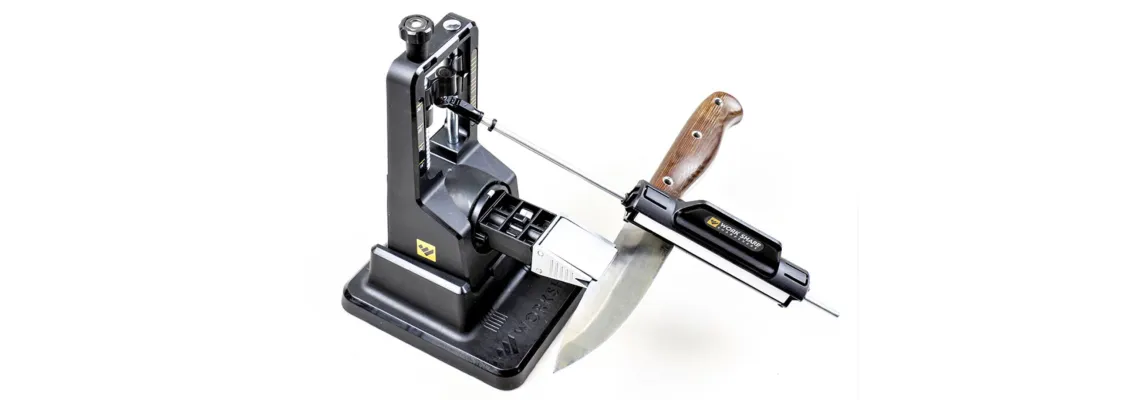
Electric sharpeners. Our range has manual sharpeners with diamond and ceramic elements, the electric KS sharpener with a diamond stone (max. angle 28°, dry operation, also suitable for ceramic knives) and the Savioli AFN — a workshop machine with a 1150×100 mm abrasive belt in a water bath with 3% emulsion, a felt disc for deburring and holders for a mincer knife and plate. The water bath matters: a dry, fast wheel easily overheats the edge, and blue or straw colour on the blade means the steel has lost its temper and will no longer hold an edge.
Knives in the dishwasher. Heat, chemicals and knocks against the basket damage both the edge and the handle. Our knife category advises washing by hand and drying immediately, storing on a magnetic strip or in a knife case.
Workshop wisdom professional sharpeners keep repeating
- “A sharp knife is a safe knife.” A dull blade needs more force, slips off a tomato skin or onion and hits a finger.
- “A steel doesn't sharpen — it straightens.” If nothing changes after five strokes per side, you need a stone.
- “Sharpen often and little, not rarely and a lot.” Small regular sharpening keeps a blade's profile for ten years.
- “The angle matters more than the grit.” An unsteady angle rounds the edge on any stone.
- “The board is part of the knife.” Glass, granite and ceramic round the edge in a few cuts; wood and food-grade plastic don't.
- “Heat is the enemy of sharpness.” If you can't hold the blade in your fingers, it is already overheated.
05 HACCP and workplace safety
Sharpness is also a food safety issue. Torn product with a larger surface and warmed mince are worse than a clean cut with a cold mass. Sharpening creates metal and abrasive dust, so a part is always washed and sanitised after sharpening before it touches food. Figures here are guidelines; write the actual intervals and checks into your HACCP plan, which the food safety authority (in Ireland, the FSAI and environmental health officers) will inspect.
- Checking and cleaning cutting parts — in the preventive maintenance part of the HACCP plan, with a responsible person.
- Colour-coded knives and boards (HACCP kitchen knives) — so nobody mixes up the green veg knife with the red meat knife while sharpening.
- Knife storage — a magnetic strip or a UV knife steriliser, not a drawer.
- Machine parts are changed and sharpened only with the power cable unplugged, not just the switch off.
- Cutter blades, the slicer disc and veg cutter blades are cleaned wearing cut-resistant gloves.
- A damaged part (crack, broken tooth, binding band) is taken out of use immediately — a safety matter, not a budget one.
06 Restaurant, takeaway, canteen, production: where the risk hides
| Segment | Sharpening rhythm and key machine |
|---|---|
| Restaurant | Knives on the steel every shift, stone every 1–2 months; slicer and mincer after use. |
| Takeaway / fast food | Veg cutter discs and slicer — a spare disc set in stock; weekly check. |
| Canteen / central kitchen | Mincer, cutter and veg cutter on a schedule; a log and one responsible person. |
| Production / catering / butcher | Saw bands, mincer pairs and boning knives as consumables; own sharpening equipment or a standing service contract. |
Every cook has their own knife but there is no shared sharpening standard. Result: five different angles and not one truly sharp knife.
Discs are washed and stored together in a box; the blades nick each other.
The mincer knife is replaced but the old plate is kept. A new knife on a worn plate becomes just as dull within days.
The saw band is changed “when it breaks”. A broken band is an injury risk and downtime mid-shift.
07 DIY, service or new? Criteria and a simple calculation
A simple calculation: what a dull knife costs
Assumptions (Ireland): average hourly earnings in accommodation and food services €18.08 (CSO, Q2 2026, provisional), employer PRSI 11.40%, a 39-hour week (169 hours a month). Employer cost — €20.14 per hour or €3,403.85 per month. A cook spends 2 hours a day purely cutting, 22 days a month. Assume that with a dull knife they work 10% slower.
Time lost: 4.4 h a month per cook = €88.62 a month. A professional knife sharpener (Sanelli 30 cm, €47.63 excl. VAT) pays for itself within the first month. Over five years, dullness would cost around €5,317 per cook. Calculate with your own wages and cutting time — 10% is a cautious assumption, not a measurement.
08 A sharpening station in the kitchen
- Location: a sturdy table away from the finished-food area, so abrasive dust and water with metal particles don't reach products.
- Water and drainage: for water stones and belt sharpeners — a sink nearby; don't pour large amounts of stone slurry into the grease trap.
- Power: the AFN workshop belt sharpener needs a 400 V three-phase supply; the KS runs on 230 V.
- Light: good, from above and the side — the light test on the edge is impossible without it.
- First use: flatten a new stone, test a new machine's sharpener on a clean blade before the first shift, and keep the manual by the machine, not in the office.
09 Workflow and the most common mistakes
- Mince smears, heats up — Cause: worn knife and plate or wrong pair; Solution: sharpen as a pair or replace the set
- Slicer tears ham — Cause: greasy or worn stones; Solution: clean, sharpen 5–10 s, deburr; replace stones
- Cutter vibrates — Cause: wings sharpened unevenly; Solution: even sharpening, balance check, original blades
- Tomato squashes in the cutter — Cause: dull slicing disc; Solution: sharpen or replace the blade; disc rack
- Saw drifts sideways — Cause: worn band, low tension; Solution: replace band, check tension and guides
- Knife goes dull quickly after sharpening — Cause: burr not removed or overheated; Solution: deburr; sharpen with water, no pressure
- Blade blue at the edge — Cause: dry, fast wheel; Solution: grind off the overheated part at a service
- Bread knife no longer cuts — Cause: sharpened on a flat stone; Solution: tapered rod along the teeth or a new knife
A typical situation in a canteen: mince for burgers starts coming out greyish and “smeary”, the cooks tighten the ring harder, the mincer starts to heat up. At the service it turns out the knife had been replaced earlier but the old plate with a wear ring was kept. Once knife and plate are sorted out as a pair and the ring is tightened by hand, the mass is granular and cool again. The job took less time than one shift of poor mince.
10 Service, spare parts and maintenance schedule
BHS service — cutting assemblies and more
Meat mincers, slicers, cutters, veg cutters and other food preparation equipment: diagnostics, checking of cutting assemblies, adjustment, part replacement and scheduled maintenance. Ask our service about sharpening options and lead times for a specific part — we will tell you whether it pays to sharpen or replace it.
+371 25 522 233
field service across Latvia; delivery across the Baltics and Europe
spare parts in Riga, Vagonu iela 23
experience with HoReCa equipment
Knives No. 12 and 22, plates 3–8 mm, Unger plates. Meat mincer spare parts
Coarse 48×15×8 and fine 50×8×8. Slicer spare parts
Original blades by model — ask our service. Cutters
Manual, electric and workshop sharpeners. Knife sharpeners
Motors, switches, seals etc. Spare parts for kitchen equipment
11 Sharpening tools and cutting parts at horecagear.com
€134.33 excl. VAT
Diamond stone, up to 28°, dry operation, also for ceramic knives.
€1,579.00 excl. VAT
Belt in a water bath, felt for the burr, holders for mincer knife and plate. 400 V.
€424.58 excl. VAT
Anodised aluminium body, removable carriage for cleaning.
Prices excl. VAT, October 2026; check the current price and availability on the product page. Confirm compatibility with your machine model before ordering.
[INSERT A REAL CUSTOMER REVIEW]
[Name, position], [restaurant]
Related articles: How to choose a professional meat grinder · Meat and fish display cases · Reducing labour costs with equipment
12 Frequently asked questions
How often should professional kitchen knives be sharpened?
Honing steel — before or after every shift. Sharpening on a stone — every 1–3 months depending on load, or when honing no longer restores the edge. If the knife slides on a tomato skin or squashes the product, sharpen it straight away.
Can a mincer knife be sharpened without the plate?
It shouldn't be. Knife and plate work as a pair and wear together; they are lapped flat at the same time or replaced together. A new knife on a worn plate quickly goes dull.
Why does the slicer still tear after sharpening?
The most common reasons: the blade wasn't cleaned, the stones are greasy or worn, deburring was skipped, or the blade is already too small relative to the guard ring. Check in that order.
Can a serrated bread knife be sharpened?
Yes, but not on a flat stone. Each scallop is sharpened with a tapered rod from the bevelled side, the other side is only deburred. For cheaper knives replacing is often better value.
What to do with veg cutter grating discs?
Grating discs and dicing grids are practically never sharpened — they are replaced. Slicing discs often allow the blade to be sharpened or replaced separately; see the manual.
Doesn't an electric sharpener ruin knives?
It does if it overheats the edge or removes too much metal. Choose a low-speed or water-cooled model and don't press. Blue colour on the blade means overheated steel.
Does BHS service help with cutting assemblies?
Yes. Our service handles meat mincers and other food preparation equipment — checks, adjusts and replaces cutting parts, and spare parts are stocked in Riga. Call +371 25 522 233 or request service.
Dull blade, but not sure whether to sharpen or replace?
Tell us the machine model and the symptoms — we will help you find the right part or send a technician.
Disclaimer: this article is for information only and does not replace the manufacturer's operating and maintenance instructions. Sharpening angles, intervals and wear signs are general guidelines; specific values are set by the manufacturer and your HACCP plan. Calculation assumptions are illustrative — calculate with your own data. Wage data: CSO, Q2 2026 (provisional). Slicer sharpening times: Berkel sharpening instructions. “What it looks like in practice” describes a typical situation, not a specific customer case. Prices excl. VAT, October 2026.