

Kitchen equipment · Electromechanical equipment
How to choose a professional meat grinder for a HoReCa kitchen
From a small café to a meat production line — machine size, power, plates and blades, refrigerated models, HACCP, maintenance, plus service and spare parts that keep the machine running for years without downtime.
A meat grinder is one of those machines where the wrong choice costs you every day. Too small — and the motor overheats during peak hours; too big — and you overpay for power you'll never use. The right meat grinder gives you consistent grind texture, saves time and lets you control meat quality from raw product to finished dish. In this guide we cover how to choose a grinder by volume, size and use case, how to care for it safely, and why service and spare parts matter just as much as the machine itself.
Why professional, not a home grinder
A home meat grinder is built for short, occasional use. In a HoReCa kitchen it overheats quickly, loses power and breaks down — and the repair costs more than the purchase saving. A professional meat grinder stands apart with a more powerful motor, durable construction and the ability to run continuously in large volumes.
The benefits are tangible: consistent grind texture in every batch, speed at peak times, control over meat quality and cost (you grind only what's needed, from a chosen product) and the hygiene that comes from stainless steel contact surfaces and a fully removable grinding unit.
How a meat grinder works
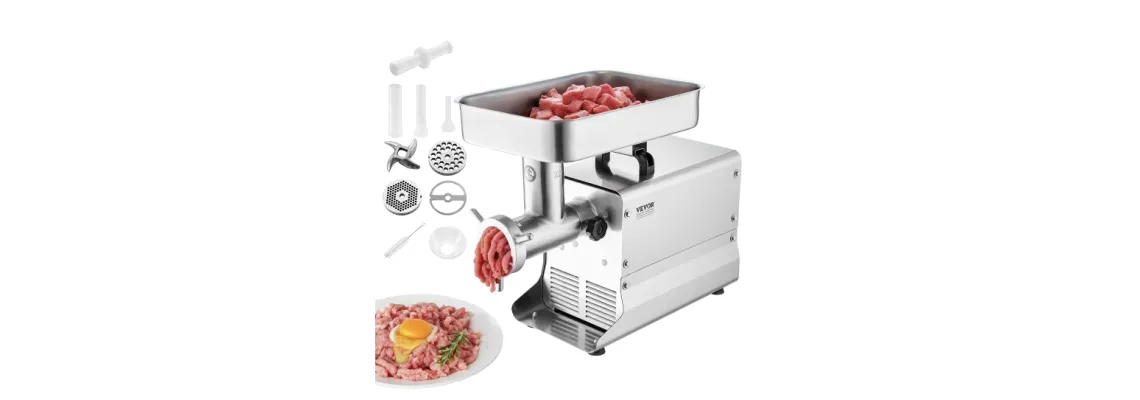
A grinder minces using a rotating worm screw (auger): the meat is pushed forward through the cutting group of a blade and a plate. The plate hole size sets the grind coarseness — from a coarse grind for large burgers to a fine grind for terrines and sausages.
Professional models have powerful electric motors that run for long periods without overheating. Many have a reverse function that clears sinews and jammed product without stopping the work. The grinding group can use a standard or a UNGER (self-sharpening) system, which keeps the blade and plate sharp for longer.
Machine size and throughput — how to choose
The grinder "size" (8, 12, 22, 32) refers to the cutting group and plate standard — the higher the number, the greater the throughput and the more powerful the machine. Choose by daily volume and intensity, not automatically "with headroom."
| Size | Approx. throughput | Typical setting |
|---|---|---|
| No. 8 / compact | up to ~80 kg/h | Small café, bistro, occasional grinding |
| No. 12 | ~150 kg/h | Restaurant, hotel kitchen, daily use |
| No. 22 | ~250–300 kg/h | Busy restaurant, deli shop, canteen |
| No. 32 | ~450 kg/h | Production, butcher shop, intensive load |
BHS recommendation
Choose throughput by your real peak volume, not the average. If your biggest day needs 60 kg ground, take a No. 22 rather than a No. 12 — the machine will run with headroom, heat up less and last longer. Our specialists help you calculate the right size for free.
Types of meat grinders
The BHS range offers several construction and equipment options. The choice depends on the product, hygiene requirements and whether the grinder also needs to perform extra functions.
Classic grinder
Anodized aluminium or stainless steel body with a removable head. A reliable workhorse for everyday minced meat, burgers and steaks.
With UNGER self-sharpening system
An AISI 304 stainless steel cutting group that keeps the blade and plate sharp on its own. Less load on the motor, stable grind quality and less frequent replacement.
Refrigerated (+4 °C)
Models with a refrigerated grinding group (e.g. T22, T32) keep the meat at a safe temperature throughout processing — ideal for intensive production and HACCP requirements.
With cheese grater (combined)
A grinder with an added cheese-grating group in one body — saves space and budget in kitchens that need both grinding and grating.
Beyond grinders, a meat tenderizer (manual or hydraulic) can be useful for preparing steaks and schnitzels — it's also available in the BHS range.
Construction and materials
A grinder's quality and hygiene are defined by the body material and the finish of the grinding group. The key things to look at:
Body
Anodized or polished aluminium (light, durable) or stainless steel (highest hygiene and longevity). Hopper and feeder are usually stainless steel.
Removable head
A fully dismountable grinding group without tools makes cleaning and HACCP procedures after each shift much easier.
Reverse function
Reverse clears sinews and jammed product without stopping grinding — fewer stops and a cleaner result.
Safety features
A protective guard above the feed opening, a pusher and motor overload protection for safe daily operation.
Plates and blades — grind coarseness
Grind coarseness is set by the plate hole diameter. One machine takes several plates, so by changing the plate you get different products from a single grinder.
| Plate hole | Grind type | Best for |
|---|---|---|
| 8–10 mm | Coarse grind | Goulash, sauces, coarse patties, first pass |
| 4.5–6 mm | Medium grind | Patties, meatballs, burgers, filling |
| 3–4 mm | Fine grind | Sausages, pâtés, minced-meat dishes |
| 2 mm and finer | Very fine | Terrines, mousses, fine meat preparations |
BHS recommendation
The blade and plate are a set — they wear together and should be replaced together. A dull blade and worn plate "smear" the meat instead of cutting it, warm the product and increase motor load. Keep at least one spare plate and blade for your most-used size in stock.
Safety and HACCP
Meat handling is a high-risk HACCP zone — temperature control and prevention of cross-contamination are mandatory.
Mandatory requirements
Push product toward the auger only with the pusher, never with hands or objects. After each shift, dismantle, wash in hot water and disinfect the grinding group. Work with chilled meat (target temperature below +4 °C) and never use one machine for raw and cooked product without a full clean in between.
The equipment offered by BHS complies with EU food safety standards and HACCP requirements. Contact surfaces — auger, blades, plate and hopper — are made of stainless steel that is easy to wash and disinfect.
Brands in the BHS range
BHS offers meat grinders from recognised European manufacturers known for durability and quality grinding:
FIMAR
The Italian maker with the widest range in the BHS catalogue — from compact to powerful and refrigerated machines for everyday HoReCa load.
SAVIOLI
Professional meat grinders focused on durability and steady operation in intensive production.
Stalgast
Economically robust models with a good price-to-quality ratio — suited to kitchens where a favourable initial investment matters.
UNGER system
Available on many models as a self-sharpening cutting group — for a longer blade and plate life and more stable grind quality.
Price guidance
Price depends on size, body material, throughput and equipment (UNGER, refrigeration, cheese grater). Approximate ranges below for orientation; see the category for exact prices.
| Segment | Approx. price | Intended for |
|---|---|---|
| Entry level | from ~€280 | Compact No. 8 machines, light load |
| Mid range | ~€500–900 | No. 12 / No. 22, daily restaurant work |
| High end | ~€1,000–1,900 | No. 22 / No. 32, UNGER, intensive load |
| Refrigerated / special | ~€2,700 and up | Refrigerated machines (+4 °C), meat tenderizers |
BHS recommendation
The cheapest model is rarely the best value if the machine runs every day. A stainless steel body, the UNGER system and correctly sized power reduce repair frequency and grinding losses — the investment pays off over time. For occasional use, an entry-level model is enough.
Maintenance and cleaning
Regular maintenance is what separates a grinder that lasts for years from one that breaks down fast. Follow a simple schedule:
| Frequency | What to do |
|---|---|
| After each shift | Dismantle the grinding group, wash in hot water, disinfect and dry the auger, plate, blade and hopper |
| Daily | Check blade and plate sharpness; wipe down the body; make sure the safety features work |
| Weekly | Check reverse and motor operation; lubricate parts if specified by the manufacturer |
| Monthly | Assess blade/plate wear; check bearings and drive belt; plan replacement if needed |
BHS recommendation
Never wash the motor block with a water jet and don't put electrical parts in a dishwasher. Clean stainless steel parts with professional chemicals and a soft brush; dry the blade and plate immediately after washing to prevent rust.
Service and technical maintenance
A meat grinder is a long-term investment, and keeping it running is just as important as the initial choice. BHS provides professional service and technical maintenance with over 25 years of experience in the HoReCa and B2B sector — fast response, quality repairs and long-term solutions.
What BHS service covers
Diagnostics, repair and preventive maintenance right at your site, plus scheduled maintenance contracts that make costs predictable and prevent unplanned downtime.
- On-site service at the customer
- Replacement of faulty parts on the spot
- Certified, experienced technicians
- Scheduled technical maintenance
- Blade and plate replacement/sharpening
- Long-term maintenance contracts
BHS recommendation
Regular prevention is cheaper than an emergency repair at peak time. A maintenance contract ensures the machine is checked and adjusted before a problem arises. Learn more in the Service section.
Spare parts — fast and on hand
To keep a grinder running without interruption, timely availability of spare parts is decisive. BHS keeps a wide spare-parts stock that lets you quickly replace the most frequently worn parts and return the machine to work in minimal time.
Blades and plates
Original and compatible blades and plates for various sizes (8/12/22/32) and grind coarseness levels.
Augers and heads
Feed augers, grinding heads and locking rings to restore the grinding group.
Motors, belts, bearings
Drive assemblies and electrical parts to restore the machine's operation.
Switches and safety parts
Switches, guards and pushers for safe operation.
Delivery across the Baltics and Europe
We work with manufacturers' official warehouses to ensure original parts are available in the shortest possible time.
- Baltics — usually 1–3 business days
- Europe — usually 2–5 business days
- Original and alternative parts
- Advice on the right part
BHS recommendation
Keep a spare blade and plate for your most-used size in stock if the grinder is critical to your work. That way you avoid downtime if a part needs urgent replacement. See the meat grinders category or ask our specialists.
Related equipment for meat processing
A meat grinder is often part of a wider meat-processing set. See all electromechanical equipment — cutters, sausage fillers, meat mixers, slicers and vegetable cutters that work alongside your grinder.
Frequently asked questions
What machine size/power do I need for a restaurant?
A small restaurant with 30–50 servings a day is fine with a No. 8 or No. 12 machine (up to ~150 kg/h). A busy restaurant or deli shop — No. 22 (~250–300 kg/h). A production site or butcher shop — No. 32 (~450 kg/h). Choose by real peak volume, not the average.
What does the UNGER system mean?
It's a self-sharpening cutting group in AISI 304 stainless steel, where the blade and plate keep each other sharp. The result is more stable grind quality, less motor load and less frequent blade and plate replacement.
How often should blades and plates be replaced?
With intensive use, blades and plates should be replaced roughly every 3–6 months. Dull blades and worn plates "smear" the meat, warm the product and increase motor load. The blade and plate are a set and should be replaced together.
Do I need a refrigerated meat grinder?
Refrigerated models (+4 °C) keep the meat at a safe temperature throughout processing — recommended for intensive production, high-volume grinding and strict HACCP requirements. For everyday restaurant work, a standard model working with pre-chilled meat is usually enough.
How do I clean a meat grinder correctly?
After each shift, dismantle the grinding group, wash in hot water, disinfect and dry. Don't wash the motor block with a water jet and don't put electrical parts in a dishwasher. Dry the blade and plate immediately after washing to prevent rust.
Does BHS provide service and spare parts?
Yes. BHS offers on-site service, technical maintenance and maintenance contracts with 25+ years of experience, plus a wide spare-parts stock (blades, plates, augers, motors) with fast delivery across the Baltics (1–3 business days) and Europe (2–5 business days).
We'll help you choose the right meat grinder for your kitchen
BHS offers a wide range of meat grinders from leading manufacturers — with service and fast spare-parts delivery across the Baltics and Europe. Our specialists will help you choose a model to match your volume, meat type and budget.