The mobile catering and street food sector is actively developing — events, markets and pop-up restaurants are becoming increasingly popular in both urban and rural areas. Trailers are a versatile solution for mobile dining in various conditions.
Trailer applications
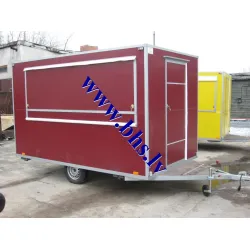
For street food and market points, trailers provide a compact, movable workspace where food can be prepared and served. An equipped trailer can include kitchen equipment, storage space and serving windows — allowing fully autonomous operation even without nearby stationary kitchen infrastructure.
For event catering companies, a mobile trailer enables food service anywhere — at festivals, corporate events and private celebrations — without dependence on stationary kitchen availability. Catering companies often use multiple trailers for different types of events: one for grilled menu preparation, another for beverage service.
This format is particularly suitable for seasonal operations at beaches, ski resorts and summer events.
Equipment and layout
Trailer equipment can include electrical appliances, cooking surfaces, grills, refrigerators, sinks and other kitchen equipment depending on the menu and operational concept. A water supply and drainage system is an essential component of any full-fledged dining trailer — without it, it’s impossible to meet HACCP hygiene requirements.
A serving window or open counter area is the main customer interaction point — its location in the trailer affects workflow and customer queue organisation. Optimal window placement allows serving a larger number of customers quickly, reducing queue wait times.
Electrical and gas supply
Trailers can operate from a mains power connection (230V or 380V three-phase) or from a mobile generator. Some trailers are equipped with gas appliances — this solution is independent of mains power availability and allows operation at event sites without stable electrical infrastructure. Hybrid solutions combine both systems, providing maximum flexibility in various conditions.
Registration and permits
Mobile food trading requires appropriate registration with the Food and Veterinary Service, as well as a municipal permit for the specific trading point or event. Before starting a mobile dining business, it’s advisable to consult with the Food and Veterinary Service and relevant municipal specialists about necessary permits, hygiene requirements and water supply solutions. Each municipality may have different requirements regarding trading location placement in public areas.
Trailer materials and durability
Quality trailers are made with stainless steel or aluminium surfaces that come into contact with food, and a durable metal or composite material frame. Stainless steel work surfaces are mandatory for food preparation areas as they meet sanitary requirements and are easy to disinfect. Trailer insulation and ventilation provide comfortable working conditions for staff even in summer heat.
Mobile dining planning
Before purchasing a trailer, a mobile dining entrepreneur plans the workspace — determining the menu, equipment list, power supply requirements and water system. Trailer selection depends on the expected number of customers per hour, food preparation complexity and event format. Careful planning saves costs and prevents unexpected expenses after trailer purchase.
Storage and infrastructure
A mobile dining trailer must be stored between events in accordance with sanitary requirements — in a closed space protected from weather conditions. Proper temperature storage extends equipment lifespan. Regular trailer cleaning between events is a mandatory HACCP system element.
Staff in a mobile unit
The compact workspace in a mobile trailer requires careful equipment arrangement to ensure staff safety. Hot equipment placement, proper ventilation and ergonomic work planning reduce accident risks. Work safety requirements also apply to mobile dining units.
Product storage in a mobile kitchen
When planning a mobile dining point menu, consider product storage conditions in the trailer — refrigeration capacity and temperature determine which products can be safely stored during events. A simpler menu with fewer product varieties reduces waste and simplifies quality control at each event.
Investment and profitability
A mobile dining trailer is a significant financial investment whose return depends on the number of attended events per season, average check and operating costs. The festival season is most active from May to September — profitability calculations should be made with annual averages, including inactive winter months. Private events and corporate catering increase annual turnover.
Competitiveness and brand building
Mobile dining as a business segment is growing every year — new concepts compete with existing businesses in popular event spaces. A visually appealing trailer with a unique menu and active social media presence are the most important competitive advantages. High-quality trailers with professional design are recognisable from a distance and attract more customers.
Why choose BHS?
BHS – Baltic HoReCa Solutions supplies professional equipment for restaurants, cafés, hotels and canteens: more than 20,000 products from many manufacturers. Our specialists help you choose the right equipment and spare parts for your kitchen or bar.
Delivery
We deliver across the European Union. Delivery time and cost depend on the order volume and destination — contact the BHS team for an exact price and lead time.