More from this brand
Technical data
| Attributes | |
| ARTICLE | 214100 |
| SIZE L/W/H | 100 |
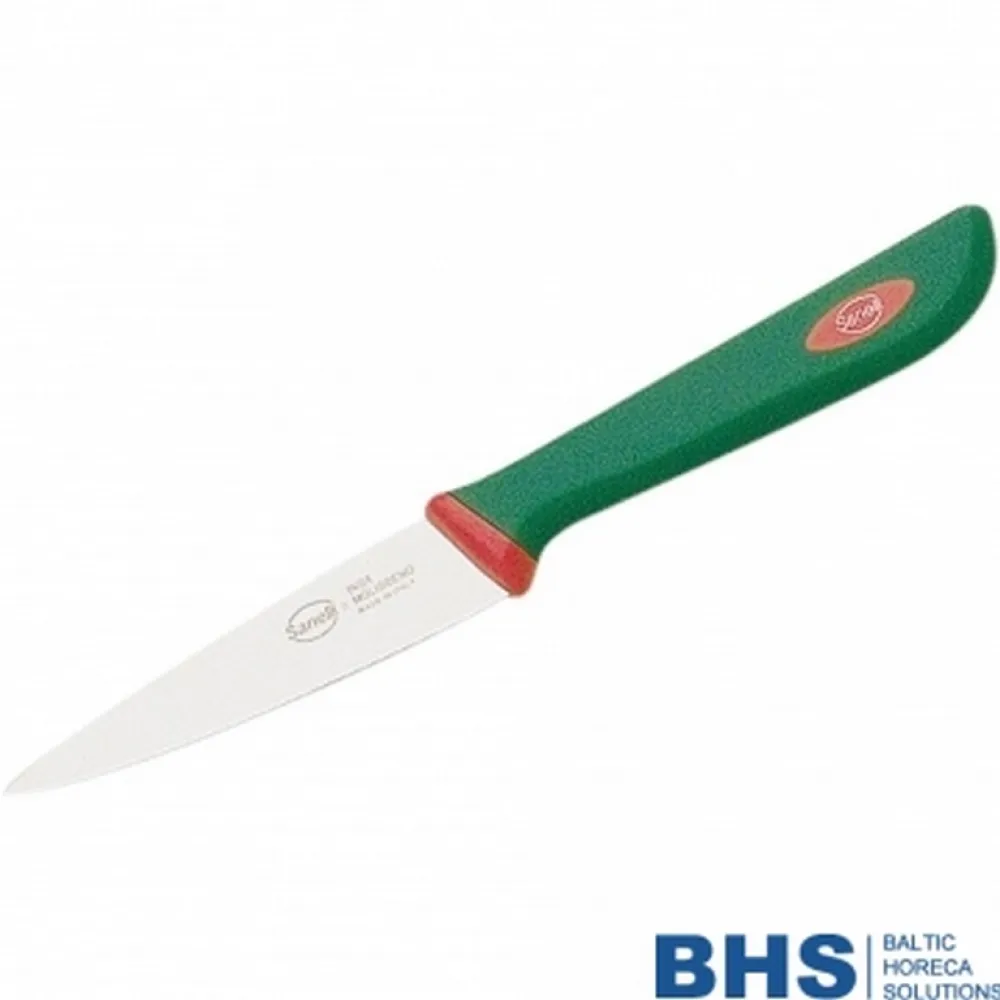
A paring knife cuts where a chef's knife is too large: peeling, trimming and shaping small fruits and vegetables. The blade follows the curve of the food, letting the cook pare skins in a single spiral or carve decorative garnishes without shifting grip. A short blade gives control; the tip reaches into tight spaces such as the core of an apple or the stem end of a tomato. The 10 cm length balances agility with enough steel to keep the edge cool and sharp through a long service.
The operator holds the knife in a pinch grip: thumb and forefinger on the blade just above the handle, the remaining fingers wrapped around the handle for stability. This grip steers the blade precisely along the contour of the food, while the short length prevents the hand from obscuring the cut. The knife is used on a stable worktop or cutting board; the small blade does not need the rocking motion of a larger knife, so the cut is made with a simple up-and-down stroke or a gentle slicing motion when peeling.
The blade is forged from a single piece of high-carbon stainless steel, hardened to 54-56 HRC. This hardness holds an edge through repeated sharpening and resists chipping when the tip is used to lift or pry. The spine is left square for comfort when the thumb is pressed against it for extra control. The handle is moulded from two types of plastic: a softer outer layer for grip and a harder inner core for strength. The shape is symmetrical, fitting either a right- or left-handed grip without adjustment.
The 10 cm blade length is measured from tip to heel; the overall length of the knife is slightly greater once the handle is included. The hardness rating of 54-56 HRC indicates a blade that will keep its edge through daily use but can still be sharpened with standard kitchen steels and stones. The dual-plastic handle provides a secure grip even when wet, reducing the risk of slippage during rapid peeling or trimming.
Cleaning is by hand in warm soapy water; the blade should be dried immediately to prevent corrosion. The handle can be sanitised with standard kitchen disinfectants. The knife is not dishwasher-safe: the heat and detergent can degrade the plastic and dull the edge. Regular honing with a steel maintains the edge between sharpenings.
The knife is supplied as a single article, with no variants or additional components. It is listed in the Stalgast catalogue under hand tools and small equipment for vegetable preparation.