More from this brand
Technical data
| Attributes | |
| ARTICLE | 075240 |
| SIZE | Ø 240 mm; H = 180 mm |

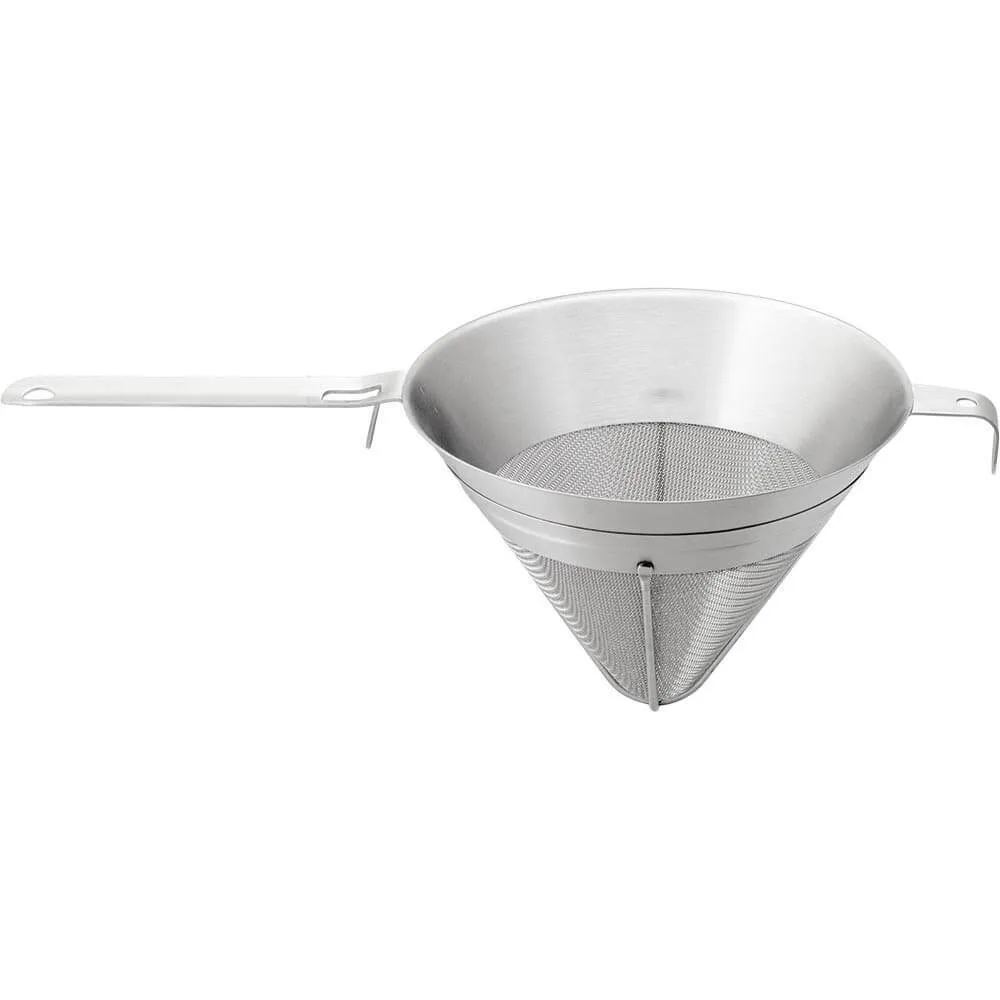
Conical stainless steel chinois strainer with a diameter of 240 mm. Fine mesh with a dense structure for filtering sauces, creams, purées, soups, and cocktails.
A conical strainer forces liquid through a fine mesh by gravity, letting the weight of the product itself push it down the sloping sides. The narrow end concentrates the flow, so the mesh catches every particle without clogging as quickly as a flat sieve would. This shape also lets the operator rest the strainer on the rim of a pot or jug, freeing both hands to press or scrape the contents through the mesh with a ladle or scraper.
To use the strainer, place it over a receiving container so the tip sits clear of the bottom. Pour or ladle the mixture into the wide mouth; the liquid drains through the mesh while solids collect inside. For thicker mixtures, use a spoon or scraper to press the contents against the mesh, speeding up the process. When the flow slows, lift the strainer and tap it gently to dislodge trapped liquid, then scrape the collected solids from the inside.
The body is a single piece of stainless steel, pressed into the conical shape and welded to a rolled rim that keeps its circular form. The mesh is a fine, dense weave of stainless steel wire, spot-welded to the inside of the cone. The size—240 mm across the mouth and 180 mm tall—gives a large surface area for fast draining without taking up excessive worktop space.
A 240 mm diameter fits over most standard stock pots, bain-maries and mixing bowls, while the 180 mm height leaves room for a ladle to reach inside without spilling. The stainless steel construction resists corrosion from acids and alkalis in sauces, fruit purées and cocktail syrups, and withstands the high temperatures of hot liquids straight from the stove.
After use, rinse the strainer under hot water to remove most residue, then scrub the mesh with a soft brush to clear trapped particles. For stubborn deposits, soak the strainer in warm water with a mild detergent, then rinse and dry it upside down to prevent water spots. The welded construction has no crevices where food can lodge, so cleaning stays straightforward.
The strainer is listed in the Stalgast catalogue under kitchen utensils for liquid preparation and filtration.