

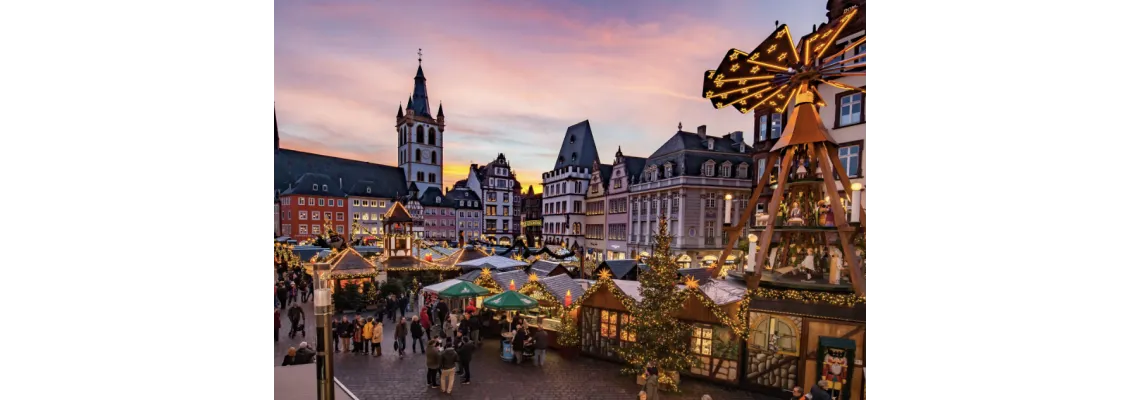
Christmas season · Hot drinks
Christmas market equipment – mulled wine kettles and drink dispensers for successful trading
At a Christmas market people smell the stall first, then see the steam, and only then look at the price. Mulled wine, punch and hot chocolate are the drinks that stop a passer-by and turn them into a customer. This article covers how to choose a mulled wine kettle and drink dispenser for a market stall or a corporate event, how many litres you need, how to avoid overheating the wine, what power the stall needs and how to serve a queue fast.
- A hot drink is what drives a market stall
- Mulled wine kettles, punch kettles and drink dispensers — what's what
- The right temperature: hot, never boiled
- Festive flavour: mulled wine and punch in volume
- How many dispensers: market stall and corporate event
- Power at the market stall
- Licences, safety and hygiene
- Christmas markets, events and cafés
- Choosing and costing
- Efficient service: stall layout, flow and selling
- Day to day, mistakes and one market evening
- BHS service, maintenance and spare parts
- Models in our range
- Frequently asked questions
01 A hot drink is what drives a market stall
At a market, customers decide in seconds. Steam above the dispenser, the smell of orange and cinnamon and a clearly visible price work better than any advert. Mulled wine also has a high margin: the ingredients for a cup cost less than a euro, while the selling price is several times higher. Here is where hot drinks earn the most:
02 Mulled wine kettles, punch kettles and drink dispensers — what's what
The names get mixed up: "mulled wine kettle", "punch kettle", "glühwein machine". Technically there are four groups of equipment, each suited to its own volume.
- Hot drink dispenser — stainless steel tank with heating element, thermostat +30…+100 °C, drip-free tap; Volume, power: 9–16 l, 0.95–1.65 kW; Best for: mulled wine, punch, water for tea; the manufacturer allows water or wine
- Hot water dispenser "for mulled wine" — single-wall tank, 2.2 kW, protection against switching on empty; Volume, power: 9–30 l; Best for: large volumes, fast heating; the manufacturer lists tea and mulled wine
- Dispenser with stirrer — transparent bowl, heating plate in the base, stirrer stops settling; Volume, power: 5–6 l, 0.85–1 kW; Best for: hot chocolate, thicker drinks
- Flow-through mulled wine unit — wine from a canister or barrel is heated in the flow and goes to heated taps; Volume, power: 100 l/h, 9 kW, 400 V; Best for: large markets and festivals, up to 500 cups an hour
How to choose a mulled wine kettle and drink dispenser for a Christmas market
- Count cups in the peak hour, not per day — a market makes half its takings in 3–4 evening hours.
- Check the power at the stall — usually one 230 V socket (up to ~3.7 kW).
- Plan a backup — while one dispenser heats up, the other is selling.
- One unit per drink — for mulled wine, the alcohol-free version and chocolate.
- Check what the manufacturer allows — some dispensers are for water or wine only, not milk or chocolate.
If the drink is not sold on the spot but carried to an event, thermoses with a tap also work — see our article "Professional beverage thermoses".
03 The right temperature: hot, never boiled
Mulled wine is never boiled. Alcohol starts to evaporate at around +78 °C, the spices turn bitter and the sugar scorches on the heating element. The best serving temperature is +65…+70 °C: the drink is hot and aromatic but doesn't burn the lips.
| Drink | Holding temperature |
|---|---|
| Mulled wine, glühwein | +65…+70 °C, do not boil |
| Punch with tea and rum | +65…+70 °C |
| Alcohol-free hot drink | +70…+75 °C |
| Hot chocolate | +70…+80 °C, stirred |
| Water for tea | +85…+95 °C |
Heating times
Heating 14 l from +10 to +70 °C takes 0.98 kWh — about 36 minutes for the 14 l dispenser (1.65 kW) without losses, around 40 in practice. The 30 l dispenser (2.2 kW) heats 30 l in ~57 minutes, the 9 l at 2.2 kW in ~17 minutes and the 9 l at 0.95 kW in ~40 minutes. Conclusion: warm the wine in a pot in the kitchen and use the dispenser only to hold temperature, or switch it on an hour before opening.
04 Festive flavour: mulled wine and punch in volume
Chef's recipe: mulled wine for 10 litres (50 cups)
10 l · 1 hour · allergens: sulphites (wine)
| Ingredient | Amount |
|---|---|
| Dry red wine | 9 l |
| Orange juice | 1 l |
| Sugar or honey | 600–800 g |
| Oranges (sliced) | 4 |
| Cinnamon sticks | 10 |
| Cloves | 20 |
| Star anise | 6 |
| Fresh ginger | 50 g |
- In a large pot, warm the orange juice with sugar and spices to +80 °C until the sugar dissolves — 10 minutes.
- Add the wine and heat to +65…+70 °C without boiling.
- Take off the heat and leave to infuse for 30 minutes under a lid.
- Strain out the spices and pour into a dispenser preheated to +65 °C.
- Add fresh orange slices — boiled ones turn bitter.
Punch and other variations
- Punch: strong black tea, orange and lemon juice, sugar, rum or brandy added after heating.
- White mulled wine: dry white wine, apple, vanilla, cardamom — lighter, for those who don't like tannins.
- Hot cider: apple cider with cinnamon and cloves.
- Berry drink for children: cranberry or blackcurrant juice with honey.
For cooking in volume, use professional pots with a heavy base — warm the wine in them and serve from the dispenser.
05 How many dispensers: market stall and corporate event
One cup is 200 ml, so 1 litre = 5 cups. The key figure is the peak hour.
20–40
4–8 l
1 × 9 l + backup in a pot
60–120
12–24 l
2 × 14 l or 30 l + 14 l
200–500
40–100 l
flow-through unit 100 l/h
160 in the first 2 h
~32 l
30 l + 9 l
A 14 l dispenser holds 70 cups, a 30 l one 150 cups. If you sell 100 cups an hour at peak, one 14 l dispenser runs dry after 40 minutes and the next batch is only hot half an hour later. So always two dispensers, or one large and one small.
For large markets — a flow-through mulled wine barrel
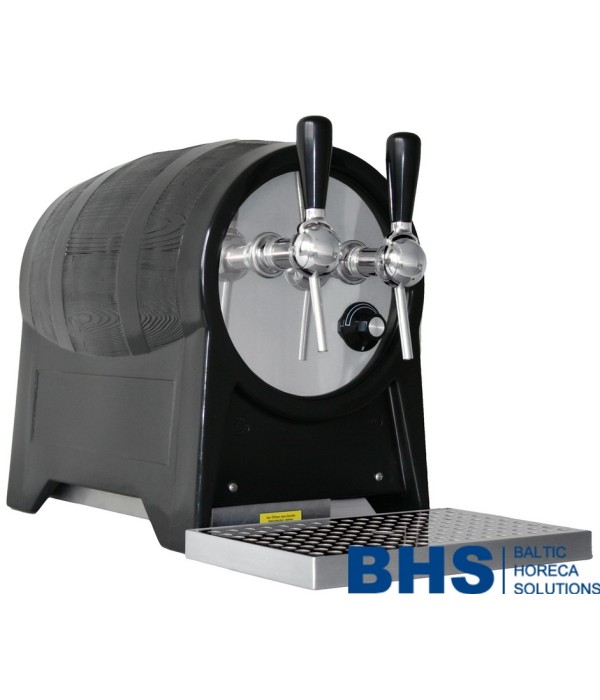
The Neumarker mulled wine barrel heats wine in the flow: 100 l an hour (up to 500 cups of 200 ml), two heated taps, thermostat +35…+85 °C, built-in pump, ready 5 minutes after switching on. It needs a 400 V, 9 kW connection. The Hot Point II is similar, with a steel body.
06 Power at the market stall
A market chalet usually has one 230 V socket on a 16 A fuse — about 3.7 kW. Add up the power of all your equipment before you set off.
5.5 kW
no — needs 2 circuits
3.5 kW
yes, with no margin
9 kW, 400 V
needs a three-phase supply
- Outdoor extension leads must have weatherproof (IP44 or higher) connectors and be fully unwound — a coiled cable overheats.
- Switch dispensers on one at a time, not all together.
- Ask the organiser for the connection power when you apply. More on phases and power in "Electrical power for a professional kitchen".
07 Licences, safety and hygiene
Mulled wine is an alcoholic drink, so a market stall needs more than equipment. Below are guide points for Ireland; check the exact requirements with the market organiser, your local authority and your solicitor.
- Place the dispenser on a stable, level surface, with the tap facing the server, not the customer.
- Hot surfaces and cables must be out of children's reach.
- Empty, wash and dry the tank every evening; do not carry the leftover drink over to the next day.
- Label the alcohol-free drink separately and serve it from a different dispenser.
08 Christmas markets, events and cafés
- Small market chalet — 9 l for mulled wine + 9 l for the alcohol-free drink; Tip: warm the wine in a pot beforehand and bring it in thermoses
- Busy market in town — 2 × 14 l + 30 l + chocolate machine; Tip: 2 power circuits, backup wine in a pot
- Large market, festival — mulled wine barrel + 2 dispensers; Tip: three-phase supply, 2 servers at the taps
- Corporate event — 30 l + 9 l, juice dispenser for cold drinks; Tip: serve in the first hour; with folding tables and a buffet
- Café, hotel — LOLA 6 l for chocolate + 9 l for mulled wine; Tip: a visible spot by the till or the entrance
09 Choosing and costing
| Criterion | What to check |
|---|---|
| Volume | cups in the peak hour ÷ 5 = litres + reserve |
| Power | heating time and fit on a 230 V socket |
| Thermostat | adjustable +30…+100 °C; +65…+70 °C for mulled wine |
| What it may heat | water and wine, or also milk and chocolate |
| Tap | drip-free, drip tray, cup clearance |
| Cleaning | removable lid, descaling, smooth inner walls |
A simple calculation: a market stall
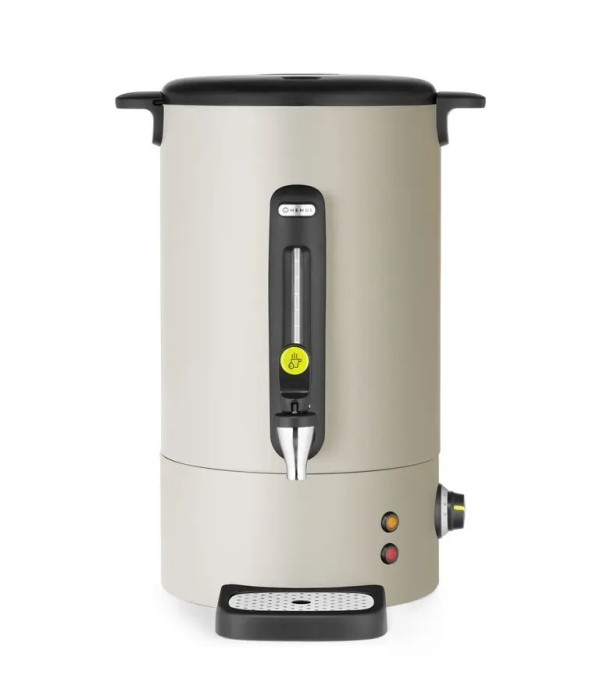
2 × €128.00
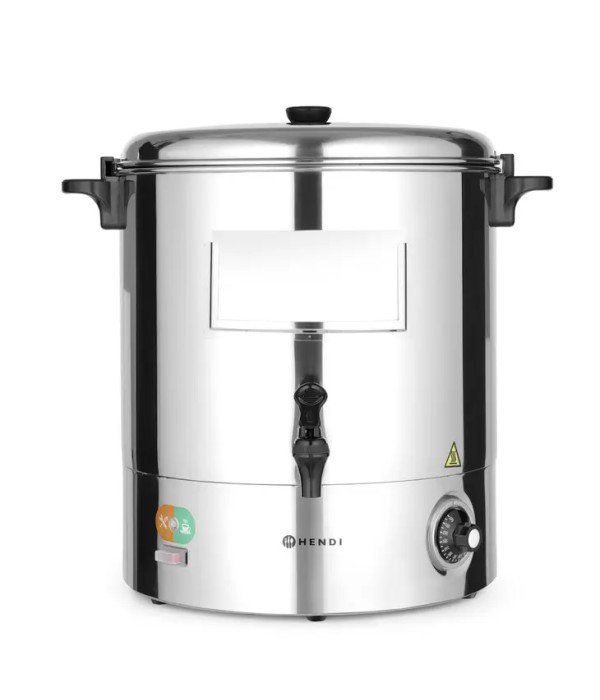
1 × €161.00
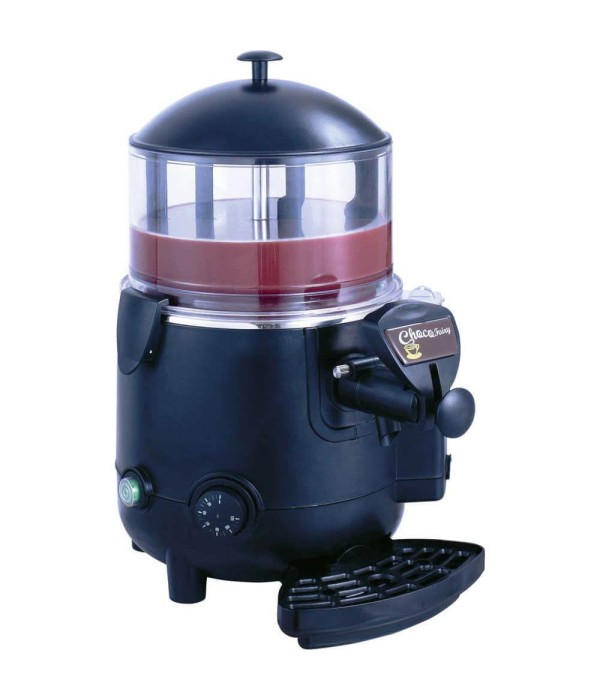
1 × €442.80
Electricity per cup (+10 → +70 °C) costs ~0.3 cents at €0.22/kWh — it hardly affects the price. Calculate with your own figures: wine, pitch fees and staff costs vary.
Corporate event for 80 guests
80 guests × 2 cups = 160 cups, or 32 l. A 30 l + 9 l dispenser costs €254.00 — €1.59 per cup at the first event, but only €0.16 after 10 events. For a caterer it is the quickest way to add a drinks service in the Christmas season.
10 Efficient service: stall layout, flow and selling
- Till first, dispensers behind it. The customer pays, the server turns and pours. One movement, not three.
- Cups lined up under the tap. 20–30 empty cups ready at peak time.
- Backup behind the stall. Warm wine in a pot or thermoses, so the next batch doesn't start from cold.
- A clear price list. 3–4 items: mulled wine, alcohol-free, chocolate, a set with a gingerbread biscuit.
- Steam and light. Lifting the dispenser lid for a moment and warm light above the tap catch the eye.
At a corporate event, place dispensers by the entrance or next to the cloakroom — the first cup is in hand within minutes. Self-service with two taps halves the queue.
11 Day to day, mistakes and one market evening
- Bitter mulled wine — boiled or spices left too long; Solution: +65…+70 °C, strain spices after 30 min
- Scorching on the base — sugar dissolved in the dispenser; Solution: dissolve sugar in the pot
- Unit switches off — overheat protection, limescale, empty tank; Solution: descale, press reset, never switch on empty
- Tap drips — sediment in the seal; Solution: dismantle and wash every evening
- Fuse trips — too much equipment on one socket; Solution: split between circuits, switch on one at a time
12 BHS service, maintenance and spare parts
Service workshop in Riga, parts across Europe
Mid-season there is no time to wait for a part from the manufacturer. BHS has more than 20 years of experience servicing kitchen and bar equipment: certified technicians, repairs in our workshop at Vagonu iela 23, Riga, and a spare parts warehouse in Riga with delivery across the Baltics and Europe.
What BHS service does
Spare parts for dispensers and water heaters
| When | What to do |
|---|---|
| Before the season | check heating element, thermostat and tap; test run with water |
| Every evening | empty, wash tank and tap, dry |
| Every week | descale with citric acid (every 2–4 weeks depending on water hardness) |
| After the season | technical service — easiest with a maintenance contract |
13 Models in our range
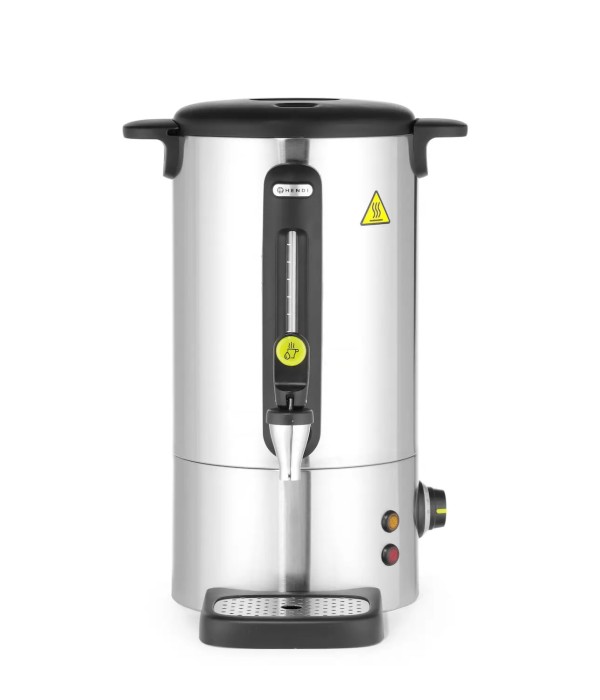
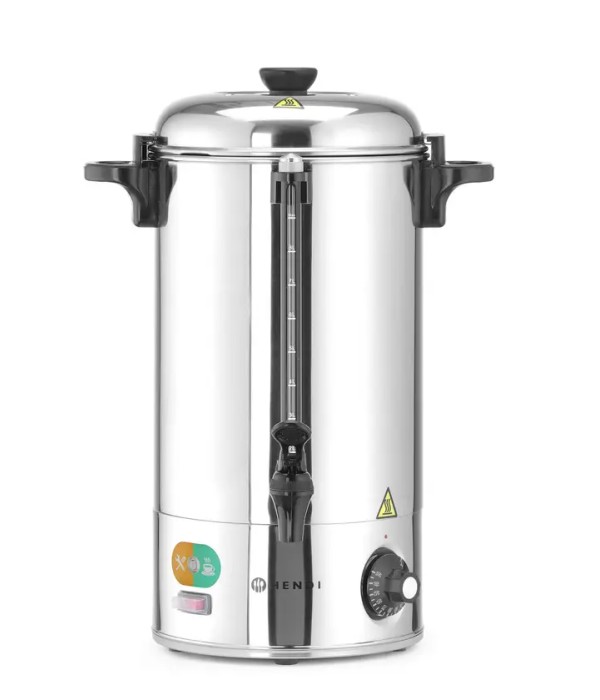
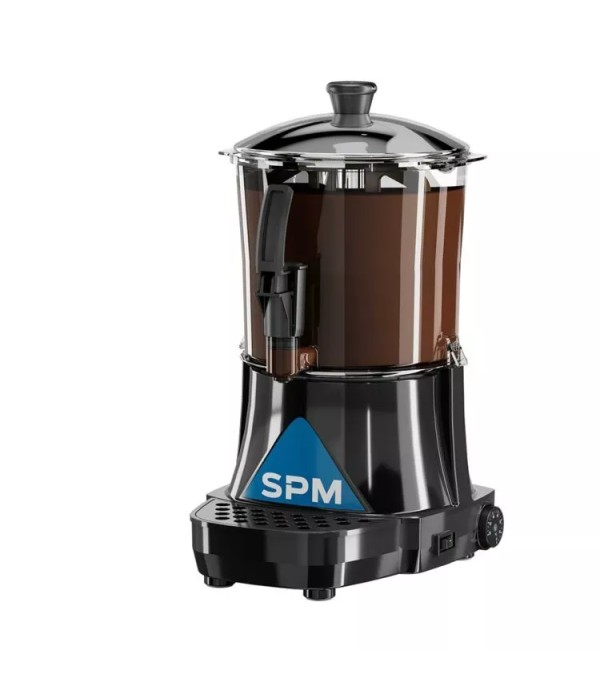
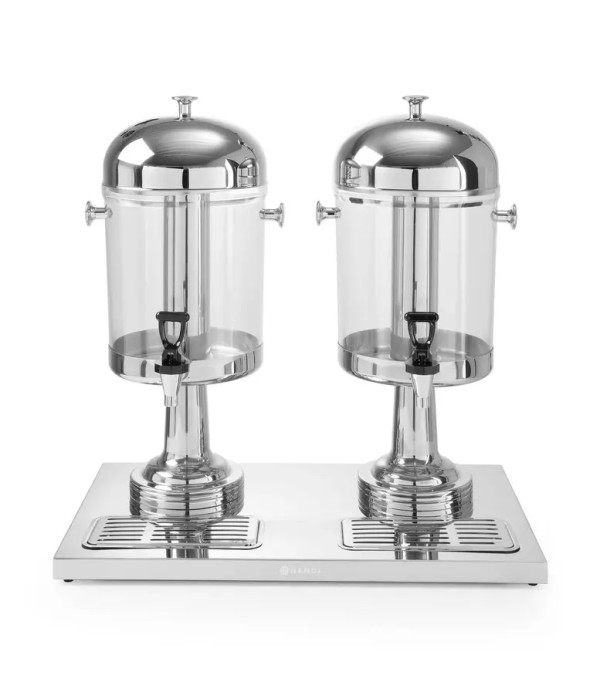
Prices excl. VAT, November 2026. Also mentioned: HENDI 18 l dispenser (€127.00) and Hot Point II (€3,692.52). 12-month warranty; after that — BHS service, maintenance contract and spare parts.
Drink dispensersHot drink machinesWater heatersCold drink equipment
14 Frequently asked questions
The best dispenser for mulled wine at a market
Two 14 l dispensers or a 30 l + 14 l combination. For a large market with a three-phase supply — a flow-through mulled wine barrel for up to 500 cups an hour.
What temperature to hold mulled wine at
+65…+70 °C. Never boil it — alcohol evaporates from around +78 °C and the taste turns bitter.
Can one dispenser heat both chocolate and wine
No. HENDI 211xxx and 209xxx dispensers are not intended for milk and chocolate; those need a machine with a stirrer, such as the Stalgast or LOLA.
How much power a stall needs
One 230 V 16 A socket handles ~3.7 kW — for example one 14 l dispenser, a LOLA and a chocolate machine. Anything more needs a second circuit.
Licence for selling mulled wine
In Ireland, selling alcohol at an event usually needs an occasional licence from the District Court, held by an on-licence holder. Check with the organiser and a solicitor.
How many litres for a corporate event
Allow 2 cups (400 ml) per guest in the first two hours: ~32 l for 80 guests — 30 l + 9 l.
Does BHS repair and service dispensers
Yes. BHS service repairs dispensers, water heaters and mulled wine machines in our Riga workshop and offers maintenance contracts. Customer service 24/7: +371 25 522 233.
Spare parts availability
Yes, heating elements, thermostats and other spare parts are in our Riga warehouse, with delivery across the Baltics and Europe.
Get your stall ready for the Christmas season
Tell us how many cups an hour you expect, what power the stall has and which drinks you will sell — we will help you choose mulled wine kettles and dispensers, and then take care of maintenance, repairs and spare parts.
Call: +371 25 522 233Drink dispensersMulled wine machinesService
This article is not legal advice; laws and local requirements change — check them before trading. Temperatures are guide values used in practice. Calculations are illustrative — use your own prices. Characters in the story are fictional. Prices excl. VAT, November 2026. Please drink responsibly.