

Refrigeration · 2026 guide
Horizontal chest freezers: how to choose, place and maintain them so stock stays frozen
A chest freezer is the simplest way for a kitchen to hold a large frozen stock at a sensible price — but only if it is chosen for the job, stands in the right place and is defrosted on time. This guide covers how a chest freezer works, which volume and lid to choose, how to look after it, what a kilo of stock costs to store and what happens if the freezer stops.
−18 °C
or colder — storage of frozen food
97–667 l
volume of professional chest freezers at BHS
24/7
BHS service, maintenance and spare parts from our Riga warehouse
Contents
- Short answer: which chest freezer for which kitchen
- How a chest freezer works
- Temperatures and models in numbers
- Food safety and HACCP
- Restaurant, café, canteen, shop
- Choosing and a simple calculation
- Installation
- Daily routine and common mistakes
- BHS service, maintenance and spare parts
- Chest freezers in the BHS range
- Frequently asked questions
01 Short answer: which chest freezer for which kitchen
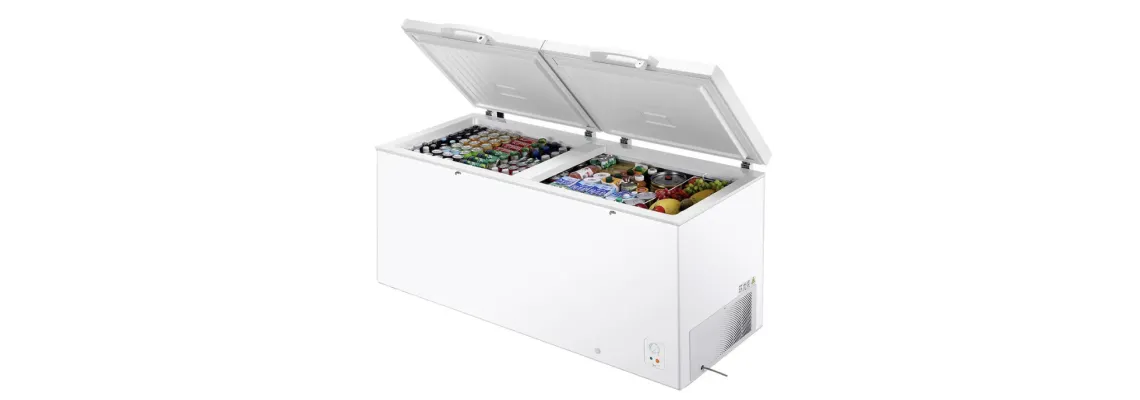
A horizontal chest freezer opens from the top. When the lid is lifted, the heavy cold air stays inside, so a chest freezer holds its temperature better than an upright and gives more litres for the same money. Its weak point is organisation: without baskets and order, forgotten products end up at the bottom.
Café and pizzeria
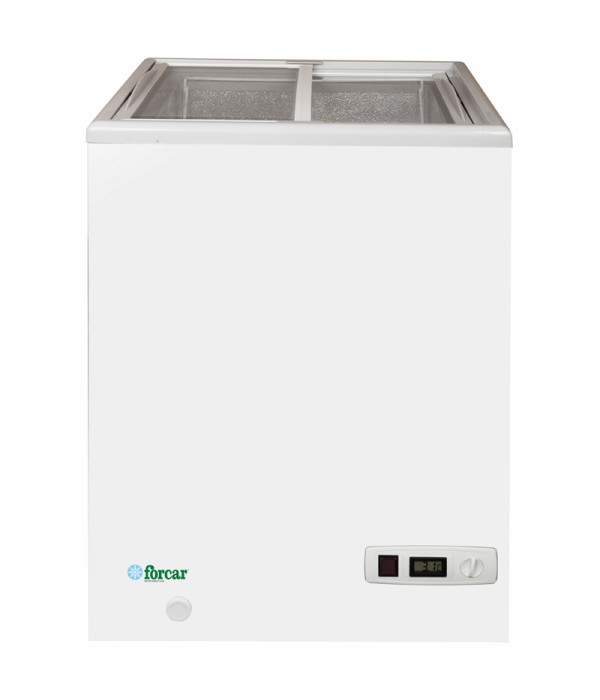
A compact 97–185 l chest next to the work area, such as G-SD100S or TEFCOLD FR205 — for ice cream, dough and fries.
Restaurant
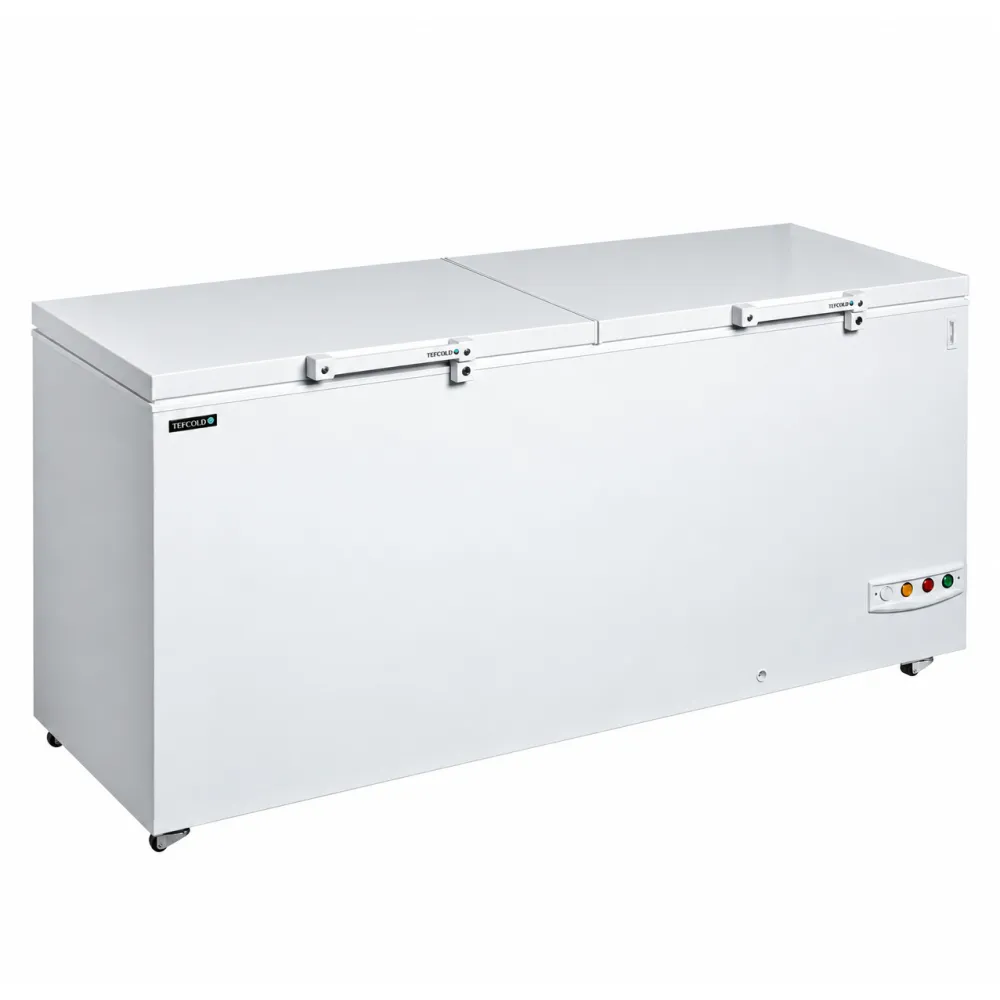
The main stock in a large chest with a two-part lid — FR606 SL (524 l net): open only half and the cold stays in.
Canteen and central kitchen
Large volume and a tough lid: CF701S SL with a stainless steel lid, 600 l net and 3 baskets.
Shop and petrol station
If customers need to see the product, you need a display chest with a glass lid — see chest freezer showcases.
Guest house and rural tourism
For seasonal stock, FR305-SL with a lock and wheels is easy to move.
Home and smallholding
Household chest freezers such as CF200WD are cheaper but not designed for intensive commercial use.
We don't just sell — we look after your equipment
Every chest freezer from BHS comes with service behind it: repairs in our workshop, preventive maintenance under contract and spare parts from our own warehouse in Riga — compressors, thermostats, seals — shipped across the Baltics and Europe. Our customer service line is open 24/7.
02 How a chest freezer works
A chest freezer works like any compressor freezer, but its shape changes a lot in daily use.
Static cooling
Most chests have no fan — the cold comes from the walls. It is quiet and efficient, but ice builds up on the walls, so defrosting is manual.
The cold stays in
Cold air is heavier, so when the lid opens it does not pour out as it does from an upright. Short openings do the chest no harm.
Compressor and refrigerant
The compressor usually sits low at one side. New chests use natural refrigerants R600a or R290 — for example FR606 SL (R600a) and CF701S SL (R290).
Defrost drain
Professional chests have a drain for meltwater — defrosting does not need a pile of cloths.
Key principle: a chest stores, it does not freeze fast
A chest freezer is designed to store products that are already frozen. Put warm food or a large batch of fresh meat inside and it freezes slowly, large crystals form and the heat warms the products around it. Cooked food goes into a blast freezer first and only then into the chest.
Lid type
The lid decides how convenient the chest is and how much cold is lost.
| One-piece lid | The simplest and cheapest; suits chests up to ~300 l. |
| Two-part lid | Open only half — less cold loss for a large chest, such as FR606 SL. |
| Stainless steel lid | Tough and easy to clean, for example Stalgast 883295 or CF701S SL. |
| Glass lid | Products are visible without opening — for shops and ice cream; these are display chests. |
Household chests have their advantages — CF200WD, for example, can run as a fridge (+2…+8 °C) or a freezer (−12…−24 °C) and freezes 9 kg per day. But a commercial kitchen needs a lock, wheels, a tough lid and available parts.
03 Temperatures and models in numbers
Freezer temperature means safety and quality. The table gives guide values; the producer's label and your HACCP plan decide.
Products and temperatures
Frozen meat and fish
Frozen vegetables, fries
Ice cream for storage
Dough and semi-finished goods
Ice
Cooked food
Models in numbers (BHS data)
SCANDOMESTIC CF200WD — household
Stalgast 883295 — steel lid
TEFCOLD FR606 SL — two-part lid
TEFCOLD CF701S SL — steel lid
“—” means the energy class is not given on the product page. Daily consumption is known for FR606 SL — 1.75 kWh; for other chests it depends on room temperature and how often the lid is opened.
04 Food safety and HACCP
A chest freezer is a food storage point and is covered by your HACCP plan. The main risks are a temperature that creeps up and unlabelled products at the bottom.
- A thermometer in every chest and a daily record — or automatic temperature monitoring with a phone alert if the chest stops at night.
- Every pack labelled with product, date and, if needed, batch. Without a label a product “disappears” in the chest.
- First in, first out: older products in the top baskets, newer ones below.
- Raw meat and fish kept apart from cooked food and ice cream, in closed containers.
- Never refreeze thawed products.
- After defrosting, clean and dry the chest before switching on and loading.
Guide values, not rules
Frozen food is usually stored at −18 °C or colder — as EU rules on quick-frozen foods also require. The exact limits are set by the producer's label and your HACCP plan; during an inspection the HSE environmental health officer checks they are kept and recorded, and FSAI guidance is the national reference.
As a general framework: the EU food hygiene regulation requires work to HACCP principles, EU rules on quick-frozen foods set −18 °C, and the EU F-gas regulation is moving new equipment to natural refrigerants. When buying a new chest, check the energy class and the refrigerant.
05 Restaurant, café, canteen, shop
The size and lid depend on how often the chest is opened and how much stock it holds.
- Café, pizzeria — small stock, frequent opening; typical solution: 97–185 l chest by the work area
- Restaurant — seasonal buying, meat and fish; typical solution: 500+ l chest with a two-part lid + small chest by the line
- Canteen, central kitchen — large volumes, several staff; typical solution: 600 l with steel lid, baskets, lock
- Shop, petrol station — selling to customers; typical solution: display chest with a glass lid
- Guest house — seasonal stock; typical solution: chest with lock and wheels
Café
A small chest by the work area means the big one in the storeroom is opened once a day, not every ten minutes.
Restaurant
Buying in larger lots is cheaper — but only if you can store it safely. A two-part lid saves cold.
Canteen
Several people — a lock and order. CF701S SL has 3 baskets and a key.
Shop
Ice cream sells when it is seen. Glass lid and LED — see display chests.
Most common mistake: a big chest where nobody can find anything
The chest is bought “with room to spare”, filled to the brim, and six months later the bottom holds undated products. They get thrown away or, worse, used. Baskets, labels and first in, first out matter more than extra litres.
06 Choosing and a simple calculation
Selection criteria
- Volume — how many kilos you store and how often you buy; what to check: net litres, number of baskets
- Dimensions — length and room to open the lid; what to check: length 580–2060 mm, height ~835–945 mm
- Lid — cold loss and durability; what to check: one-piece / two-part / steel / glass
- Temperature — is −18 °C enough or do you need −24 °C; what to check: working range
- Room temperature — how warm the storeroom gets in summer; what to check: max ambient, e.g. +38…+43 °C
- Convenience — lock, wheels, baskets, thermometer, drain; what to check: standard on professional chests
- Service — are parts available and who will come; what to check: compressor, thermostat, seal
A simple calculation: what a kilo of stock costs to store
Assumptions: a restaurant keeps its main stock in a large chest and the daily stock in a small chest by the line. Total net volume 621 l; with baskets and room for air, roughly 0.5 kg per litre → ~310 kg of stock.
- Electricity: FR606 SL — 1.75 kWh a day (manufacturer data); G-SD100S — 58 W × 24 h × 50 % ≈ 0.70 kWh (assumption). Total 2.45 kWh × €0.22 = €0.54 a day, ~€196 a year.
- Equipment: €1,118.00 / (7 years × 365) = €0.44 a day. With electricity — €0.98 a day.
- Per kilo: €0.98 × 30 / 310 kg ≈ 9.4 cents per kilo per month.
- If buying larger lots saves you €0.40/kg, that covers about 4 months of storage.
- Risk: a full stock at €6/kg is worth ~€1,860 — more than both chests together. That is why a thermometer, monitoring and service are not an extra cost.
Conclusion
A chest stores a kilo for a few cents a month, but one unnoticed stop can cost more than the chest itself. Run the numbers with your own prices and tariff.
07 Installation
A chest takes floor space, and its location decides both consumption and how long the compressor lasts.
Location and air
Not next to an oven, range or radiator, and not in direct sun. Leave the manufacturer's clearance to the wall so the compressor can release heat.
Room temperature
In a warm storeroom in summer the chest runs non-stop. Check the maximum ambient temperature — FORCAR Eco Line states +38…+43 °C.
Electricity
A dedicated earthed socket, no extension leads. Place it where it cannot be switched off by accident.
First start-up
After transport let the oil settle (time in the manual). Switch on empty, wait for −18 °C and only then load products that are already frozen.
08 Daily routine and common mistakes
A chest is simple, but its daily routine decides whether the stock is safe.
- At the start of the shift — read and record the thermometer.
- Take products from a list, with a plan — keep the lid open briefly.
- New stock goes to the bottom, older stock to the top baskets.
- Close the lid fully; if there is a lock, lock it after work.
- Once a week, review the stock and the dates.
What it looks like in practice: “Monday morning”
On Monday morning chef Declan opens the storeroom chest and feels that the products are soft. On Friday evening someone did not close the lid fully, the walls iced up, the compressor ran all weekend and the thermometer shows −6 °C. Half the stock has to be written off.
After that the kitchen brings in three things: a lock and a lid check before leaving, a temperature sensor with a phone alert, and a yearly BHS maintenance visit that replaces the hardened seal. Same chest — a different routine.
Workshop wisdom from chefs
- Baskets and coloured labels for each product group — finding things takes seconds, not minutes.
- A full chest holds temperature better than a half-empty one, but leave room for air at the walls.
- Do not freeze large amounts of fresh meat in the chest — portion it and use a blast freezer.
- Plan defrosting before a big delivery, when the chest is half empty.
- If the lid does not close easily, check the seal before the walls ice up.
Common mistakes: problem — cause — solution
- Thick ice on the walls — lid left open, damaged seal; solution: defrost, replace the seal
- Temperature rises — dirty condenser or no air; solution: free up space, clean
- Compressor runs non-stop — warm room, ice, lid not fully closed; solution: check location and lid, defrost
- Frosty, dried-out products — damaged packaging, temperature swings; solution: airtight packaging
- Water on the floor after defrosting — drain not used; solution: use the drain and a tray
- Noisy chest — not level, vibration; solution: level it, check the compressor mounting
09 BHS service, maintenance and spare parts
BHS service: 24/7
BHS service works with professional refrigeration — refrigerators, freezers, cold tables and display cabinets. Repairs are carried out in our service workshop in Riga (Vagonu iela 23) by certified, experienced technicians, with more than 20 years of BHS experience behind them. Customer service 24/7: +371 25 522 233.
What BHS service does
Diagnostics and repair
The fastest route is the workshop, where tools and parts are on hand. Call first — we will tell you what to check and whether a part can solve it.
Maintenance contract
Scheduled technical inspection, cleaning and adjustment, safety checks, wear monitoring and timely part replacement — before the chest stops over a weekend.
Spare parts in stock
Compressors, evaporators, thermostats, fans, motors, seals — kept in Riga and shipped across the Baltics and Europe.
Repair warranty
Repairs carried out in the BHS workshop come with a warranty under the BHS service warranty terms. New chests carry a 12-month warranty.
Spare parts for freezers
The most frequently replaced parts are available online — order them yourself or let a technician fit them.
Thermostats
If the temperature jumps or the chest never switches off, the culprit is often the thermostat.
Compressors
Only a technician replaces a compressor — first checking the condenser and the power supply.
TEFCOLD spare parts
Original parts for TEFCOLD refrigeration and all spare part categories.
Maintenance schedule
| Daily | Temperature record, check the lid closes |
| Weekly | Review stock and dates, wipe the seal |
| When ice reaches ~5 mm | Defrost, clean, dry |
| Yearly | Technical maintenance: seal, compressor, thermostat, electrical connections — easiest under a maintenance contract |
If the chest stops at night
Without an alarm you only find out in the morning. Wireless temperature sensors with phone alerts and an automatic log let you react in time and keep your HACCP records at the same time.
10 Chest freezers in the BHS range
Eight chests for different jobs — from a 97 l chest by the line to a 667 l chest for the storeroom.

Household: 199 l, fridge +2…+8 °C or freezer −12…−24 °C, 9 kg/24 h, 2 baskets, LED in the lid.
€252.00 excl. VAT
View product →97 l, ≤ −18 °C, 580×520×810 mm, static, 64 mm insulation, works up to +43 °C. By the work line.
€399.00 excl. VAT
View product →


295 l, stainless steel lid, digital display, LED, basket and divider.
€607.50 excl. VAT
View product →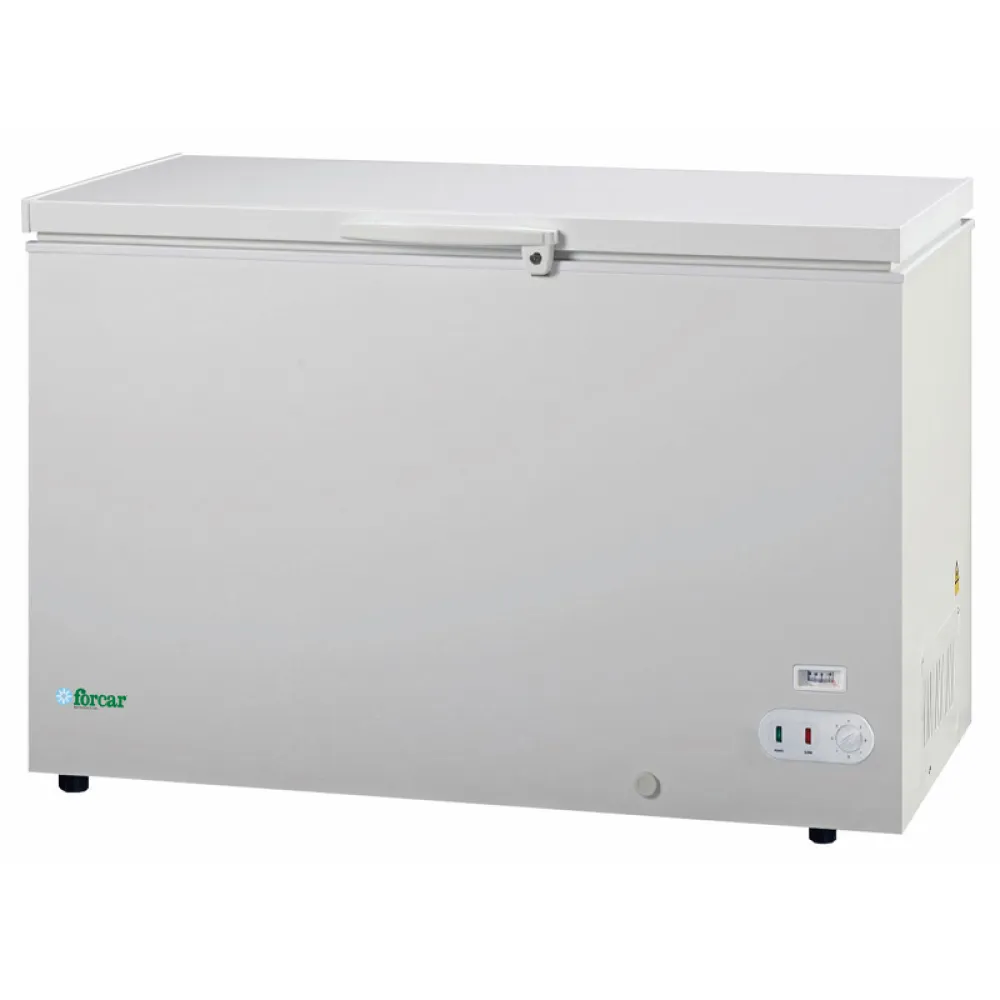
565 l (524 l net), two-part lid, 1.75 kWh/24 h, class C, lock, 4 double wheels.
€719.00 excl. VAT
View product →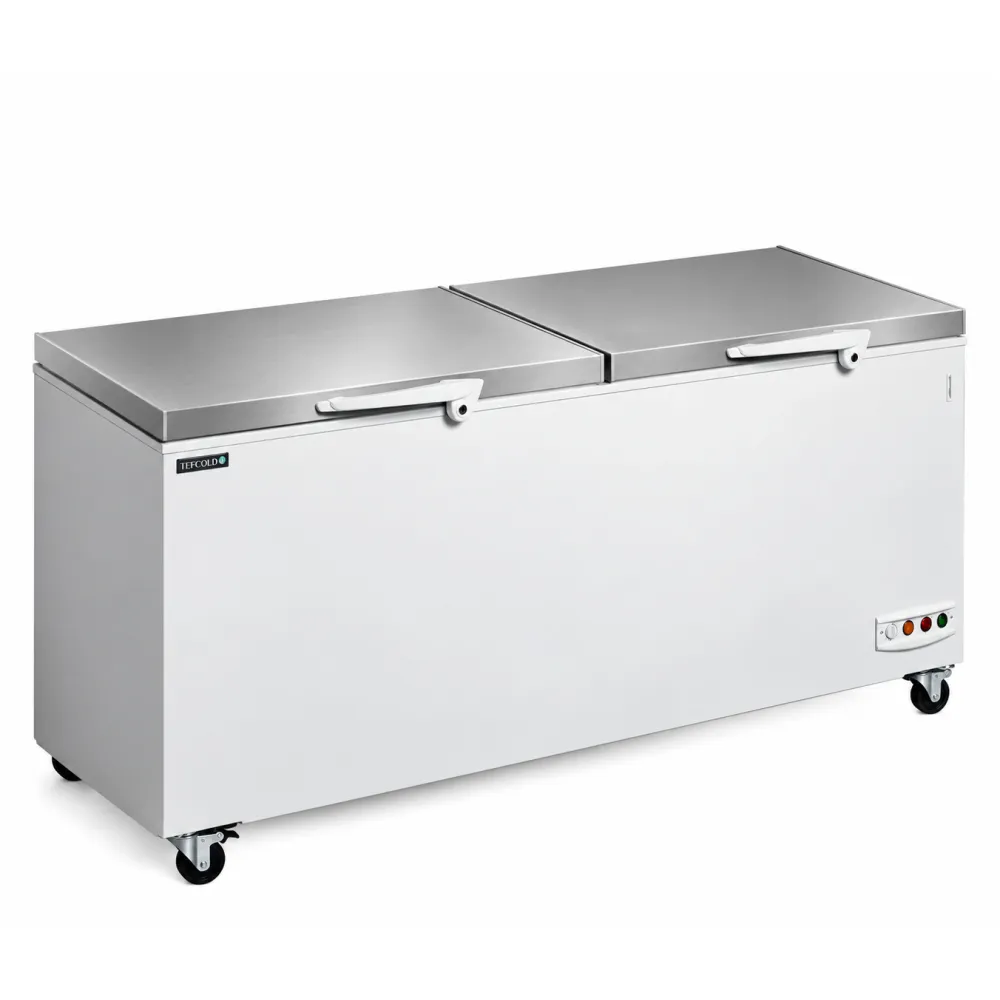
667 l (600 l net), two-part stainless steel lid, 3 baskets, key lock, R290.
€999.00 excl. VAT
View product →Prices excl. VAT, November 2026. Warranty 12 months from purchase; after that — BHS service, maintenance contracts and spare parts. Check the current price and specifications on the product page before buying.
11 Frequently asked questions
What temperature to set on a chest freezer
−18 °C or colder for frozen food. For longer storage of ice cream and fish many choose −20…−24 °C if the chest allows it.
Chest or upright freezer
A chest gives more litres for the money and loses less cold when opened. An upright takes less floor space and makes products easier to find.
How often to defrost
When the ice layer reaches about 5 mm or the lid no longer closes easily. Thick ice raises consumption and reduces volume.
Can warm food be frozen in a chest
No. A chest is for storage. Cool and freeze cooked food in a blast freezer and only then move it to the chest.
Can a household chest be used in a restaurant
It is cheaper, but the manufacturer designs it for the home. For a commercial kitchen choose a professional chest with a lock, wheels and available parts.
Does BHS repair and maintain chest freezers
Yes. BHS service repairs freezers in its workshop in Riga and offers technical maintenance contracts. Customer service 24/7: +371 25 522 233.
Are spare parts available
Yes. The BHS warehouse in Riga stocks compressors, evaporators, thermostats, fans, seals and other parts, and there is a dedicated section with TEFCOLD spare parts.
What to do if the chest has stopped
Keep the lid closed — a full chest holds the cold longer. Check the power and socket, record the temperature and call +371 25 522 233.
Let us choose your chest freezer together
Tell us how much stock you keep, how often you buy and where the chest will stand — we will suggest the volume and lid, deliver it and then take care of maintenance, repairs and spare parts.
Call: +371 25 522 233Chest freezersDisplay chestsSpare partsService
Related articles
This article is for information only. Prices excl. VAT, November 2026; specifications from BHS product pages. The calculation is an example based on assumptions — use your own prices and tariff. Temperatures are guide values; the producer's label and your HACCP plan take precedence. The story describes a typical situation; the characters are fictional.