

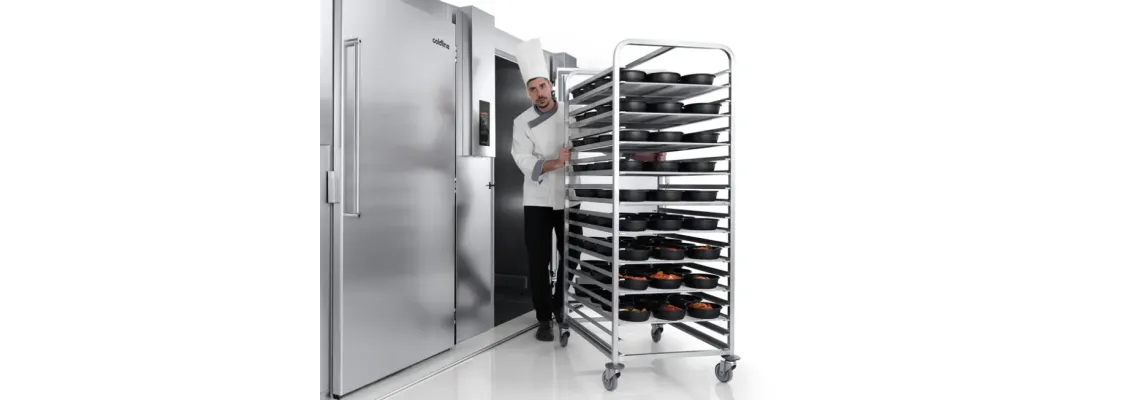
Blast chillers and shock freezers: selection, capacity, HACCP, installation and service
A pot of hot soup placed in an ordinary refrigerator takes 6–8 hours to cool down. All that time it sits in the temperature range where bacteria multiply fastest — and warms up everything next to it. A blast chiller does the same job in an hour and a half. In this article we explain how a blast chiller works, what HACCP requires for cooling, how to calculate the capacity you need, what to prepare on site and how to keep the unit in good working order.
- The short answer: who needs a blast chiller
- How a blast chiller works: chilling, freezing and the core probe
- HACCP: cooling requirements and how to document them
- Blast chiller vs ordinary refrigerator: comparison
- Types of blast chillers
- Restaurant, takeaway, central kitchen or production plant
- Capacity: how to size the right model
- Selection criteria: what to check before buying
- Installation: location, power, ventilation and drainage
- Correct use and the most common mistakes
- Service, spare parts and maintenance
- Models in the BHS range
- Frequently asked questions
01The short answer: who needs a blast chiller
A blast chiller is not a “faster refrigerator”. It is a processing unit: its job is to pull heat out of hot food quickly, not to store it for a long time. After the cycle, the product moves to an ordinary refrigerator or freezer. If even one of the situations below applies to your kitchen, a blast chiller will pay for itself in safety, quality and time.
- you prepare sauces, stocks, sides and meat in advance
- you work with sous-vide or cook-chill
- you want to take prep work out of peak hours
- desserts, creams and mousses must set quickly
- large volumes of soups and stews
- food is cooked one day and served the next
- deliveries to schools, hospitals, offices
- cooling times must be proven during inspections
- setting cakes and tortes before glazing
- frozen dough products and croissants
- ice cream and semifreddo
- freezing pizza dough balls as stock
- preparing event food the day before
- portioning and packing after cooling
- longer shelf life with a documented process
- continuous flow — tunnel solutions
02How a blast chiller works: chilling, freezing and the core probe
In an ordinary refrigerator air moves slowly, and the compressor is sized only to maintain the temperature of food that is already cold. A blast chiller has a powerful compressor, a large evaporator and strong fans that wash every tray with very cold air from all sides. Heat is pulled out of the product several times faster.
| Cycle | What it does | Air temperature | Suitable for |
|---|---|---|---|
| Soft chill | Cools to +3 °C without freezing the surface | around 0 °C or slightly below | Desserts, creams, fish, vegetables, rice, thin cuts |
| Hard chill | Very cold air at first, then gradually warmer so the surface does not freeze | down to −20 °C at first, around 0 °C at the end | Thick cuts of meat, stews, soups, large volumes |
| Shock freezing | Freezes the product to −18 °C at the core | down to −35…−40 °C | Meat, fish, dough, ice cream, ready meals for stock |
| Holding after the cycle | The unit switches automatically to +3 °C or −18 °C | depending on cycle | If staff don’t remove the product right away |
| Extra cycles (model-dependent) | Thawing, proofing, ice cream hardening, internal sanitisation | programmable | Pastry shops, pizzerias, restaurants |
The core probe: the most important part
A cycle can end in two ways: by time or by temperature inside the product. The core probe is a needle with a sensor inserted into the thickest part of the product. The unit runs until the core reaches +3 °C or −18 °C and saves the cycle data. A timed cycle guarantees nothing: a full tray of thick meat can still be +20 °C inside after 90 minutes. Only a probe-controlled cycle is valid HACCP evidence.
During slow freezing, large ice crystals form in the cells and tear the cell walls. After thawing the product loses juice: meat becomes dry, vegetables watery, dough heavy. In shock freezing the crystals are tiny, the cells stay intact, and after thawing the product is very close to fresh. The same applies to chilling: fast-cooled food evaporates less and loses less weight.
03HACCP: cooling requirements and how to document them
Bacteria multiply fastest in the so-called danger zone — roughly +5 to +60 °C (limits vary slightly between sources). Some spore-forming bacteria, such as Clostridium perfringens and Bacillus cereus, survive cooking and start multiplying exactly when food cools slowly. That is why cooling hot food is one of the typical critical control points in a food business’s HACCP plan.
EU Regulation No 852/2004 requires food to be cooled as quickly as possible after heat treatment, but the specific times and temperatures are set by each business in its own HACCP plan. In practice the following benchmarks are used:
| Process | Target at product core | Maximum time | Note |
|---|---|---|---|
| Blast chilling (cook-chill) | from +70 °C to +3 °C | 90 min | Widely used international benchmark; manufacturers state capacity on this basis |
| Cooling without a blast chiller | from +60 °C to +10 °C | 2 h | A critical limit often used in HACCP plans |
| Shock freezing | from +70 °C to −18 °C | 240 min | Then store in a freezer at −18 °C or below |
| Storage after chilling | 0…+3 °C | usually up to 3–5 days | The exact shelf life is set by your HACCP plan |
| Reheating before serving | at least +75 °C at the core | — | Reheated food must not be chilled again |
What to record
- product name and batch, date and time of cooking;
- cycle start and end time and core temperature at the end of the cycle;
- who carried out the cooling (signature or system user);
- corrective action if the target was not reached in time (for example, product discarded);
- label on the container: product, date, “use by”.
Modern blast chillers with a HACCP function store the cycle data themselves and allow export (USB, Wi-Fi or app). Combined with remote temperature monitoring, the paper log can be replaced by an automatic archive for all refrigeration equipment. For storage temperatures by refrigerator shelf, see our article Food storage rules in the refrigerator.
A typical inspection scenario: the kitchen has a blast chiller, but staff run it by time, without the probe, and write “90 min, OK” in the log. The inspector asks what the temperature was inside the product — and there is no answer. The equipment is there, but the evidence is not. The fix is simple: start every cycle with the probe in the thickest product and keep the unit’s printout or exported file. The log entry then takes 10 seconds and will stand up to any inspection.
04Blast chiller vs ordinary refrigerator: comparison
A common question: can’t you just put hot food in a refrigerator or freezer? You can — but it is slow, risky and harmful to the unit itself.
| Criterion | Blast chiller | Ordinary refrigerator / freezer |
|---|---|---|
| Cooling +70 → +3 °C | ~90 min | 6–8 h or longer (depending on volume) |
| Freezing to −18 °C | ~4 h | 12–24 h |
| Ice crystals | Tiny, texture preserved | Large, product loses juice |
| Effect on other products | None — separate chamber | Hot food warms the products next to it |
| Load on the unit | Designed for hot products | Compressor runs non-stop, wears faster, ice builds up on the evaporator |
| Core temperature control | Probe and data logging | None |
| HACCP evidence | Automatic cycle data | Manual measurements only |
| Weight loss (evaporation) | Minimal | Higher, especially for meat and rice |
A pot in cold water with stirring, and splitting food into shallow containers, really do speed up cooling, and it is a good backup procedure. But every day and with large volumes it takes staff time, is hard to repeat consistently and leaves no automatic record. If cooling is a daily process, a blast chiller usually pays for itself through saved labour and lower waste.
05Types of blast chillers
Sits on a worktop or under a counter. 3 × GN 2/3 or GN 1/1, around 7–12 kg chilling per cycle, 230 V. For cafes, small pastry shops, à la carte restaurants. Example: Sammic AT-3 2/3 — 600 × 605 × 400 mm, 7 kg / 4.9 kg per cycle.
Under a counter or on a stand, 5 × GN 1/1 or 600 × 400 mm. Around 15–22 kg chilling per cycle. The most common choice for restaurants and pastry shops. Example: GEMM BCB/05 — 22 kg chilling, 15 kg freezing.
Free-standing cabinet for 10–20 GN 1/1 trays. 30–80 kg per cycle. For cook-chill restaurants, canteens, catering. Example: TEFCOLD BLCA10X1 — 10 GN, 40 kg chilling, 28 kg freezing, still on 230 V.
Full GN or pastry trolleys roll straight from the combi oven into the chamber. No transferring trays. For central kitchens, hotels, bakeries. Example: GEMM MAXI BCC series for GN 2/1 or 600 × 800 mm trolleys.
Continuous-flow units where products move through the freezing zone. For food production, semi-finished and frozen products. Example: GEMM MAXI TUNNEL series.
GN 1/1 or 600 × 400 mm?
Restaurants work with GN containers (530 × 325 mm), pastry shops and bakeries with 600 × 400 mm trays. Many blast chillers have universal guides that take both formats; for others they must be ordered separately. Before buying, check which containers you use, as well as the spacing between guides: 67–70 mm is standard and accepts 40 or 65 mm deep GN containers.
06Restaurant, takeaway, central kitchen or production plant: how the choice differs
The same unit does completely different work in different businesses. In a restaurant a blast chiller is the chef’s tool for quality, in a takeaway kitchen it is a tool for speed and safety, in a canteen it is a logistics step, and in a production plant it is part of the process line. That is why the selection criteria differ in each segment.
| Criterion | Restaurant kitchen | Takeaway, quick service | Canteen, central kitchen | Production, industrial |
|---|---|---|---|---|
| Main task | Quality, mise en place, desserts | Fast batch cooling, packing | Large volumes, delivery to other sites | Continuous flow, long shelf life |
| Typical volume | 5–25 kg per cycle | 10–40 kg per cycle | 50–200 kg per day | hundreds of kg per hour |
| Unit type | 3–5 trays undercounter or on a worktop | 5–10 tray upright | 10–20 trays or roll-in trolleys | Roll-in chambers, tunnel systems |
| Cycles | Soft, hard, freezing, desserts, thawing | Hard chill, freezing | Hard chill, holding | Freezing, programmable recipes |
| Tray format | GN 1/1, GN 2/3 | GN 1/1, packaging boxes | GN 1/1, GN 2/1 trolleys | 600 × 800 mm trolleys, belts |
| Power supply | 230 V | 230 V or 400 V | 400 V | 400 V, often a remote condensing unit |
| HACCP requirements | Probe-based cycle data | Cycle data + label on packaging | Batch traceability, data archive | Full traceability, certified process, approval by the food authority |
| Key purchase factor | Compact size, low noise, many cycles | Speed, durability, simple controls | Capacity, trolleys without transferring | Power, continuous operation, project design |
Here the blast chiller works with small batches many times a day: sauces, stocks, sous-vide meat, panna cotta, ice cream bases. Flexibility matters more than power — many cycles, soft chilling for desserts and a compact body under the counter next to the hot line. 3–5 trays and 230 V are usually enough.
Food is cooked in batches, chilled, packed and sold later or delivered. It is critical to chill before packing: hot food in a closed box condenses moisture and is an ideal environment for bacteria. Choose a 5–10 tray model with hard chill, a robust build and simple controls any shift worker can learn. On the packaging: cooking date and “use by”.
Here cooling is a logistics step: food is cooked in one place and served in another or the next day. High capacity and roll-in models let you wheel full trolleys straight from the combi oven without transferring. HACCP requires batch traceability, so a data archive and remote monitoring help.
In a food production plant shock freezing is part of the process line: semi-finished products, dumplings, bakery products, ready meals for retail. You need continuous flow, programmable recipes, a remote refrigeration unit and an individual project together with cold rooms. The business usually needs approval from the food authority, and the process must be fully documented.
A typical situation: a takeaway kitchen or small production unit buys a compact restaurant blast chiller because it is cheaper, and starts cooling 60–80 kg a day in it. The unit runs non-stop, cycles stretch to 3 hours, the compressor overheats, and after a year an expensive repair is needed. If the volume exceeds 40 kg at a time or cooling runs all day, choose an upright or roll-in model with reserve capacity. Production always needs a project, not a catalogue unit chosen “by eye”.
07Capacity: how to size the right model
Blast chiller capacity is stated in two ways: number of trays and kilograms per cycle. Kilograms matter most — they show how much food the unit can cool in 90 minutes. Chilling kilograms are always higher than freezing kilograms, because freezing requires removing much more heat.
| Business | Typical configuration | Chilling per cycle | Example from BHS |
|---|---|---|---|
| Cafe, small pastry shop | 3 trays | 7–12 kg | Sammic AT-3, TEFCOLD BLCA3X1 |
| Restaurant, 40–80 seats | 5 trays | 15–25 kg | GEMM BCB/05, TEFCOLD BLCA5X1 |
| Cook-chill restaurant, catering | 10 trays | 30–40 kg | TEFCOLD BLCA10X1, GEMM BCB/10 |
| Canteen, central kitchen | 15–20 trays or trolleys | 50–100+ kg | GEMM BCB/15–24, MAXI BCC |
| Food production plant | Roll-in chambers, tunnels | continuous flow | GEMM MAXI TUNNEL |
1) Work out how many kg of food must be cooled at one time at peak (for example, after lunch prep). 2) Manufacturer figures are measured under optimal conditions: product layer up to 4–5 cm, no lids, normal room temperature. In daily use, plan for 70–80% of nominal capacity. 3) One chilling cycle including loading and unloading takes about 2 hours, so you get 3–4 cycles per shift.
Example: a restaurant cools 25 kg of sauces, stocks and sides after morning prep. 25 kg ÷ 0.75 = ~33 kg of nominal capacity. The right choice is a 10-tray model with ~40 kg per cycle, not a 5-tray model with 22 kg, which would need two cycles in a row.
Rule of thumb for tray load: one GN 1/1 tray 65 mm deep usually holds 3–4 kg of product. If the layer is thicker than 5 cm, the cycle will be considerably longer, and the 90-minute target may not be met even in a powerful unit.
A broader budget breakdown for equipping a kitchen is in our article How much does it cost to equip a cafe, pizzeria and restaurant in 2026. If your volume is not yet clear, consider equipment rental or leasing.
08Selection criteria: what to check before buying
| Criterion | Why it matters | What to look for |
|---|---|---|
| Core probe | Without it, HACCP cooling cannot be proven | Included as standard; multi-point probe for larger models |
| HACCP data logging | Cycle data automatically, no paper | Data export (USB, Wi-Fi, app), alarm history |
| Chilling and freezing kg | Real performance, not tray count | Both figures stated, with the test conditions |
| Climate class | Kitchens are often +30…+35 °C | Climate class 4 (+30 °C) or 5 (+40 °C) |
| Tray format | So containers fit without transferring | GN 1/1 and/or 600 × 400 mm, 67–70 mm pitch |
| Cycles | Different products, different modes | Soft, hard, freezing, holding; plus thawing, ice cream |
| Refrigerant | Environment and future serviceability | Natural R290 (propane) — low climate impact |
| Power supply | No need to rebuild the electrical installation | 230 V is often enough for models up to 10 GN |
| Interior and cleaning | Hygiene and durability | Stainless steel, rounded corners, removable guides, drain |
| Service and parts | The unit works every day | Service support, parts in stock, known manufacturer |
09Installation: location, power, ventilation and drainage
A blast chiller is one of the most powerful refrigeration units in the kitchen. Its condenser rejects a lot of heat, and if that heat has nowhere to go, the unit will not meet the 90-minute target, however expensive it is.
- At least 10–20 cm of free space around the ventilation openings (exact figures in the manufacturer’s manual).
- Do not place it next to a combi oven, fryer or range: hot air at the condenser reduces capacity.
- An undercounter model needs airflow from the front.
- For large models you can choose a remote condensing unit that rejects heat outside the kitchen.
- Compact and mid-size models often run on 230 V, large ones on 400 V three-phase.
- Dedicated circuit with a suitable breaker; never connect via an extension lead.
- Earthing and, where required, residual current protection.
- Consider the total kitchen load — compressor starting current is higher than the rated current.
- Defrost water must drain away: into the sewer via a trap, or into a collection tray.
- The unit must be level so the door seals tightly and water does not pool in the chamber.
- Roll-in models need a level floor or a ramp for trolleys.
- After transport the unit must stand upright before switching on (time as per manual).
- Clean the chamber, check the probe and set the clock so HACCP data has the correct time.
- Pre-cool the empty unit before the first cycle.
- Train staff: probe, cycles, data saving, cleaning.
BHS delivers blast chillers across the Baltics and Europe, helps choose the location and provides installation and commissioning. If you are equipping a new kitchen, use our professional kitchen project and design service so the blast chiller, combi oven and cold rooms sit in a logical flow.
10Correct use and the most common mistakes
The right procedure
- Pre-cool. Switch the empty unit on 10–20 minutes before loading so the chamber is already cold.
- Shallow containers. Split food into GN containers with a layer of no more than 4–5 cm. Soups and sauces go into shallow 40–65 mm containers, not a stockpot.
- No lids or film. A lid acts as insulation. If protection is needed, use perforated lids or cover after the cycle.
- Probe in the thickest spot. In the largest piece of meat or the centre of the container, not at the edge.
- Space between trays. Air must circulate. Do not block the fan with containers.
- Load straight after cooking. There is no need to wait for food to cool at room temperature — a blast chiller is designed for hot products.
- After the cycle — into storage. Label the containers and move them to a refrigerator or freezer. A blast chiller is not a storeroom.
- The unit is overloaded because “it’s powerful anyway” — the cycle takes 3 hours.
- Soup is cooled in a full 20-litre pot.
- Timed cycle without a probe — no evidence.
- The blast chiller is used as an extra freezer and products sit in it for weeks.
- The door is opened often during the cycle “to check”.
- The condenser hasn’t been cleaned for months — the unit slowly loses capacity.
11Service, spare parts and maintenance
A blast chiller works at maximum load several times a day. When it starts cooling more slowly, the kitchen doesn’t notice straight away — usually only when a 90-minute cycle becomes 150 minutes and non-compliances appear in the HACCP log. Regular maintenance prevents exactly this.
+371 25 522 233
We offer long-term maintenance contracts: cleaning of condenser and evaporator, refrigerant circuit checks, core probe and controller checks, seal and fan inspection. Work on the refrigerant circuit is carried out by certified technicians only. About BHS service →
Most frequently replaced parts
The “heart” of the unit. The most common cause of failure is overheating due to a dirty condenser or poor ventilation. Compressors
Condenser and evaporator fans run constantly. Noise, vibration or slower cooling are the first signs. Fans
If ice builds up on it or it is damaged, airflow drops and cycles get longer. Evaporators
The probe is the most mechanically stressed part: it gets pulled by the cable, bent and washed. A wrong reading means wrong HACCP data. Thermostats and sensors
A worn seal lets in warm, moist air: ice forms and the compressor runs non-stop. Door seals
A clogged drain causes water to pool in the chamber. Drain pipes · Other spare parts
When ordering parts, give the manufacturer, model and serial number from the unit’s rating plate. Use original or manufacturer-approved parts: a compressor of a different capacity or a probe with a different curve can upset the whole refrigeration system. All categories — BHS spare parts; for older models, parts from used equipment can also help.
Maintenance schedule
| When | What to do | Who does it |
|---|---|---|
| After every cycle | Wipe up spills, clean and disinfect the core probe. | Staff |
| Daily | Clean the chamber and guides with a non-abrasive product, leave the door ajar so the chamber dries. | Staff |
| Weekly | Check the gasket and drain, clean the drain opening. Check for ice on the evaporator. | Staff |
| Monthly | Clean dust and grease from the condenser grille (if accessible to the user). | Staff |
| Every 6–12 months | Professional service: condenser and evaporator, refrigerant circuit, fans, electrical connections, probe calibration. | Service |
Signs that service is needed
- The cycle takes noticeably longer than before with the same load.
- The unit shows a high condensing temperature alarm or a probe error.
- A layer of ice forms on the evaporator or walls.
- The compressor clicks, cycles on and off or runs very loudly.
- Water collects under the unit or in the chamber.
- The core probe reading differs from a reference thermometer by more than 1 °C.
A typical service case: a canteen complains that its blast chiller “can’t cope” in summer — cycles take 2.5 hours. Diagnostics show the condenser fins completely clogged with grease and flour dust, and the unit standing half a metre from a combi oven. After cleaning and moving the unit, cycles returned to 85–90 minutes. The compressor was saved — a few more weeks like that and it would have needed replacing. Cleaning the condenser is the simplest and cheapest maintenance that protects the most expensive part.
More on daily care of refrigeration equipment in our articles Defrosting, cleaning and maintaining a freezer and Using and maintaining a professional freezer.
12Models in the BHS range
BHS offers 55 blast chiller models from GEMM, SAMMIC, TEFCOLD and Stalgast — from compact 3-tray units to tunnel systems for food production. A few examples for different tasks:
Prices exclude VAT as of October 2026 and may change. All models — in the Blast freezers category. For storage after the cycle see refrigerators, freezers, refrigerators for tray trolleys and cold rooms; for pastry shops also proofing and cold fermentation equipment.
13Frequently asked questions
What is the difference between a blast chiller and a shock freezer?
A blast chiller cools the product to +3 °C without freezing it. A shock freezer freezes it to −18 °C. Most professional units are combined and run both cycles, which is why catalogues call them either blast chillers or shock freezers.
Can hot food go into a blast chiller straight from the stove?
Yes, that is exactly what it is designed for. Manufacturers state capacity from +70 or even +90 °C. Waiting for food to cool on the counter makes no sense — that is precisely the time in the danger zone you want to avoid.
Why do models in the same class state different kilograms?
Manufacturers measure capacity under different test conditions: starting temperature (+70 or +90 °C), product type and layer thickness, room temperature. So compare models under the same conditions and count on 70–80% of the nominal value in daily use.
How long can food be stored after blast chilling?
In a cook-chill system, chilled food is usually stored at 0…+3 °C for up to 3–5 days, including the day of cooking and the day of consumption. The exact shelf life for each product is set by your HACCP plan. Frozen products are stored at −18 °C or below; their shelf life is measured in months.
Can a blast chiller be used as an ordinary freezer?
Briefly — yes, after the cycle it automatically holds +3 or −18 °C. But long-term storage takes up space needed for the next cycle and wears out the powerful compressor. After the cycle, products should be moved to a refrigerator or freezer.
Does a blast chiller need a 400 V supply?
Not always. Many models up to 10 GN 1/1 trays, such as the TEFCOLD BLCA10X1 and GEMM BCB/05, run on 230 V. Larger models and roll-in chambers usually need a 400 V three-phase supply. Before buying, compare the unit’s power with your kitchen’s electrical installation.
Why does a blast chiller cool more slowly in summer?
Usually because of a hot room and a dirty condenser. If the kitchen is +35 °C but the unit’s climate class is rated for +25 °C, it cannot reject the heat. Choose climate class 4 or 5, ensure ventilation and clean the condenser regularly.
Does BHS service blast chillers not bought from BHS?
Contact customer service on +371 25 522 233 and give the manufacturer and model. BHS services professional refrigeration equipment, and we will help find the fastest way to get your unit working again.
Choosing a blast chiller for your kitchen?
Tell us what and how much you cool at one time, which containers you use and where the unit will stand — we will help calculate capacity, choose the model, check the connections, deliver and provide service and spare parts for the whole life of the unit.
This article is for information only and does not replace legislation or your company’s food safety (HACCP) plan. Specific cooling limits and shelf lives are set by your HACCP plan and applicable law. Capacity and power data are indicative and based on manufacturer specifications; installation requirements for a specific unit are set out in the manufacturer’s manual.