More from this brand
Technical data
| Attributes | |
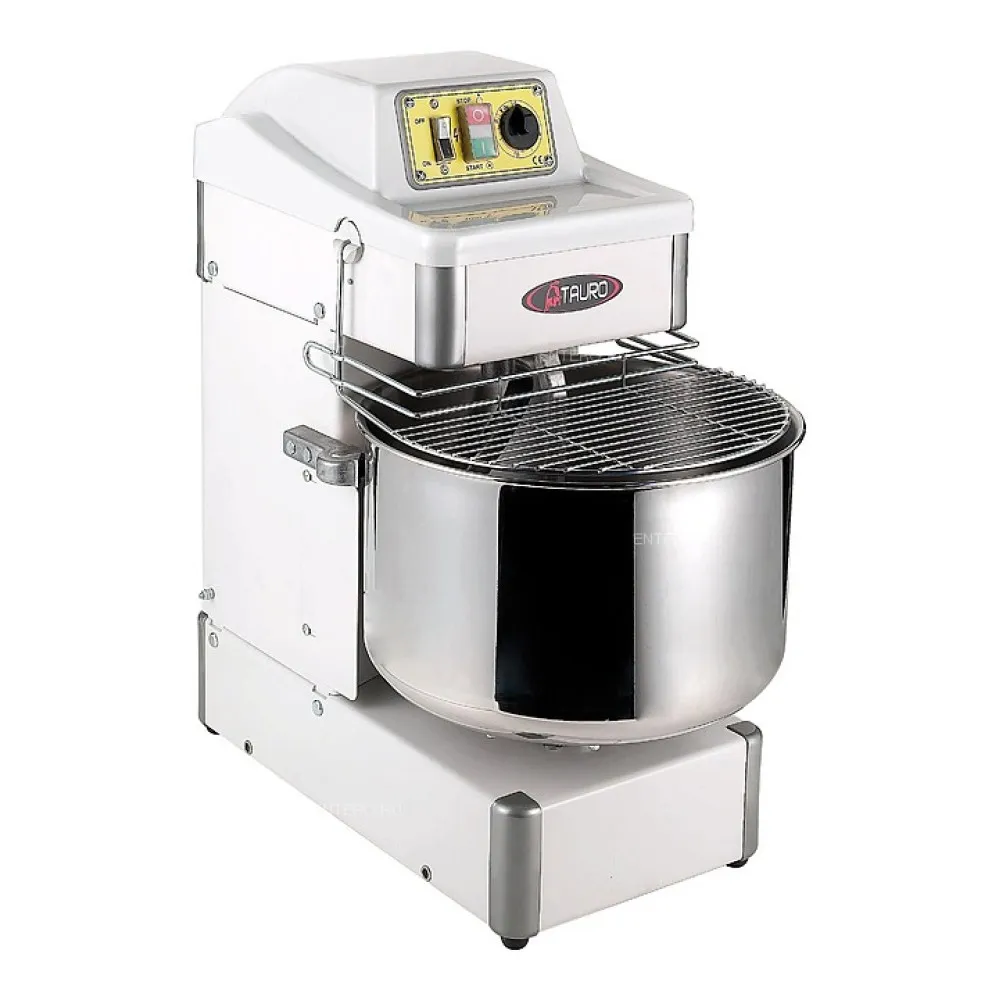
| ARTICLE | TAURO30 |
| POWER | 0,8/1,1 kW |
| SIZE L/W/H | 480 / 750 /780 |
| VOLUME | bowl-41L, flour(max) 18.5kg water(min)10L |
| WEIGHT | 75 Kg |
| NOTES | bowl 480x260 |
1or 3phase
2speed
A spiral mixer combines flour, water and yeast into homogeneous dough by driving a spiral-shaped agitator through the mass. The spiral's helical path pulls the ingredients downward and outward, folding and stretching the gluten strands without tearing them. This kneading action develops the dough's elasticity and gas retention, producing a smooth, extensible texture essential for bread, pizza and pastry bases. The bowl remains stationary, so the entire volume is worked evenly, and the rounded bottom ensures no unmixed pockets form at the base.
To operate the Sigma Tauro 41 L mixer, place the stainless-steel bowl on its support and secure it. Add the measured flour and any dry ingredients through the hole in the PETG plastic lid. Pour the liquid ingredients into the bowl, then lower the lid. Set the desired mixing time on the frontal control panel and start the motor. The spiral rotates at a controlled speed, drawing the mass inward and upward before releasing it back into the bowl. Once the cycle finishes, lift the bowl from the machine and transfer the dough to the next stage of production.
The 0.8/1.1 kW motor powers the spiral through inextensible toothed belts, reducing slippage and maintaining consistent torque. A 41-litre bowl capacity accommodates up to 18.5 kg of flour and a minimum of 10 litres of water, allowing batches large enough for medium-scale bakeries without overloading the motor. The 75 kg weight provides stability during operation, while the 480 mm width, 750 mm depth and 780 mm height fit beneath standard worktop extractor hoods. The frontal control panel, sealed against moisture, keeps flour and water away from the electronics, extending the mixer's service life.
The stainless-steel spiral, shaft and bowl resist corrosion and are easy to clean after each use. The PETG lid can be removed for thorough washing, and the well-rounded bowl bottom prevents dough from sticking. Pre-lubricated ball bearings in the kinematic motion reduce maintenance, while the toothed-belt transmission requires no adjustment between batches. The mixer meets CE and EAC certification standards, confirming compliance with European and Eurasian safety regulations.
Cleaning involves removing the bowl and lid, washing them with warm water and mild detergent, then drying thoroughly before reassembly. The control panel should be wiped with a damp cloth, avoiding direct water contact. Regular inspection of the toothed belts ensures they remain tight and intact, while the ball bearings require no additional lubrication.