

HoReCa furniture · 2026 guide
Table bases: a stable table for your restaurant, café or bar — in any colour and size
Guests only notice a table when it wobbles. The base decides whether the table stands firm, whether there is room for legs underneath and whether it fits the interior. This guide covers how to choose a base for the top, height and location, what to do when the colour you need is not in the catalogue, and how BHS makes bases to individual projects.
720–750 mm
standard dining table height
900–1100 mm
bar and poseur table height
RAL
any colour: painted to order, existing bases repainted
Contents
- Short answer: which base for which table
- How a table base is built
- Sizes and heights in numbers
- Colour: RAL to order and repainting
- Custom projects and design help
- Café, restaurant, bar, terrace
- Choosing and a simple calculation
- Assembly, care and common mistakes
- BHS service: restoration and extras
- Table bases in the BHS range
- Frequently asked questions
01 Short answer: which base for which table
A table base is the metal structure the table top is fixed to. Together with a table top it makes a complete table. The right base depends on the size of the top, the table height and how much legroom you need.
Café
Tops of 60×60 or 70×70 cm — a single-column base with a cross or round foot, such as C-11 or A-15. It leaves room for legs and chairs.
Restaurant
80×80 cm or round tops — a heavier base with a wider foot, such as C-44 (15 kg). For long tables, the double B-58 for tops up to 80×180 cm.
Bar and poseur tables
Height 900–1100 mm: A-15-101-700 (1100 mm) or the adjustable A-15R-500 (720–1100 mm) if one table has several uses.
Terrace
A compact laminate top and a heavy, stable base. In windy spots, add a 4 kg cast-iron weight.
Banquets and events
TL-HIDE-1 folding legs for large tables that are taken down and stored after the event.
Colour or size not in the catalogue
We paint bases in any RAL colour, repaint your existing ones and make non-standard heights and shapes to individual projects.
We do more than sell table bases
If the catalogue lacks the colour you need, we paint the bases in your chosen RAL shade or repaint the ones you already have. If you need another height, size or shape, we make it to an individual project and help you design it — from measuring to a drawing or 3D visualisation.
Call: +371 25 522 233Custom projectsRepainting and restoration
02 How a table base is built
Almost all HoReCa bases are self-assembly — they arrive in several parts, and each part has its own job.
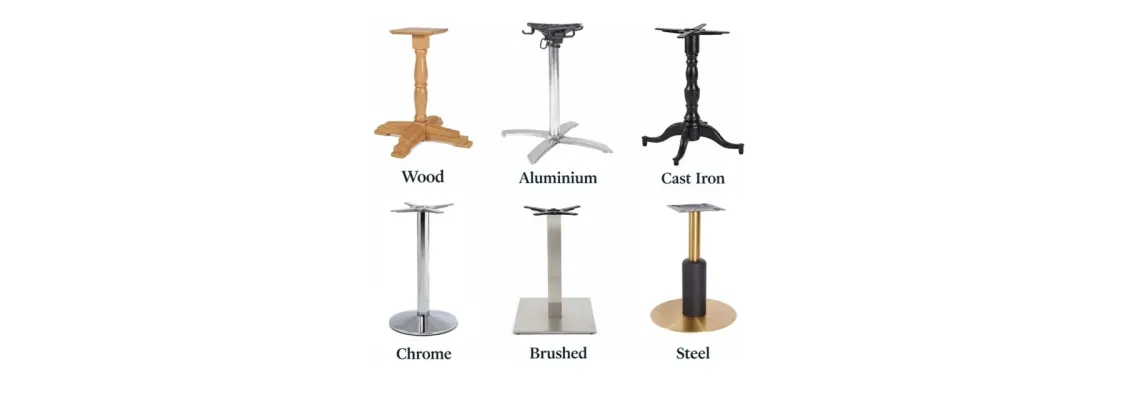
Foot
Cross, round or three-legged — the foot decides stability. Materials: painted steel, chrome-plated steel, cast iron or stainless steel.
Column
Connects the foot to the top. Its height sets the table type — dining, bar or adjustable.
Top plate
Usually 250×250 mm, 3 mm thick — the top is screwed to it. Larger tops have bases with bigger plates, such as Omega R at 45×45 cm.
Adjustable feet
3 or 4 feet level an uneven floor. Without them even an expensive base will wobble.
The stability formula
The larger the top, the wider and heavier the foot must be. A light base (5–7 kg) suits a small top, while a top of 80×80 cm or more needs 11–15 kg or an extra cast-iron weight. A heavy stone or ceramic top needs an even more stable base.
Types of base
- Single column, cross foot — the café classic, chairs fit from every side; suits: square tops up to 70–80 cm
- Single column, round foot — elegant, easy to clean, does not catch feet; suits: round tops
- Cast-iron foot — heavy and very stable, wobbles less; suits: restaurants, terraces
- Double base — two columns in one frame; suits: long tables up to 80×180 cm
- Bar base — height ~1100 mm, wider foot; suits: poseur and bar tables
- Adjustable — height 720–1100 mm; suits: multi-use spaces
- Folding legs — removed after the event; suits: banquets and large tables
03 Sizes and heights in numbers
Numbers to know before you order. Also check the maximum top size on the product page of the base.
Heights
| Dining table | 720–750 mm (base ~720–730 mm + top) |
| Bar or poseur table | 900–1100 mm |
| Adjustable base | 720–1100 mm, for example A-15R-500 |
| Other height | to order at extra cost or to an individual project |
Top and base
60×60 or 70×70 cm
80×80 cm, Ø 70–90 cm
70×120 and 80×140 cm
up to 80×180 cm
Bases in numbers (BHS data)
C-11 cross
A-15-720-700 round
C-44 cross
B-L4 cast iron
E-05-700 round
B-58 double
A-15-101-700 bar
A-15R-500 adjustable
If the product page gives different maximum top sizes, go by the smaller value or ask us.
04 Colour: RAL to order and repainting
Standard bases are usually black or chrome, some also white. Interiors often call for something else: graphite, bronze, a sand tone or a brand colour. That is no obstacle.
Colour not available — we will paint it
We paint new bases to order in any RAL colour at extra cost. If you already have bases but the interior is changing, there is no need to throw them away — BHS restoration repaints or recoats metal bases and frames, and removes corrosion and applies a protective coating to terrace furniture.
New bases in a RAL colour
For most bases the colour can be chosen when ordering — C-11, A-15, C-44, A-15R-500 and others.
Repainting existing bases
A new colour for a sound structure — without buying new bases and without needless waste.
Terrace bases
Corrosion removal and a protective coating add several more seasons to their life.
When new is better
If a base is deformed, broken or damaged, restoration does not pay — then we recommend a new one.
How repainting works
- Choose a RAL shade (or send a sample from your interior and we will help find it).
- Send photos of the bases, the model and the quantity — we will check the structure is sound.
- We agree the timing and delivery; in large venues the work can be split so the room keeps running.
- The bases come back ready to fit — in the new colour, with the feet checked.
Cost and timing
Restoration usually takes 1–3 weeks. As a general guide, restoration costs roughly 20–40 % of the price of new furniture; we will quote an exact price based on the number and condition of your bases.
05 Custom projects and design help
Not every space can be furnished with standard tables: a window niche, a long counter along a wall, a table around a column, a non-standard height or a brand design. For such spaces BHS makes bases and tables to individual projects and helps design them.
Non-standard height and size
Bases with another height or foot, for long or unusually shaped tops.
Design together with you
We measure the room, look at how guests and staff move and propose a layout.
Drawing or 3D
Before production you see a drawing or 3D visualisation and approve it.
No minimum quantity
Custom elements can be ordered one at a time — even a single table for a niche.
Project stages and timing
| 1. Consultation and measuring | a specialist views the space and listens to your idea |
| 2. Drawing or 3D visualisation | consultation and drawing approval usually take 1–2 weeks |
| 3. Production | usually 3–6 weeks from approval, depending on complexity |
| 4. Check, delivery and installation | every element is checked against the drawing before delivery |
Start with a conversation
Send a floor plan or photos and tell us how many guests you want to seat. We will help choose standard bases where they fit and custom solutions where they do not.
06 Café, restaurant, bar, terrace
The location decides what matters most — legroom, weight, colour or the ability to rearrange tables.
- Café — small tops, tables moved often; recommendation: single column, cross or round foot
- Restaurant — bigger tops, tables pushed together; recommendation: heavier base; double base for long tables
- Bar — poseur tables and high stools; recommendation: bar base ~1100 mm or adjustable
- Terrace — wind, damp, uneven ground; recommendation: heavy base, adjustable feet, protective coating
- Hotel, conference room — the use of the room changes; recommendation: adjustable bases or folding legs
Café
A cross foot lets chairs fit on every side. Black or chrome suits almost any interior — we will paint any other shade.
Restaurant
Tables are often pushed together for groups — the foot must allow them to sit tight.
Bar
A high table needs a wider, heavier foot than a dining table, or it will wobble.
Most common mistake: a base too small for the top
A cheaper, lighter base under an 80×80 cm top looks fine until a guest leans on the edge. Then the table tips, glasses fall and the next day folded napkins appear under the feet. The base must match the top, not the budget.
07 Choosing and a simple calculation
Selection criteria
- Top size — the maximum top the base is made for; what to check: see the product page; if in doubt, the smaller value
- Height — dining or bar table; what to check: 720–750 mm or 900–1100 mm
- Weight and foot — stability and legroom; what to check: cross, round, cast iron
- Material and colour — interior and cleaning; what to check: black, chrome, stainless, RAL to order
- Location — indoors or terrace; what to check: terrace — protective coating, heavier base
- Quantity — minimum order; what to check: 3 pcs; 1–2 pcs — 50 % surcharge
A simple calculation: bases for a café
Assumptions: a café with 10 tables with 70×70 cm tops and 4 bar tables by the window, 2 guests each — 28 seats in total. Table tops are not included.


- Per day: €952.00 / 28 seats / (5 years × 300 working days) ≈ 2.3 cents per seat per day.
- Minimum order: 2 C-44 bases with the 50 % surcharge cost €216.00 — the same as 3 bases (€216.00). Buy three and you get a spare at no extra cost.
- Colour: if you want another RAL shade, ask for a price before ordering — the surcharge depends on quantity.
- If you already have bases but need a new colour, restoration costs roughly 20–40 % of new — about €190–€381 in this example. We will quote the exact price.
Conclusion
A stable base costs a few cents per seat per day; a wobbly table costs the guest's mood. Run the numbers with your own table count and prices.
08 Assembly, care and common mistakes
Bases arrive in parts: foot, column, plate, screws and adjustable feet. Assembly takes minutes if you know a few things.
Screws for the top
Screws for fixing the top are not included — choose them by the top's material and thickness so they do not go through.
Centring
Place the plate exactly in the centre of the top — an offset of a few centimetres already makes the table less stable.
Adjusting the feet
Once the table is in place, adjust the feet so it does not wobble. Check them once a month.
Extras
At extra cost: a 4 kg cast-iron weight for more stability and a round aluminium adapter for glass tops.
What it looks like in practice: “The terrace and the wind”
In spring, café owner Siobhán buys light bases for 80×80 cm terrace tops. On the first windy day the tables wobble and the waiters slip folded napkins under the feet.
In autumn she chooses heavier bases with cast-iron weights for the terrace and sends the old ones to be repainted in graphite for smaller tops indoors. The terrace is stable and not a single base was thrown away.
Tips from furniture craftsmen
- Measure the top thickness before ordering — the screw length depends on it.
- Clean chrome bases with a damp cloth, no abrasives.
- Do not use solvents on painted bases — they damage the coating.
- Bring terrace bases in for winter and check them for corrosion.
- Order one spare base — when something breaks, you will not have to wait.
Common mistakes: problem — cause — solution
- Table wobbles — feet not adjusted or uneven floor; solution: adjust the feet
- Table tips when leaned on — base too small for the top; solution: larger foot or a cast-iron weight
- Screws come through the top — screws too long; solution: choose by top thickness
- Paint peels — abrasives or solvents; solution: mild cleaner; repaint
- Rust on a terrace base — damp, damaged coating; solution: remove corrosion and apply a protective coating
- Base does not match the interior — the design has changed; solution: repaint in a RAL shade
09 BHS service: restoration and extras
BHS: painting, restoration and projects
BHS has more than 20 years of experience in the HoReCa sector. We paint bases to order, repaint and restore existing ones and make non-standard tables to individual projects. Call +371 25 522 233 (24/7); we are at Vagonu iela 23, Riga, and deliver across the Baltics and Europe.
Call: +371 25 522 233Repainting and restorationCustom projects
What BHS does
RAL painting
New bases in any RAL colour at extra cost — one shade for the whole room.
Repainting and restoration
Metal bases and frames, table top renewal or replacement, chair upholstery.
Made to project
Non-standard heights, sizes and shapes — even a single element with no minimum quantity.
Design help
Measuring, layout, a drawing or 3D visualisation before production.
Extras and parts
- 4 kg cast-iron weight for more stability (extra cost).
- Round aluminium adapter for glass tops (extra cost).
- Another base height — to order.
- Adjustable feet are included; if one goes missing, ask us.
Care schedule
| Daily | Wipe the base with a damp cloth |
| Monthly | Check and tighten the feet and screws |
| Every season | Terrace bases — check for corrosion and coating damage |
| As needed | Repainting or restoration by BHS |
10 Table bases in the BHS range
Eight bases for different settings — from a café to a bar and long tables.

Cross foot, 725 mm, foot 410×410 mm, black steel, 7 kg, 4 feet. For tops up to 70×70 cm.
€40.00 excl. VAT
View product →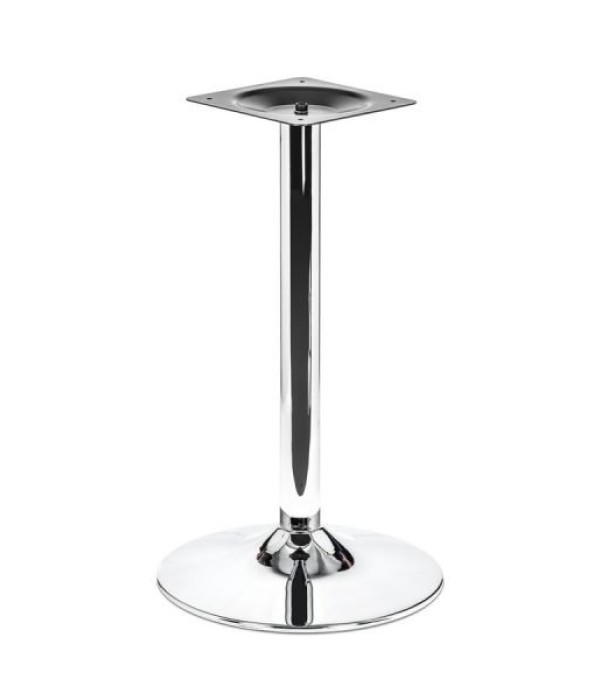
Round foot Ø 430 mm, 730 mm, chrome, 5 kg. For cafés; glass adapter available.
€49.00 excl. VAT
View product →
Cast-iron foot, 730 mm, black, 11 kg, 3 feet. Stable for tops up to 70×70 cm.
€73.00 excl. VAT
View product →Cross foot, 730 mm, 450×450 mm, black steel, 15 kg. For tops up to 80×80 cm.
€72.00 excl. VAT
View product →
Stainless AISI 201, matt, Ø 400 mm, 730 mm, 13 kg. For tops up to Ø 700 mm.
€74.00 excl. VAT
View product →
Double cast-iron base, 730 mm, 11 kg. For long tables up to 80×180 cm.
€88.00 excl. VAT
View product →
Adjustable 720–1100 mm, Ø 380 mm, chrome, black or white; other RAL at extra cost.
€99.00 excl. VAT
View product →Prices excl. VAT, November 2026. Warranty 12 months. Minimum order 3 pcs; 1–2 pcs carry a 50 % surcharge. Other height, RAL colour and cast-iron weight at extra cost. Screws for the top are not included. Check current data on the product page before buying.
11 Frequently asked questions
What height for a dining table and a bar table
720–750 mm for dining, 900–1100 mm for bar and poseur tables. If one table has several uses, an adjustable base of 720–1100 mm works.
Which base suits an 80×80 cm top
A base with a wider foot and more weight, such as C-44 (450×450 mm, 15 kg). Add a cast-iron weight to a lighter base.
Can a base be ordered in another colour
Yes. We paint new bases in any RAL colour at extra cost and can repaint existing ones through BHS restoration.
Does BHS make bases and tables to individual projects
Yes. We make non-standard heights, sizes and shapes, including single elements with no minimum quantity. Production usually takes 3–6 weeks.
Do you help design the table layout
Yes. We measure the room, propose a layout and prepare a drawing or 3D visualisation for you to approve before production.
What is the minimum order
For standard bases, 3 pcs. Orders of 1–2 pcs carry a 50 % surcharge, so 2 bases cost the same as 3.
Are the bases suitable for a terrace
For a terrace choose a heavier base, adjustable feet and a compact laminate top. For terrace furniture BHS removes corrosion and applies a protective coating.
Why does the table wobble
Usually the feet are not adjusted or the base is too small for the top. Adjust the feet; if that does not help, you need a larger foot or a cast-iron weight.
A stable table in any colour
Tell us how many tables you need, what top you have and what colour you want — we will suggest a base, paint it in the RAL shade you need, or design and make it to an individual project.
Call: +371 25 522 233Table basesTable topsCustom projectsRepainting and restoration
Related articles
This article is for information only. Prices excl. VAT, November 2026; specifications from BHS product pages. The calculation is an example based on assumptions — use your own prices. The restoration cost percentages are a general guide, not a price list. The story describes a typical situation; the characters are fictional.