

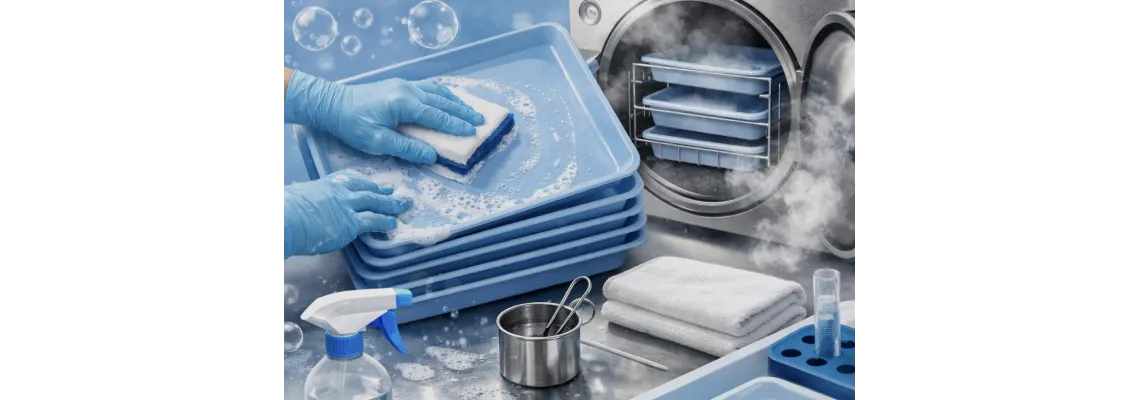
Hygiene · Sterilisation and disinfection
Sterilisation and disinfection: knife sterilisers and touchless hand washing stations
Most contamination reaches food not from the product but from hands and tools: a knife that has just cut raw meat, a tap touched with dirty hands, a towel hanging there all day. In this article: how knife sterilisers work, why hand washing needs a touchless station, how to sort it all out in a market stall without a water supply, what the food safety inspector looks at, plus models, a calculation and service.
20 s
minimum time to lather your hands — a touchless tap means you don't touch it afterwards
€0.87
per day for a mobile hand wash station and a knife steriliser over 5 years
24/7
BHS service, maintenance and spare parts from our Riga warehouse
Contents
- Why sterilisation and disinfection are part of every day
- Cleaning, disinfection and sterilisation — the difference
- Knife sterilisers: how UV works and what it can't do
- Touchless hand washing stations and models in numbers
- Correct hand washing and the knife hygiene cycle
- What the inspector looks at: a few points from practice
- Experience from a market stall
- Segments: meat, fish, deli, kitchens, events
- How to choose and a simple calculation
- Installation: water, drainage, electricity, location
- Daily care and common mistakes
- BHS service, maintenance and spare parts
- Sterilisers and hand washing stations in the BHS range
- Frequently asked questions
01 Why sterilisation and disinfection are part of every day
Food safety starts with three things that happen dozens of times a day: hands, knives and surfaces. If one of them isn't clean, bacteria from raw meat end up on ready-to-eat food — and no fridge can fix that. A knife steriliser and a touchless hand washing station are not a luxury but the simplest way to break that chain.
Meat and fish counters
Knives and boards move from raw to ready-to-eat; hands are washed dozens of times an hour.
Market stalls and kiosks
Often no water supply at the counter — the answer is a mobile station with tanks.
Delis and patisseries
Ready-to-eat food that won't be heated again — hand hygiene is the last barrier.
Restaurant and canteen kitchens
A dedicated hand basin by the work area and a knife steriliser by the meat bench.
Production and catering
A hygiene point at the entrance and documented tool disinfection.
Events and food trucks
A temporary food stall also needs a hand washing point.
We don't just sell — we service too
BHS repairs and maintains sterilisers and equipment in its service workshop in Riga, offers a maintenance contract, and spare parts are in stock in Riga and shipped across the Baltics and Europe. Hand washing stations are made of stainless steel, also to custom size. Customer service is available 24/7.
Call: +371 25 522 233ServiceSpare parts
02 Cleaning, disinfection and sterilisation — the difference
These three words are often confused, but they mean different things — and the order matters.
Cleaning
removes visible dirt, grease and protein
wash the knife with hot water and detergent
Disinfection
reduces micro-organisms to a safe level
treat the surface with a disinfectant for the stated contact time
Sterilisation
destroys almost all micro-organisms on the surface
expose a clean knife to UV-C or treat it with hot water
The golden rule: clean first, then sterile
Neither UV nor disinfectant works through grease and meat residue. A knife that goes into the steriliser dirty comes out dirty — just with a feeling that everything is fine.
03 Knife sterilisers: how UV works and what it can't do
A knife steriliser is a closed cabinet with a UV-C lamp. Ultraviolet light damages the DNA of micro-organisms so they can no longer multiply. For it to work, four conditions must be met:
- The knife is clean and dry — UV only acts on the surface it can see.
- The blade is exposed — knives are not packed together; the holder keeps the blade facing the lamp.
- Enough time — Stalgast 690552 runs a 150-second cycle, SAVIOLI STER16UV has a 0–60 min timer; stored in the cabinet, knives stay clean until next use.
- The lamp works — UV output drops over time, so replace the lamp as the manufacturer specifies, even if it still lights up.
What a UV steriliser can't do
- it doesn't remove grease and meat residue;
- it doesn't treat areas in shadow — handle gaps, tightly packed knives;
- it doesn't replace cleaning boards and surfaces;
- it isn't safe for eyes and skin — which is why the door has a microswitch and the lamp must never run with the cabinet open.
Other ways to sterilise knives
- UV-C cabinet — light on a clean, dry knife; knives can also be stored; Suitable for: meat and fish counters, delis, kitchens
- Hot water steriliser — knife in hot water (often around 82 °C); Suitable for: intensive meat cutting
- Dishwasher — washing and rinsing with hot water; Suitable for: kitchens with a machine, if knives are dishwasher-safe
- Chemical disinfection — solution at a set concentration and contact time; Suitable for: where there is no electricity or hot water
Your HACCP plan decides which method to use. The law doesn't require a UV cabinet as such — it requires that tools can be cleaned and disinfected, and that this is done regularly.
04 Touchless hand washing stations and models in numbers
A tap touched with a dirty hand becomes a carrier: you wash your hands, turn off the tap — and they're dirty again. In a touchless station, water and soap are switched on without hands.
Sensor tap
infrared sensor under the spout
kitchens, production, entrance hygiene points
Knee control
press the front panel with the knee
next to benches where hands are dirty
Foot pedal
with the foot
meat rooms, fish counters
Mobile station with tanks
foot pump, clean and waste water tank
markets, kiosks, events without a water supply
A complete hand washing point also needs liquid soap in a dispenser, single-use paper towels and a pedal bin. Hand sanitiser is a supplement, not a substitute — it doesn't work on greasy or dirty hands.
Models in numbers
- Stalgast 690552 — UV steriliser: 17 knives (up to 320 mm) or 30 eggs, 150 s cycle, lamp switches off when the drawer opens; Price: €269.33
- SAVIOLI STER16UV — stainless steel UV cabinet, 14 knives up to 350 mm, 0–60 min timer, 16 W, 430×160×630 mm; Price: €429.00
- Stalgast 610004 — compact touchless basin, activated by the front panel, Ø 350 mm; Price: €142.80
- MONOLITH ARES050 — basin with automatic mixer, knee control, 4–6 s flow; Price: €225.00
- Novameta L610005 — knee-operated basin with soap dispenser, ½-inch hoses included; Price: €299.00
- Novameta 2008 — free-standing station with sensor tap and touchless soap; Price: €708.00
- Novameta mobile station — no water supply needed: foot pump, clean and waste water tank, castors; Price: €873.00
- Neumarker 12 l — mobile basin with 12 l tank, soap dispenser, towel holder and bin; Price: €1,872.00
For larger businesses there are multi-place stations such as Novameta 2001; Novameta stations can be made to custom size.
Hand washing stationsSterilisation equipment
05 Correct hand washing and the knife hygiene cycle
Hand washing — 6 steps
- Wet your hands under the touchless tap.
- Take liquid soap from the dispenser.
- Lather for at least 20 seconds: palms, between fingers, thumbs, nails, wrists.
- Rinse under running water.
- Dry with a single-use paper towel.
- Throw the towel into the pedal bin — don't touch the lid or the tap.
When to wash your hands
- before work and after a break;
- after raw meat, fish, eggs and unwashed vegetables;
- after the toilet, waste, your phone, touching your face or hair;
- after handling money — if the same person can't be kept away from food;
- before putting on gloves and after taking them off.
The knife hygiene cycle
- After working with raw food, wipe the knife and wash it straight away with hot water and detergent.
- Rinse and dry with a single-use towel.
- Place it in the steriliser with the blade facing the lamp, close the door and start the cycle.
- Store it in the cabinet until next use — not on a board among products.
- Use separate knives and boards for raw and ready-to-eat food, ideally colour-coded.
06 What the inspector looks at: a few points from practice
An inspector doesn't check how expensive your equipment is, but whether the system works. In practice they most often look at:
- The hand washing point — separate from food washing, with potable water, soap and single-use towels. Food premises need hot and cold running water.
- Temporary and mobile premises (market stalls, stands, kiosks) — they too need facilities for washing and drying hands, for cleaning and disinfecting tools, and a supply of potable water.
- Tools — knives, boards and surfaces are clean and undamaged, and it is clear how and when they are disinfected.
- Food safety management — HACCP plan, cleaning schedule and records showing it is actually done.
- Staff — hygiene training, clean workwear, hair covering.
- Pests and waste — protection against insects, a lidded bin.
The good news
If there is a hand washing point by the counter, knives have their own place and cleaning is recorded, half the inspection is passed before the inspector opens the HACCP folder. More on preparing for an inspection in our article on food safety inspectors.
In Ireland, food businesses — including market stalls — register with the HSE Environmental Health Service, which carries out inspections; the FSAI sets national guidance. The points above are general guidance from practice; your specific requirements come from the EU food hygiene regulation, national rules and your HACCP plan.
07 Experience from a market stall
This is a typical case of the kind BHS sees at markets.
Story: “Saturday morning at the market”
Pádraig sells meat and smoked products from a stall in a covered market. There is no water supply at his counter, so hands were washed in a basin from a water jug, and knives lay on a board among the products. Many stallholders worked like that.
At a routine inspection, the environmental health officer points out three things: no separate hand washing point with soap and single-use towels, no cleaning and disinfection routine for knives, and no cleaning records. He has a few weeks to fix it.
Pádraig puts a mobile touchless station with clean and waste water tanks behind the counter — no plumbing needed. On the wall, a UV knife steriliser, and two colour-coded knife sets: red for raw meat, blue for smoked products. A cleaning schedule is fixed to the cabinet. At the follow-up visit there are no issues, and customers notice he washes his hands after every portion of raw meat.
What to do differently at a market stall
- Water — a mobile station with tanks; fill the clean tank from a potable source every morning, empty the waste tank into the sewer, not onto the ground.
- Warm water — soap works better in warm water; pour it into the tank or use a station with a heater if there is electricity.
- Location — the station on the staff side, within arm's reach of the counter, not a shared basin at the end of the hall.
- Money — if possible, one person handles money and another the food; if not, wash hands or change gloves.
- Knives — at least two sets: one in the steriliser while you use the other.
- Pests — an insect killer lamp near the counter, not above open food.
08 Segments: meat, fish, deli, kitchens, events
Typical choices:
- Meat and fish counter — STER16UV on the wall and knee-operated L610005; Most common mistake: knives go into the steriliser unwashed
- Market stall, kiosk — mobile station or Neumarker 12 l and Stalgast 690552; Most common mistake: a shared basin at the end of the hall
- Deli, patisserie — station 2008 at the work area entrance and a steriliser; Most common mistake: the hand basin also used for food
- Restaurant kitchen — 610004 or ARES050 at each workstation; Most common mistake: hand basin blocked with dishes
- Production, catering — station 2001 at the entrance hygiene point; Most common mistake: no disinfection records
- Events, food truck — mobile station with tanks; Most common mistake: nowhere to empty the waste water
The most common mistake everywhere
There is a hand washing point, but it is far away or blocked. If you have to walk ten steps to the basin, hands get washed less often. The basin belongs where the hands work.
09 How to choose and a simple calculation
- Water supply — yes — sensor or knee basin; no — mobile station with tanks
- Number and length of knives — how many at once and maximum blade length
- Location — wall or bench mounting, free-standing, mobile
- Electricity — sensors and UV need 230 V; pedals and knee controls don't
- Complete set — soap dispenser, towel holder, pedal bin
- Maintenance — UV lamp replacement, sensor and valve checks, service nearby
A simple calculation: a hygiene kit for a market stall
A meat stall at a market: a mobile touchless station and a UV knife steriliser, 5 years of use at 300 working days. Risk — one day closed: turnover €600 and €150 of products written off. Calculate with your own numbers.
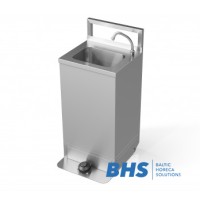
873.00 €
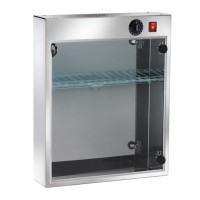
429.00 €
| Indicator | Value |
|---|---|
| Station per day | €0.58 |
| Steriliser per day | €0.29 |
| Kit per day | €0.87 |
| One day closed | €750 |
| Kit compared with one closed day | ~1.7 days |
What this means
The kit costs less than two days of being closed. But the main gain isn't money — it's customer trust: people see the seller washing his hands and the knife coming out of the steriliser.
10 Installation: water, drainage, electricity, location
- Water — ½-inch connection for cold and hot water or a thermostatic mixer; mobile units — fill the tanks with potable water.
- Drainage — trap and sewer connection; mobile units — a waste tank emptied into the sewer.
- Electricity — a splash-protected 230 V socket for sensors, heaters and UV sterilisers.
- Location — hand basin in the work area, not behind a door; steriliser by the meat or fish bench, not above the stove or in direct sun.
- Height — basin at a comfortable standing height, steriliser at eye level so knives are visible without bending.
- First start-up — check sensor range, fill the soap dispenser, set the UV timer, train staff.
11 Daily care and common mistakes
Daily routine
- Morning: tanks filled, soap and towels in place, steriliser on.
- During the day: hands after every raw product, knives in the steriliser between tasks.
- Evening: clean and disinfect the basin and station surfaces, empty and wash the waste tank.
- Weekly: wash the steriliser interior and knife holder; with the cabinet unplugged, wipe the lamp guard.
- Monthly: check sensors and soap dispenser, clean filters.
- Yearly: maintenance — UV lamp condition, valves, sensors; easiest with a maintenance contract.
- Knives dirty after the steriliser — put in unwashed or packed together; Solution: wash first, leave gaps
- UV lamp doesn't light — door not closed, switch, worn lamp; Solution: check the door; lamp replacement — for service
- Sensor doesn't react — dirty sensor window, power; Solution: wipe it, check the power supply
- Water runs non-stop — sensor or valve fault; Solution: shut off the supply, call service
- Smell in the mobile station — waste tank not washed; Solution: empty and wash it every day
- Hands rarely washed — basin far away or blocked; Solution: move the basin to the workstation
If the hand washing point stops working
- Don't continue working with unwrapped food without a way to wash hands.
- Use another basin or a mobile station for the time being.
- If the steriliser fails, use the dishwasher or a disinfectant for knives as your HACCP plan sets out.
- Call BHS service: +371 25 522 233 (24/7).
12 BHS service, maintenance and spare parts
BHS service — 24/7
We repair and maintain sterilisers, basins and other equipment in our service workshop in Riga, Vagonu iela 23. Spare parts warehouse in Riga with delivery across the Baltics and Europe, certified technicians, more than 20 years of experience.
What BHS service does
Diagnostics and repair
In our Riga workshop: sensors, valves, mixers, UV lamps, electronics.
Maintenance contract
Scheduled inspection, cleaning and adjustment, safety checks, timely parts replacement.
Spare parts in stock
Bulbs, switches, hoses and other parts — from our Riga warehouse.
Repair warranty
Repairs carried out in our workshop are covered by the BHS service warranty.
Spare parts and accessories
Bulbs and lamps
Replacement bulbs for equipment; ask our service about the right UV lamp for your steriliser.
| When | What to do |
|---|---|
| Daily | basin, tanks, soap, towels |
| Weekly | steriliser interior, holder |
| Monthly | sensors, dispensers, filters |
| Yearly | UV lamp, valves, electronics — easiest with a maintenance contract |
13 Sterilisers and hand washing stations in the BHS range
Eight models — from a countertop UV steriliser to a mobile station without a water supply:
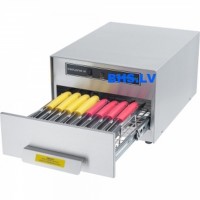
Stalgast 690552
Universal UV steriliser: 17 knives up to 320 mm or 30 eggs, 150 s cycle, lamp switches off when the drawer opens.
269.33 €
View product →SAVIOLI STER16UV
UV knife cabinet, 14 knives up to 350 mm, 0–60 min timer, 16 W, stainless steel, removable holder.
429.00 €
View product →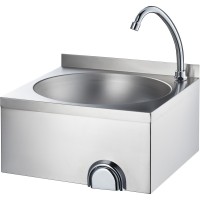
Stalgast 610004
Compact touchless basin, Ø 350 mm, activated by the front panel, 400×400×225 mm.
142.80 €
View product →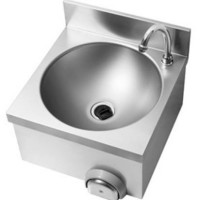
MONOLITH ARES050
Basin with automatic mixer, knee control, 4–6 s flow, 400×400 mm.
225.00 €
View product →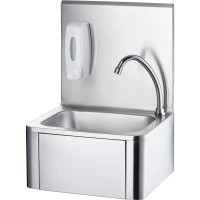
Novameta L610005
Knee-operated basin with soap dispenser, stainless steel, hoses and fixings included.
299.00 €
View product →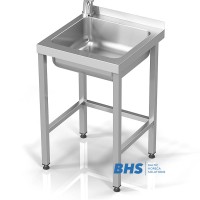
Novameta station 2008
Free-standing, sensor tap, touchless soap, stainless steel; also to custom size.
708.00 €
View product →Novameta mobile station
No water supply needed: foot pump, clean and waste water tank, castors, stainless steel.
873.00 €
View product →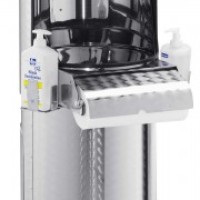
Neumarker, 12 l tank
Mobile basin 400×400×1530 mm, soap dispenser, paper towel holder, bin, foot operation.
1,872.00 €
View product →Prices excl. VAT, November 2026. 12-month warranty; after that — BHS service, maintenance contract and spare parts.
14 Frequently asked questions
Whether a knife steriliser is mandatory
The law doesn't require a specific device, but it does require that tools can be cleaned and disinfected. A UV steriliser is a simple, verifiable way to do it; your HACCP plan sets the method.
Whether UV kills everything
UV-C acts on the clean surface it reaches. On grease, in shadow and in gaps it works poorly — so wash the knife first and place it with the blade facing the lamp.
How often to replace the UV lamp
As the manufacturer specifies — output drops even while the lamp still lights. BHS service checks the lamp during maintenance.
What to do if a market stall has no water supply
Use a mobile station with clean and waste water tanks, fill the clean tank from a potable source and empty the waste into the sewer.
Whether hand sanitiser replaces washing
No. It is a supplement. It doesn't work on greasy or visibly dirty hands — those must be washed with soap and water.
Whether hands can be washed in the food sink
Hand washing must be separate from food washing. It's one of the first things an inspector checks.
Whether BHS repairs and maintains sterilisers and stations
Yes. BHS service repairs equipment in its Riga workshop, offers a maintenance contract, and customer service is available 24/7: +371 25 522 233.
Whether spare parts are available
Yes. Bulbs, switches, hoses and other parts are in the BHS warehouse in Riga and shipped across the Baltics and Europe; if something is missing, our service will help order it.
Let's sort out hygiene at your counter or in your kitchen
Tell us what products you handle and whether there is a water supply at the workstation. We will recommend a hand washing station and a knife steriliser, and then take care of maintenance, repair and spare parts.
Call: +371 25 522 233Hand washing stationsSterilisation equipmentService
Related articles
This article is for information only and is not legal advice; regulations change. Your specific requirements are set by the legislation in force, the competent authority and your HACCP plan. The calculation is approximate. The characters in the story are fictional. Prices excl. VAT, November 2026.