

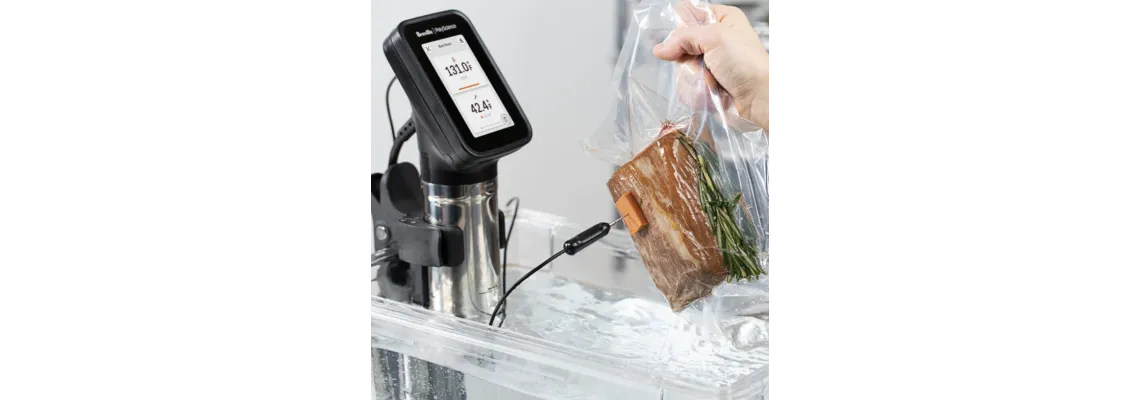
Sous vide cooking in restaurants: the chef’s secret to perfect results
A steak that is evenly pink from edge to edge. A duck breast that is juicy even in the hundredth portion. Beef cheeks you can cut with a spoon that still hold their shape. This is not a chef’s talent that only works on a good day — it is a method. We explain how sous vide works, which temperatures and times to use, how to introduce it safely in a restaurant kitchen, what equipment you need — and share a chef’s recipe.
- Why restaurants choose sous vide
- How it works: vacuum, water and precise temperature
- Temperature and time table
- Food safety during cooking
- Equipment: circulator, water bath or combi oven
- Restaurant, banquet, canteen, catering: the differences
- Workflow in a restaurant kitchen
- Chef’s recipe: beef cheeks at 68 °C
- Common mistakes and fixes
- Service, spare parts and maintenance
- Models in the BHS range
- Frequently asked questions
01Why restaurants choose sous vide
Sous vide (French for “under vacuum”) means cooking vacuum-packed food in a water bath at a precisely controlled temperature. The method was born in France in the 1970s, but professional kitchens adopted it widely once reliable circulators appeared. Today it is a standard technique in fine dining, hotels and banquet kitchens — and increasingly in bistros.
The product never exceeds the set temperature. If the bath is 56 °C, the steak will be 56 °C — no more. Overcooking is practically impossible.
The first and the hundredth portion are identical. The result does not depend on who is at the stove today.
The juice stays in the bag, not in the pan. Lower weight loss means more portions from the same kilogram of meat.
Cooking happens before service. During the rush you only sear and plate — 2–3 minutes per portion.
A restaurant serves 20 kg of beef fillet a week. Oven roasting often loses around 25% of the weight (5 kg); sous vide around 8% (1.6 kg). The difference is 3.4 kg of meat a week: at €30/kg that is ~€100 a week or ~€5,000 a year from one product alone. Add fewer returned dishes and chef time saved at peak hours — a professional circulator usually pays back within a few months. Calculate with your own prices and volumes.
02How it works: vacuum, water and precise temperature
In an oven or pan the heat source is far hotter than the desired doneness: the meat surface reaches 150–200 °C while the centre is still 40 °C. So the outer layer is always overcooked and the chef has to catch the right moment. Sous vide reverses this: the water temperature is exactly what you want at the centre of the product. The product slowly reaches equilibrium and can then stay in the bath for a long time without overcooking.
- Vacuum ensures close contact between product and water (even heat transfer) and keeps juices, aromas and marinade in the bag.
- Water transfers heat far more efficiently than oven air, so temperature evens out quickly and uniformly.
- The circulator keeps the water moving and holds temperature to about 0.1 °C.
- Searing afterwards — pan, grill, salamander or torch — creates the crust and Maillard flavour that water cannot.
Temperature sets doneness (how pink the steak is). Time sets texture and safety: how much connective tissue turns into gelatine and whether the product is pasteurised. Beef cheeks at 68 °C will be cooked but tough after 2 hours — and butter-soft after 24 hours. In both cases they are equally “done”.
03Temperature and time table
The table gives indicative values from restaurant practice. Time depends on thickness: a 2.5–3 cm piece needs far less time than a 6 cm one. Final values for your dishes must be set and approved in your HACCP plan.
| Product | Temperature | Time | Result / note |
|---|---|---|---|
| Beef steak (fillet, ribeye) | 54–56 °C | 1–3 h | Medium-rare; then sear 30–60 s each side |
| Beef cheeks, short ribs | 68 °C | 24–48 h | Tender but holds shape and pink colour |
| Pork tenderloin | 58–60 °C | 1.5–3 h | Juicy, light pink |
| Pork shoulder (pulled) | 70–74 °C | 18–24 h | Easy to pull, juicy |
| Chicken breast | 62–64 °C | 1.5–3 h | Very juicy, fully pasteurised by time |
| Duck breast | 56–58 °C | 1.5–2 h | Then crisp the skin in a pan |
| Duck legs (confit) | 75–82 °C | 10–14 h | With duck fat in the bag |
| Salmon | 45–50 °C | 20–40 min | Silky; fish must be previously frozen (see section 04) |
| Eggs (in shell) | 63–64 °C | 45–60 min | “Perfect egg” with a creamy yolk |
| Root vegetables | 84–85 °C | 45–90 min | Cooked, with vivid colour and flavour |
| Fruit (pears, rhubarb) | 65–80 °C | 20–60 min | For desserts, with syrup in the bag |
04Food safety during cooking
Sous vide often runs below the traditional 70–75 °C. That is safe if you follow one principle: pasteurisation is a combination of temperature and time. A chicken breast held long enough at 63 °C is as safe as one cooked to 74 °C briefly — but much juicier.
- Danger zone. Food must not stay for long at roughly +5…+52 °C. Do not load a large amount of cold product if the circulator cannot recover temperature quickly.
- Core probe. For new dishes and thick cuts, check when the centre reaches bath temperature. The probe goes through special sealing tape so the bag stays airtight.
- Fish. Fish served lightly cooked (below ~60 °C) must be frozen beforehand to kill parasites — usually −20 °C for at least 24 hours.
- Vulnerable groups. Offer fully pasteurised options to pregnant women, young children and people with weakened immunity.
- Cook and serve, or chill. Serve cooked food immediately or chill it quickly to +3 °C. Slow cooling on the counter is the biggest mistake.
This article is about cooking. If you cook ahead and store, chilling is a separate HACCP critical point — see Blast chillers and shock freezers: selection, capacity, HACCP.
05Equipment: circulator, water bath or combi oven
| Solution | How it works | Pros | Best for |
|---|---|---|---|
| Immersion circulator | Clips onto a GN container or pot, heats and circulates water | Mobile, affordable, easy to store | À la carte restaurants, starting with sous vide |
| Bath with built-in heater | Stainless steel tank with one or more zones | Robust, several temperatures at once | Restaurants with a broad menu |
| Combi oven (sous vide mode) | Steam at a precise temperature | Large volume, no water | Banquets, hotels, canteens |
What else you need
Essential in a professional kitchen. It also vacuums liquids (marinades, sauces, oil), which an external sealer cannot. Chamber vacuum machines
Special bags that withstand long heating (usually up to 100–120 °C). External sealers need embossed bags. Vacuum bags
GN container or an insulated container. Insulation balls reduce evaporation in long cycles and save energy.
Probe thermometer with sealing tape for core checks. Thermometers
More on choosing vacuum machines and bags in our article Vacuum packing — the best solution for food storage.
06Restaurant, banquet, canteen, catering: the differences
| Criterion | À la carte restaurant | Banquets and hotels | Canteen, central kitchen | Catering, takeaway |
|---|---|---|---|---|
| Goal | Quality, precise desserts, steaks | Hundreds of identical portions at once | Tenderising tough cuts, reducing loss | Cooking ahead, transport |
| Equipment | 1–2 circulators, 15–30 L | Combi oven or several baths | Large baths, combi oven | Circulators + blast chiller |
| Key factor | Several temperatures at once | Volume and timing | Cheaper cuts, less loss | Chilling and labelling |
Typical sizing: a circulator of about 1.5 kW with a 15–30 L bath handles roughly 10–20 bags per shift; for larger volumes choose 2–2.5 kW models or several baths so you can cook at different temperatures at once.
07Workflow in a restaurant kitchen
- Prep. Portioned meat or fish, salt, seasoning, a little oil or butter. Use fresh garlic sparingly — it turns harsh in long cycles.
- Vacuum. One layer, pieces not touching, bag not overfilled. Chill liquids before vacuuming so they don’t boil in the chamber.
- Label. Product, date, temperature, time, cook.
- Bath. Water already at temperature, bags fully submerged, space between them for circulation.
- Holding for service. Finished bags can be held at serving temperature (e.g. steaks at 54 °C) for 1–2 hours without losing quality.
- Finish. Pat dry, salt, sear in a very hot pan or on the grill for 30–60 seconds per side. Use the bag juices for the sauce.
- Serve. Immediately — seared surface, perfect centre.
A typical scenario: a restaurant serves 60 steaks on a Friday night. Without sous vide each steak is cooked individually, the chef watches oven and thermometer, and some come back as “overcooked”. With sous vide the steaks sit in a 54 °C bath from the afternoon and are only seared during the rush. A portion is ready in 3 minutes, almost nothing comes back, and a junior cook can work the grill.
08Chef’s recipe: beef cheeks at 68 °C
Beef cheeks are a cheap, tough cut traditionally braised for 3–4 hours, often falling apart into fibres. Sous vide at 68 °C for 24 hours makes them tender and juicy while keeping their shape — ideal for portions.
09Common mistakes and fixes
| Problem | Cause | Fix |
|---|---|---|
| Bag floats | Air in the bag or gas from long cooking | Chamber vacuum; hold down with a rack or weight |
| Bag opens or bursts | Dirty or wet seal, wrong bag | Clean seal area, double seal, cooking-grade bags |
| Meat grey, no crust | Not seared or seared wet | Pat dry, very hot pan, short |
| Mushy texture | Too long at low temperature | Shorten time; follow the table |
| Water evaporates, cycle stops | Long cycle without cover | Lid, insulation balls, water level check |
| Uneven result | Overloaded bath, bags packed tight | Smaller load, rack to separate bags |
| Circulator shows an error | Low water level or scale on the heater | Top up water, descale regularly |
10Service, spare parts and maintenance
Circulators and vacuum packers work every day, often 24–48 hours non-stop. Hard water is common, so limescale is the main enemy of heating elements and pumps.
+371 25 522 233
Vacuum pump oil changes, sealing bar and Teflon tape replacement, circulator descaling and sensor checks. Long-term maintenance contracts for restaurants. About BHS service →
| Unit | What to do | How often |
|---|---|---|
| Circulator | Descale heater and pump (citric acid or descaler) | Every 2–4 weeks |
| Circulator | Check temperature against a reference thermometer | Monthly |
| Vacuum packer | Change pump oil, check oil level | Per manufacturer (often every 100–300 h) |
| Vacuum packer | Clean sealing bar, replace Teflon tape and lid gasket | When worn |
| Water bath | Empty, clean, disinfect | After each cycle / daily |
Frequently replaced parts: heating elements, pumps, thermostats and sensors and other spare parts. For water softening — water filters. When ordering, give the manufacturer, model and serial number.
11Models in the BHS range
BHS offers sous vide circulators and water baths from SAMMIC and other brands, plus more than 150 chamber vacuum packers (ORVED, Stalgast, FIMAR). A few examples:
Prices excl. VAT as of October 2026 and may change. All models — Sous vide circulators and Chamber vacuum machines. Want to try first? Equipment rental is also available.
“[PASTE A REAL CUSTOMER REVIEW — 2–3 sentences on how sous vide changed their kitchen.]”
— [Name, position], [restaurant, city]
12Frequently asked questions
Is sous vide safe if the meat is pink?
Yes, if time and temperature values are followed. Pasteurisation also happens at 55–63 °C when the product is held long enough. Colour is not a safety indicator — core temperature and time are.
Can I use ordinary plastic bags?
Not in a professional kitchen. Use vacuum bags made for food and long heating. Zip-lock bags don’t withstand long cycles and don’t hold a vacuum.
Do I need a chamber vacuum packer or is an external one enough?
An external sealer suits dry products in small volumes. Marinades, sauces, oil and larger volumes need a chamber unit — it vacuums liquids and gives a more stable vacuum.
Can sous vide be done in a combi oven?
Yes, many combi ovens have a low-temperature steam mode. It is convenient for large volumes, but precision is usually lower than a water bath, so delicate products (fish, eggs) do better in a bath.
How much electricity does a circulator use?
It runs at full power (1.5–2 kW) while heating up, then only maintains temperature, so average consumption is much lower. A lid or insulation balls cut consumption in long cycles.
Does BHS help introduce sous vide in a kitchen?
Yes. We help choose the circulator and vacuum packer, plan the space in the kitchen and provide service. Call +371 25 522 233.
Introducing sous vide in your kitchen?
Tell us about your menu and portion count — we will help choose the circulator, vacuum packer and bags, deliver across the Baltics and Europe and provide service and spare parts.
This article is for information only. Temperatures and times are indicative and depend on product thickness and raw materials; the specific values for your dishes are set and approved in your company’s HACCP plan. Equipment use is governed by the manufacturer’s manual.