

Hot equipment · Ovens · Pastry · Restaurant
Convection oven or pastry oven: what to bake in each and how to get the best results
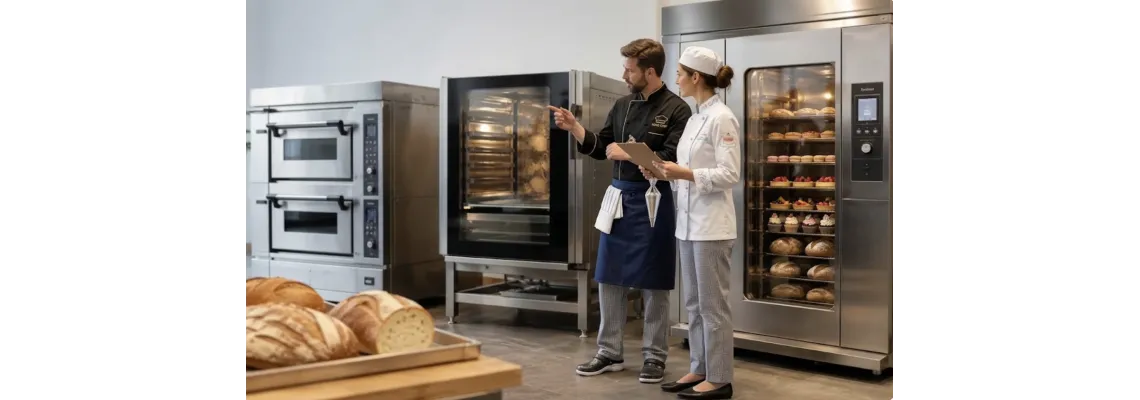
From the outside both ovens look the same: a cavity, a fan, a glass door. But one is built for GN containers, roasts and sides, the other for 600×400 trays, croissants, sponge and bread. If the oven doesn't match the product, you get uneven croissants, lopsided cakes and dry roasts. This article brings together the experience of pastry chefs and restaurant cooks: temperatures by product, how to use steam and the vent, the most common mistakes and maintenance.
- Short answer: which oven for whom
- How convection works and what sets a pastry oven apart
- What to bake in a pastry oven: temperatures and tips
- What to cook in a convection (GN) oven
- Steam, vent and fan: three tools for a good result
- HACCP and food safety
- Restaurant, café, canteen, bakery
- Choosing and a calculation
- Installation
- Workflow and the most common mistakes
- Service, spare parts and maintenance
- Ovens in our range
- Frequently asked questions
01 Short answer: which oven for whom
A pastry oven is a convection oven adapted to dough: 600×400 trays, more space between rails, gentler and more even airflow, steam injection, a vent to release moisture and often a proofing mode. A convection (gastro) oven is built for GN 1/1 containers, cooking with humidity, meat, vegetables and regeneration. Both can bake “anything”, but each does its own job better. A combi steamer (e.g. Convotherm) is another class: steam generator, core probe and automatic cleaning.
A gastro convection oven with humidity or a combi steamer. Desserts in small batches; if you have your own pastry chef or bread programme, a second 600×400 oven.
A compact 4×600×400 oven with steam. Frozen croissants, buns and bread in the morning; during the day, warming sandwiches and quiches.
A pastry oven with fan speed control, a vent and a proofer underneath. If you bake rye bread — an extra oven with top and bottom heat.
GN ovens with 6–10 levels: roasts, bakes, vegetables, fish. Buns on GN trays work, but at a lower load.
02 How convection works and what sets a pastry oven apart
In a convection oven the fan drives hot air around the whole cavity and strips away the layer of cool air at the product's surface. Heat transfers faster than in a static oven, so you usually bake 10–20 °C lower or for a shorter time. A reversing fan changes direction so both sides of the tray brown evenly. The larger the flat trays and the more delicate the dough, the more even airflow matters — and that is exactly where a pastry oven differs.
Measure your trays and moulds before buying. If your pastry section already has 600×400 trays, silicone mats and racks, a GN oven means replacing everything or baking at half capacity.
03 What to bake in a pastry oven: temperatures and tips
The table is a starting point for a convection pastry oven with a full but not overloaded cavity. Every oven has its own character: bake the first batch by eye, note the result and only then save the programme.
Pastry chefs' experience: what makes a croissant
- Proofing matters more than the oven. An under-proofed croissant “leaks” butter in the oven and stays dense. Proof at 24–28 °C and 75–85% humidity; warmer melts the butter in the layers. A proofer under the oven saves space.
- The butter must not warm up before the oven. Don't keep trays of shaped croissants next to a hot oven.
- Egg wash only just before baking, and thinly. Egg running onto the tray glues the layers and burns.
- A full oven bakes differently from an empty one. With 4 trays, the temperature is sometimes raised by 5–10 °C or the time extended.
- Colour is the first indicator. A finished croissant is evenly golden brown on the sides too, and the base sounds hollow.
Baking sponge with the fan on full speed. Strong airflow blows the surface, the cake rises lopsided and cracks. Instead of high fan speed — low speed or pulse mode and a slightly lower temperature.
Bread: when convection isn't enough
White bread, baguettes and buns can be baked very well in a convection oven with steam. Steam keeps the surface elastic at the start, the bread expands, and starch forms a glossy thin crust. Heavy rye bread and large loaves need strong heat from below — an oven with separately adjustable top and bottom heat or a deck oven with a stone base does this better. In convection, rye bread will have a thinner crust and a paler base.
Inject steam only into a fully heated cavity. In a cold cavity the steam condenses on the door and trays, and the bread gets a damp surface and spots.
04 What to cook in a convection (GN) oven
In a restaurant the oven runs all day with different products, so humidity, power and a core probe matter most. Humidity reduces meat weight loss; dry heat gives a crust. Many kitchens roast in two phases: humidity for cooking, dry heat for browning.
Restaurant chefs often conclude: one oven can do both desserts and meat if the day is planned right. In the morning, bake dough in a clean, odour-free cavity, then raise the temperature for meat and vegetables. After fish or roasted onions the cavity must be vented and cleaned, otherwise croissants pick up foreign flavours.
So many GN containers go into the convection oven that there is no air between them. The roast steams in its own juices, the bottom containers stay pale. Leave a free level between tall containers and use shallower ones for browning.
05 Steam, vent and fan: three tools for a good result
| Tool | When to use |
|---|---|
| Steam / humidity | Start of bread and laminated dough, cheesecake, the first phase of roasting, fish, regeneration. |
| Vent open | Meringue, choux, cookies, crisp vegetables, the last minutes of bread, when moisture must go. |
| Low fan speed | Sponge, muffins, macarons, liquid batters, egg mixtures. |
| High speed | A full oven of roasts, vegetables and bread, when fast heat transfer is needed. |
| Pulse mode | Delicate products in a full oven: the fan pauses so airflow doesn't blow the surface. |
Don't overdo steam. Too much steam gives bread a thick, leathery crust and blisters, and laminated dough less rise. Pastry chefs advise starting with a short burst and adding more only if the surface is still dull.
If cookies brown unevenly along the tray edges, check the trays before changing the programme. Dark thin trays brown faster, light thick aluminium trays brown evenly. Use identical trays in one batch.
06 HACCP and food safety
The oven is also a HACCP control point. The doneness of meat and poultry is determined by core temperature, not time; write the values into your HACCP plan, which the food safety authority (in Ireland, the FSAI and environmental health officers) inspects. For poultry, a core temperature of at least 75 °C is a common guideline.
- Clean and sanitise the core probe after each use; check its accuracy periodically with a calibrated thermometer.
- Check and record the core temperature of regenerated dishes, especially in canteens and catering.
- Cool after cooking in a blast chiller, not at room temperature or in a fridge.
- Keep the cavity free of fat and burnt residue: they cause smoke, odour and fire risk.
- Clean only with chemicals made for ovens; aggressive products damage seals and enamel.
07 Restaurant, café, canteen, bakery
| Segment | Recommended oven |
|---|---|
| Restaurant | Gastro convection or combi oven, 6–10 GN 1/1; a pastry oven if you have your own bread or desserts in volume. |
| Café / bake-off | 4×600×400 with steam and a proofer or stand underneath; easy to clean, with programmes. |
| Canteen / central kitchen | Large GN ovens with humidity and probe; regeneration and cooking on several levels. |
| Bakery / patisserie / catering | Pastry ovens with 6–10 levels, a proofer; for bread — top and bottom heat. |
Buying one oven for everything and then baking desserts in a cavity that smells of meat.
Putting frozen croissants on 6 trays in a small oven. Following the manufacturer's pack instructions, 4 trays bake better than 6.
Baking buns on GN trays with 67 mm spacing, and the tops stick to the tray above.
An oven without fan speed control: even sponge and macarons are impossible.
08 Choosing and a calculation
| Criterion | What to check |
|---|---|
| Tray size | 600×400 or GN 1/1; whether both fit (e.g. RX 604 and STB 604). |
| Number of levels and spacing | At least 75–80 mm for tall products; number by batches per day. |
| Steam and vent | Steam for bread and laminated dough; a vent for meringue and choux. |
| Fan | Reverse and speed control if you bake sponge or macarons. |
| Controls | Manual (M) is simple and cheaper; touchscreen (V7) gives programmes, proofing and repeatability. |
| Connections | 400 V, power in kW, 3/4" water and drainage; for the gas version, a gas connection and extraction. |
A simple calculation: electricity and waste
Assumptions: a 4×600×400 oven at 7.5 kW, electricity at €0.22/kWh (calculate with your own tariff), preheating 15 min at full power, baking 20 min at an average of 50% power, 48 croissants per batch.
First batch including preheating: €0.69, or 1.4 cents per piece. Every following batch: €0.28, or 0.6 cents per piece. Electricity is a small share of the cost — waste is far more expensive.
A café bakes 200 croissants a day. If 6% come out uneven or overbaked in an unsuitable oven but 2% in a suitable oven with the right settings, the difference is 8 pieces a day. At a cost of €0.60 each, that is €144 a month, not counting lost revenue. The waste percentages are illustrative — measure your own.
09 Installation
- Electricity: a 4-level pastry oven is ~7.5 kW, 10 levels ~15.6 kW, 400 V three-phase. Check the site's supply before ordering.
- Water: humidity and steam need a 3/4" connection. Hard water quickly deposits limescale, so a softening filter is recommended.
- Drainage and extraction: steam from the vent and door must be removed; a canopy above the oven.
- Placement: level, with clearance to walls for ventilation; not next to a fryer or range that heats the casing.
- Stand or proofer underneath: working height and space for proofing.
- First start-up: heat the empty oven, check the temperature on several levels with a thermometer and bake a test batch.
If the oven isn't level, liquid batter sets at a slant in the mould. Before the first sponge, check the level on the rack with a spirit level.
10 Workflow and the most common mistakes
- Preheat 15–25 °C above the baking temperature: opening the door cools the cavity.
- Load the trays quickly and all at once, close the door; set the baking temperature.
- Don't open the door during the first part of baking, especially for sponge and choux.
- After each batch, remove crumbs; vent the cavity between dough and meat.
- At the end of the day — clean with oven chemicals or the automatic programme, leave the door ajar.
- One side browner — Cause: overloaded cavity, damaged seal or fan; Solution: fewer trays; check the seal and reverse
- Sponge lopsided or sunk — Cause: strong airflow, door opened too early; Solution: low speed, slightly lower temperature
- Croissants dense, butter leaks — Cause: under-proofed or proofed too warm; Solution: proof at 24–28 °C, check with a finger
- Choux collapses — Cause: moisture in the cavity, door opened; Solution: vent open after 15 min, keep the door shut
- Bread has a pale, thick crust — Cause: steam in a cold cavity or too much; Solution: steam only in a hot cavity, shorter burst
- Baking paper flies up — Cause: fan airflow; Solution: silicone mats, perforated trays
- Roast is dry — Cause: temperature too high, no humidity; Solution: humidity phase and a core probe
- No or weak steam — Cause: limescale in the system, clogged filter; Solution: descaling and a service check
A typical situation in a café: in the morning the croissants on the top tray are dark, on the bottom one pale. Staff change programmes and swap trays, but the problem stays. At the service it turns out the door seal is cracked and one fan reverse direction doesn't work. After replacing the seal and repairing the fan, the same programme gives an even colour on all trays again.
Workshop wisdom from patisseries and restaurants
- “The oven display lies; the thermometer in your hand doesn't.” Check the temperature with an independent thermometer once a month.
- “Bake by colour, not by timer.” The timer is a reminder, not a decision.
- “A full oven is a different oven.” Save the recipe with the number of trays.
- “The first batch is a test.” Always, in a new oven and with a new product.
- “A clean cavity bakes better.” Burnt residue and grease change heat reflection and flavour.
11 Service, spare parts and maintenance
BHS oven service
Diagnostics, repair and scheduled maintenance of convection, pastry and combi ovens: heating elements, fan motors, thermostats and sensors, door seals, descaling of the steam and humidity system, electronics checks. Long-term maintenance contracts let you plan costs.
+371 25 522 233
field service across Latvia; delivery across the Baltics and Europe
spare parts in Riga, Vagonu iela 23
experience with HoReCa equipment
Uneven or slow heating. Heating elements
Temperature doesn't match the setting. Thermostats
Heat escapes, one side browns. Door seals
Limescale in the steam system. Water filters
12 Ovens in our range
€1,289.00 excl. VAT
4×600×400 or GN 1/1, 80 mm spacing, reversing fan, 5.7 kW. Version with humidifier available.
€2,489.00 excl. VAT
4×600×400, humidity 0–100%, reverse, manual controls, 7.5 kW.
€3,499.00 excl. VAT
Up to 300 °C, 10 fan speeds, proofing, probe, bread recipes.
€4,989.00 excl. VAT
10×600×400 for patisseries and bakeries, self-cleaning, 15.6 kW.
€2,369.00 excl. VAT
5×GN 1/1, 67 mm spacing, humidity 0–100%, reverse, for restaurants.
€7,291.00 excl. VAT
Combi: steam, combi, convection, probe, 35 baking profiles, automatic cleaning.
€2,479.00 excl. VAT
Separate top and bottom temperature, up to 350 °C, humidity control.
Prices excl. VAT, October 2026; check the current price on the product page. All ovens: gastro convection · pastry · MINI · Convotherm · trays and grids.
[INSERT A REAL CUSTOMER REVIEW]
[Name, position], [patisserie / restaurant]
Related articles: Pastry equipment · Electrical power for a professional kitchen · Planetary mixer or dough mixer
13 Frequently asked questions
Can croissants be baked in a convection oven?
Yes, if there is enough rail spacing, even airflow and a little steam. In a GN oven with small spacing, bake fewer trays at once. For large volumes a pastry oven gives a more even result.
What is the main difference between a convection and a pastry oven?
Tray size (GN 1/1 vs 600×400), rail spacing, airflow control, steam and vent, plus bread and proofing programmes.
How much lower should I bake in convection than in a static oven?
Usually 10–20 °C lower, or the same temperature for a shorter time. For delicate products, start at the lower value and watch the colour.
Do I need steam?
For bread, buns and laminated dough — yes. For cookies, meringue, choux and sponge — no; the vent matters more for them.
Can I bake rye bread?
Yes, but the best crust and base come from an oven with separately adjustable top and bottom heat or a stone base.
Why does the oven bake unevenly?
Most common reasons: an overloaded cavity, mixed trays, a damaged door seal, a fan reverse or heating element not working. If the simple things don't help, request service.
How often should the steam system be descaled?
It depends on water hardness and use. Less often with a softening filter; the manual and our service will set the interval for your water.
Not sure which oven to choose?
Tell us what and how much you bake a day — we'll help choose the size, power and functions, or send a technician to your existing oven.
Disclaimer: this article is for information only and does not replace the oven manufacturer's instructions. Temperatures, times and humidity settings are guidelines and vary by oven, load and recipe; always bake the first batch as a test. Core temperatures and checks are set by your HACCP plan. Calculation assumptions are illustrative — calculate with your own data. “What it looks like in practice” describes a typical situation, not a specific customer case. Prices excl. VAT, October 2026.