

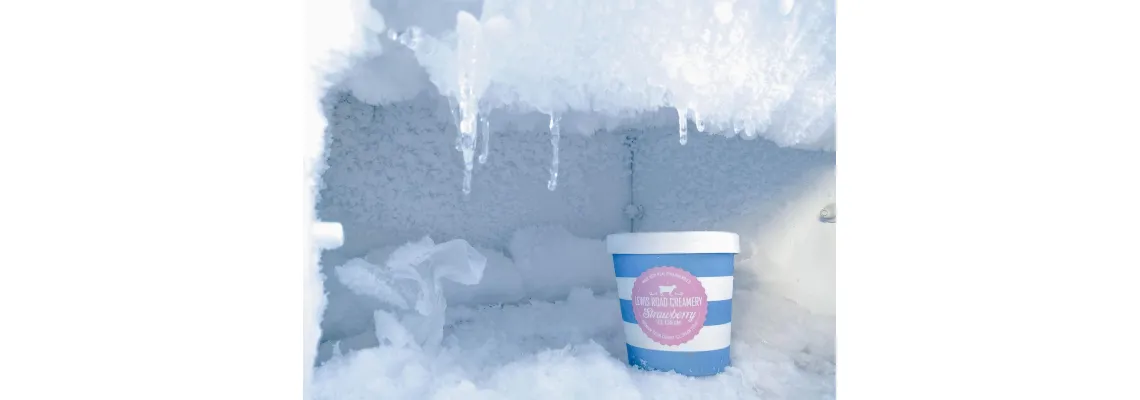
How often should you defrost a freezer — and how to do it right
A layer of ice in the freezer isn't just an inconvenience — it's a silent money leak: higher electricity consumption, less capacity and accelerated compressor wear. In this guide — how often to defrost manual and No Frost units, how to defrost step by step, and why the door gasket is the most important part of the whole process.
The freezer and the fridge's freezer compartment are among the hardest-working units in a professional kitchen — running 24 hours a day, 365 days a year. That is exactly why regular defrosting and maintenance are not a formality but a direct way to protect your products, cut electricity bills and postpone an expensive compressor repair.
In this article we answer the key question — how often — and walk through the entire defrosting process, from moving the products to checking the door gaskets.
Why ice forms in a freezer
Ice comes from the moisture that enters the chamber with air and products. Every time the door opens, warmer and more humid air flows in — the moisture condenses and freezes on the evaporator and chamber walls. Three factors accelerate the process: frequent door opening during intensive work, loading warm or uncovered products, and — most often — a worn door gasket that no longer seals and lets humid air flow in continuously.
How often to defrost — concrete answers
Manual-defrost units
The standard recommendation is to defrost 2–4 times a year — quarterly, or at least every six months. But the calendar is only a guideline: the key criterion is the ice thickness. As soon as a 3–5 mm layer of ice has formed on the walls or the evaporator, defrost regardless of the date. In intensive HoReCa work with frequent door opening that can mean defrosting even once a month.
No Frost units
Units with automatic defrosting (No Frost) defrost themselves — manual defrosting isn't needed day to day. Still, 1–2 times a year they too should be fully switched off, emptied and thoroughly cleaned and disinfected inside. If ice does appear in a No Frost chamber, it signals a technical problem — most often a faulty gasket, defrost heater or sensor — and is a reason to call service.
Signs defrosting is needed right now
A visible ice layer
3–5 mm or thicker frost on the walls, shelves or evaporator — the most reliable signal.
The door closes badly
Ice keeps the door from closing tightly or it “sticks” — the seal is compromised and ice will grow even faster.
The compressor never stops
The unit almost never switches off and hums continuously — ice insulates the evaporator and the motor wears itself out.
The temperature fluctuates
The unit no longer holds the set temperature and products partially thaw — a direct food-safety risk and an HACCP violation.
What ice actually costs you
Ice is an excellent thermal insulator — and that's exactly the problem. A layer of ice on the evaporator acts like a “blanket” that blocks heat transfer: to hold the temperature, the compressor has to run longer and more often. As a result electricity consumption rises by up to 30 %, the chamber's usable capacity shrinks, and the compressor — the most expensive part of the unit — wears out prematurely. Unstable temperature also endangers product quality and is a direct HACCP violation that can cost more at an inspection than the repair itself.
Defrosting step by step
Move the products
Transfer frozen goods to another freezer or thermo boxes with ice packs. Plan the defrost for when stocks are lowest — for example, just before a delivery day.
Disconnect the unit from power
Switch the unit off and unplug it. Open the door and let the ice melt naturally. You can speed things up with a bowl of hot (not boiling) water inside, replaced from time to time.
Collect the meltwater
Place towels and a shallow tray at the base of the chamber. If the unit has a drain hole, make sure it isn't clogged — a blocked drain is a common cause of water leaks.
Clean and disinfect
Wash the chamber, shelves and drawers with a mild cleaner suitable for food equipment. Don't forget the drain hole and the door-gasket grooves, where dirt and mould accumulate.
Check the gasket
While the chamber is empty, inspect the door gasket — cracks, deformation, stiffness or mould mean it needs replacing. The test is described in the next section.
Dry and switch on
Dry the chamber thoroughly, switch the unit on and let it reach working temperature (usually 2–4 hours). Only then return the products — a warm chamber with products means fresh condensation and immediate icing.
Never scrape ice off with a knife or other sharp objects! One careless jab into the evaporator means a refrigerant leak and a repair that can cost more than half the price of a new unit. Likewise, don't use an open flame or a heat gun right next to the ice — heat can deform plastic parts and gaskets. Only time, a bowl of warm water and a plastic spatula will do.
The door gasket — the key part in the fight against ice
A worn gasket is the most common reason a freezer ices up again and again, no matter how often you defrost it. Through a leaky seal, humid air flows into the chamber continuously — the unit runs non-stop, ice grows visibly and the electricity bill climbs. Rubber loses elasticity over time, cracks and deforms — natural wear that can't be prevented, only spotted in time.
A simple seal test: close the door on a sheet of paper between the door and the body. If the sheet pulls out without resistance — the gasket no longer seals at that point. Repeat the test at several points around the whole door perimeter. Clean the gasket regularly with warm soapy water — dirt and grease accelerate rubber ageing.
Replacing a gasket is cheap and quick prevention compared with the consequences of ignoring it. The YOUR HORECA spare-parts department stocks door gaskets for both bar and kitchen refrigeration equipment — even for discontinued models we can match or produce a suitable solution.
The complete maintenance schedule for refrigeration equipment
| Task | Frequency | Notes |
|---|---|---|
| Cleaning outer surfaces and handles | Every day | A hygiene requirement in a busy kitchen |
| Checking and cleaning the interior and shelves | Every week | Spills and product residues — immediately |
| Gasket cleaning and paper test | Once a month | Warm soapy water, test around the whole perimeter |
| Cleaning dust off the condenser | Every 1–3 months | A dusty condenser = an overheating compressor |
| Full defrost and disinfection | 2–4× a year | Or as soon as the ice layer reaches 3–5 mm |
| Preventive service maintenance | Once a year | Refrigerant, thermostat, compressor, electrical safety |
When cleaning no longer helps — time for service
If the unit ices up within days of defrosting, won't hold temperature, makes unusual noises or water appears underneath, the problem is no longer maintenance — most likely a faulty thermostat, defrost heater or fan, a blocked drain or a refrigerant leak. Keeping the unit running in this state risks losing your products and destroying the compressor completely.
YOUR HORECA service with over 25 years of experience diagnoses and repairs refrigeration equipment, and our warehouse stocks spare parts — from gaskets to compressors — for all leading manufacturers' equipment.
Spare parts for refrigeration equipment in the YOUR HORECA range
Door gaskets
Gaskets for bar and kitchen refrigeration equipment — the key part for a tight seal and protection against icing. We also match older models.
View spare parts →Thermostats and sensors
If the unit won't hold temperature or the compressor never stops, the thermostat is often the culprit — not the compressor.
View spare parts →Compressors for fridges and freezers
Compressors of various capacities and manufacturers — with advice on compatibility with your exact model.
View spare parts →Fans and evaporators
Even cold distribution in the chamber — a broken fan is a common cause of local icing and temperature swings.
View spare parts →If your kitchen has only one freezer, every defrost becomes a logistics challenge. Consider a backup unit or a set of thermo boxes with ice packs — it not only makes maintenance easier but also protects your products in an unexpected breakdown.
✓ Spare parts from stock
Gaskets, thermostats, compressors and other parts — without a long wait.
✓ Fast delivery across the Baltics and Europe
Courier or freight transport, flexible logistics solutions on request.
✓ Service with 25+ years of experience
Diagnostics, repairs, preventive maintenance and spare parts in one place.
Refrigeration service and spare parts in one place
YOUR HORECA provides full care for refrigeration equipment — preventive maintenance, diagnostics, repairs and spare parts from a single supplier. If your freezer ices up too fast, won't hold temperature, or you simply want to put a maintenance schedule in order — our specialists will help.