See also the Cold Serving Zone for a wider range of equipment — BHS provides a complete cold zone setup for fuel stations across Europe.
Refrigeration chambers for fuel stations — a refrigeration chamber is an infrastructure element, not front-room equipment; it ensures that the fuel station’s front-room refrigerators are always fully stocked and staff do not waste time on frequent small-scale replenishments.
Modular refrigeration chamber — what it is and how it works
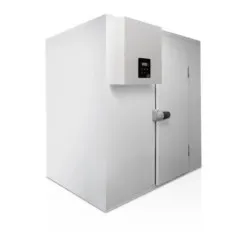
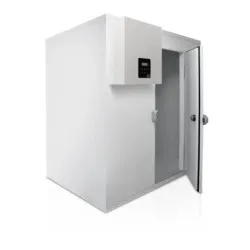
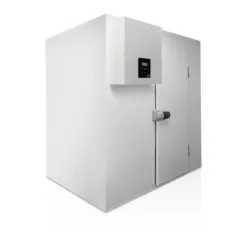
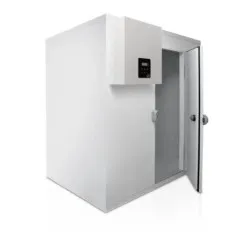
Refrigeration chambers for fuel stations — a modular refrigeration chamber is an assemblable chilled space constructed from panels. Panel system — the chamber is made from 80–120 mm thick polyurethane panels with a metal cladding; the panels are modular — a chamber can be created in any size; installation time 1–3 days. Cooling unit — the refrigeration unit is installed on a wall or roof; outdoors or indoors; it maintains a temperature of +2°C–+8°C in a positive-temperature refrigeration chamber; see Refrigerators for Fuel Stations. Door system — sliding or hinged doors; doors must seal tightly to prevent cold air loss; an internal safety lock is mandatory. Lighting — internal LED lighting; energy-saving feature — it switches off when no one is in the room.
Use of refrigeration chambers in a fuel station
Refrigeration chambers for fuel stations — a refrigeration chamber in a fuel station serves several functions that facilitate daily operations. Beverage stock storage — beverage crates are stored in the chamber at a temperature of +4°C–+8°C; staff transfer products from the chamber to the front-room refrigerators; it saves energy compared to storing beverages in an unheated storage room. Food reserves — ready-to-serve snacks, dairy products, fresh sandwiches; the chamber ensures storage in larger volumes; see Freezers for Fuel Stations. Receiving deliveries — when a large delivery arrives, everything is placed directly in the chamber; products are stored in the chamber, and staff transfer the required quantities. Seasonal stocks — before the summer peak, the station prepares a large stock of ice cream and beverages in the chamber.
Installation requirements and record-keeping
Refrigeration chambers for fuel stations — installing a refrigeration chamber requires careful planning. Space requirements — the chamber needs a floor with sufficient load-bearing capacity; ventilation in the room where the unit is placed; a power connection, three-phase or single-phase (depending on the unit). Mandatory requirements — HACCP documentation (temperature logging); an internal safety lock (for employee safety); emergency lighting; see Cold Serving Zone. Record-keeping and documentation — temperature measurement and logging at least twice a day; a HACCP protocol for product receipt, storage and transfer. Air circulation — shelves and crates must be spaced to ensure air circulation around the products; an overfilled chamber cools unevenly.
Planning the size of a refrigeration chamber for a fuel station
Refrigeration chambers for fuel stations — the right chamber size is an economically important decision. Small chamber (2–6 m²) — suitable for a medium-sized fuel station with an average beverage turnover; fits in a storage corner; low installation costs. Medium chamber (6–12 m²) — for large stations or stations with a wide range; can store a week’s stock at once; see Refrigerators for Fuel Stations. Large chamber (12–30 m²) — for motorway stations or stations with an extensive food range; can store large-volume deliveries. Investment vs savings — a larger chamber means larger purchase orders and better prices from suppliers; the savings can cover the chamber’s costs. BHS helps plan the right chamber size.
Frequently asked questions
How long does it take to install a modular refrigeration chamber in a fuel station? Refrigeration chambers for fuel stations — a standard modular refrigeration chamber (4–8 m²) is installed in 1–2 days; larger chambers — 3–5 days; after installation, the chamber reaches operating temperature in 4–12 hours; contact BHS for details; see Cold Serving Zone.
Can a refrigeration chamber operate outdoors? Refrigeration chambers for fuel stations — yes; specially insulated refrigeration chambers are designed for outdoor installation; they must have additional protection against moisture and temperature fluctuations; see Freezers for Fuel Stations.
Why choose BHS?
BHS – Baltic HoReCa Solutions supplies professional equipment for restaurants, cafés, hotels and canteens: more than 20,000 products from many manufacturers. Our specialists help you choose the right equipment and spare parts for your kitchen or bar.
Delivery
We deliver across the European Union. Delivery time and cost depend on the order volume and destination — contact the BHS team for an exact price and lead time.