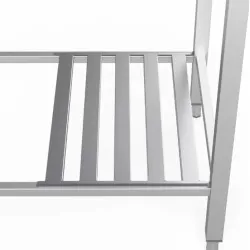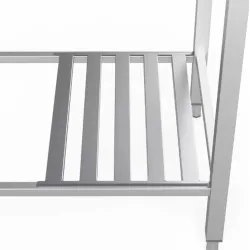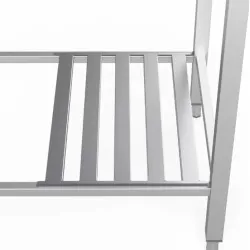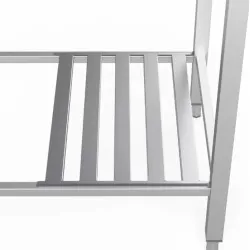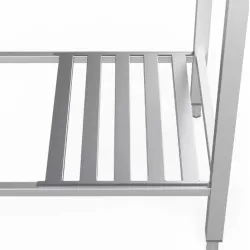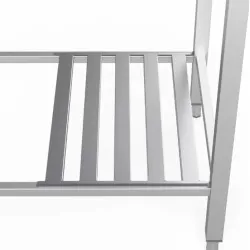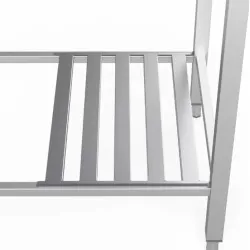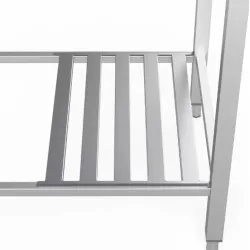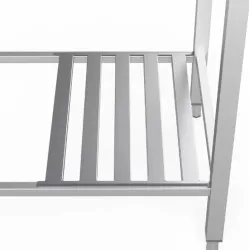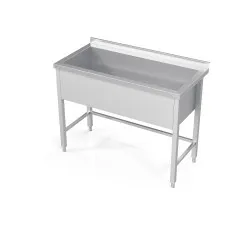
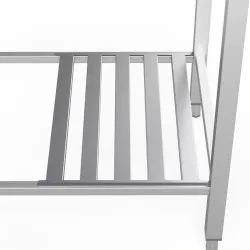
A pot sink with frame is professional stainless steel kitchen equipment featuring a deep basin for washing pots and a simple open-frame base — a straightforward, easy-to-clean configuration without a storage shelf. The deep basin provides ample capacity for washing large pots, roasting pans and other oversized kitchen utensils. The open-frame base ensures stable support while keeping the space underneath free, which simplifies daily cleaning beneath the unit. The durability of stainless steel and its ease of disinfection make this model a suitable solution for intensive use in HoReCa kitchens. BHS offers pot sinks with frame as part of its Work Tables with Sinks and Basins range to HoReCa businesses across Europe.
See also the pot sink with shelf. BHS helps kitchens choose the most suitable pot sink based on utensil sizes and kitchen space configuration.
A pot sink with frame is professional washing equipment with a deep basin designed for the efficient washing of large-format kitchen utensils — pots, pans, frying pans and other large items. The frame base provides an open and easy-to-clean structure.
Use of pot sinks in the kitchen
Washing pots is one of the most demanding kitchen tasks — large pots and pans require deep sinks where they can be fully submerged under water. A standard sink is often not deep or wide enough for this purpose. A pot sink with a deep basin is specifically designed for washing and rinsing such large items. Professional kitchen chef teams appreciate pot sinks as an efficient solution for handling large kitchen utensils.
Advantages of the frame base
The frame base is the simplest and lightest configuration — without a shelf or doors. The space underneath remains free, making daily cleaning under the equipment easier. The open space ensures good air circulation, which helps reduce moisture build-up and the risk of mould in a damp kitchen environment. Compared to a pot sink with shelf, the frame version is lighter and requires fewer materials.
Durability of stainless steel
A pot sink is subjected to intensive daily use — hot water, heavy equipment and cleaning chemicals. Stainless steel is the only suitable material for such conditions — resistant to corrosion, scratches and deformation under heavy loads. The sink is safe for food contact and complies with food industry hygiene regulations. With proper maintenance, a stainless steel pot sink will last for decades in an intensive commercial kitchen.
Large kitchens and canteens
In large canteens, hotels and restaurants with a high number of meals served daily, a pot sink is one of the essential elements of the washing area. Large pots, stockpots and frying pans are washed several times a day, which requires a specialised deep sink. A separate pot washing area speeds up workflow, as large utensils do not interfere with standard dishwashing. The largest canteens and restaurants use pot sinks as an integral part of their washing area.
Water systems and connections
A pot sink requires a water supply with sufficient pressure to ensure quick filling of the deep basin. The drain pipe must be large enough to handle the volume of water released when the deep basin is emptied. Limescale deposits in hard water conditions can form on the inner surfaces of the sink and in the drainage system — regular descaling is recommended.
Choosing the right size
Pot sinks are available in various basin sizes depending on the volume of kitchen utensils. Larger basins are more suitable for large restaurants and canteens where large-format pots are washed regularly. BHS helps choose a pot sink based on kitchen space configuration and utensil sizes.
Pot sinks and HACCP regulations
For food industry businesses, HACCP principles require that utensil washing be carried out according to a defined procedure. A pot sink can be included in a three-stage washing system as a specialised element for washing large-format utensils. Larger kitchen equipment — such as pots, wok pans and baking trays — cannot be placed in standard dishwashers, so a pot sink is the only way to process this utensil in compliance with hygiene regulations. BHS provides advice on configuring a washing area in compliance with HACCP.
Pot sink vs. standard dishwasher
A standard dishwasher effectively processes medium and small-sized dishes, but large pots and pans cannot be placed in its mechanisms. A pot sink is a manual washing solution that complements a dishwasher for processing large-format utensils. The deep basin ensures that a pot can be completely filled with washing solution and soaked if necessary. This combination — a dishwasher for small dishes and a pot sink for large items — is the optimal washing area configuration for large kitchens.
Installation and maintenance
A pot sink is connected to a water supply with sufficient pressure to ensure quick filling of the deep basin. The drain pipe must be large enough to empty the basin after washing. The steel surface is cleaned with specialised stainless steel cleaning products to prevent limescale build-up and maintain an attractive appearance.
Frequently asked questions
What is the typical basin depth of a pot sink?
Pot sinks usually have 40–50 cm deep basins, unlike standard 30 cm. BHS provides specific sizes.
Is a pot sink with a frame better than a model with a shelf?
A frame is easier to clean under the sink, while a shelf provides additional storage. BHS helps with the choice.
Why choose BHS?
BHS – Baltic HoReCa Solutions supplies professional equipment for restaurants, cafés, hotels and canteens: more than 20,000 products from many manufacturers. Our specialists help you choose the right equipment and spare parts for your kitchen or bar.
Delivery
We deliver across the European Union. Delivery time and cost depend on the order volume and destination — contact the BHS team for an exact price and lead time.