


Workplace safety · HACCP · Protective gloves
Protective gloves at work: which gloves to wear at the knife, the oven, the sink and with food
In a kitchen the hands are the main tool, and they are also what gets hurt most often: a cut from a knife or slicer, a burn from an oven tray, skin irritation from detergents. At the same time a glove can do harm when it is worn the wrong way and starts carrying bacteria. This article sorts out which glove fits each task, how to read the marking on the pack, what health and safety and food hygiene rules require, and what a full set costs for a small kitchen.
F
the highest cut resistance class under EN 388 — at least 30 N
15 s
how long a heat glove must withstand contact with a hot surface at each level
4
main risks to the hands: cuts, heat, chemicals and food contamination
Contents
- Short answer: which glove for which task
- How to read the marking: EN 388, EN 407, EN ISO 374
- Materials: nitrile, latex, polyethylene, leather, steel
- Food safety and HACCP: gloves do not replace hand washing
- What health and safety rules require
- Restaurant, takeaway, canteen, production
- Choosing and a simple calculation
- Correct use, care and common mistakes
- Service, equipment cleaning and maintenance
- Protective gloves in our range
- Frequently asked questions
01 Short answer: which glove for which task
There is no universal kitchen glove. You choose a glove not by job title but by what the hand is doing at that moment. One chef may change three types of gloves during a shift.
Knife, slicer, meat, fish
Oven, grill, fryer, pots
Dishwashing and cleaning
Cold kitchen and service
The key idea
02 How to read the marking: EN 388, EN 407, EN ISO 374
The marking on professional gloves is small but very informative. Pictograms with numbers and letters appear on the glove or the pack. General requirements for all protective gloves (sizes, dexterity, skin safety, marking) are set by EN ISO 21420, while the other standards describe a specific risk.
- EN 388 (mechanical risks) — shield with a hammer; four digits (abrasion, cut by rotating blade, tear, puncture), a letter A–F (cut to ISO 13997) and P if there is impact protection; What it means: knives, slicers, mandolines, bones
- EN 407 (thermal risks) — shield with a flame; six values, the second — contact heat — matters most in a kitchen; What it means: ovens, grills, fryers, hot pans
- EN ISO 374-1 (chemicals) — flask; type A, B or C and letters under the pictogram showing which chemicals were tested; What it means: detergents, disinfectants, oven cleaners
- EN ISO 374-5 (micro-organisms) — biohazard sign; the word VIRUS if the glove was also tested against viruses; What it means: raw meat, eggs, waste
- Food contact — glass and fork symbol; the material must comply with the EU regulation on materials in contact with food; What it means: any glove that touches food
Cut resistance to EN ISO 13997 (the letter on the EN 388 shield)
| Level | Force needed to cut and a kitchen example |
|---|---|
| A | at least 2 N — minimal protection, light vegetable peeling |
| B | at least 5 N — small sharp objects, opening packaging |
| C | at least 10 N — cutting vegetables, mandolines, graters |
| D | at least 15 N — intensive knife work, cleaning slicers |
| E | at least 22 N — meat and fish processing |
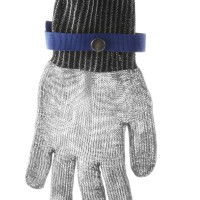
| F | at least 30 N — boning and butchery; our stainless steel chain mail gloves are rated in this class |
Contact heat to EN 407
| Level | Temperature the glove withstands for at least 15 seconds |
|---|---|
| 1 | 100 °C — steam, hot items from the dishwasher |
| 2 | 250 °C — oven trays, GN pans, ovens |
| 3 | 350 °C — pizza oven peels, grill grates |
| 4 | 500 °C — rare in kitchens, special tasks only |
Reading an example
03 Materials: nitrile, latex, polyethylene, leather, steel
The material decides how nimble the fingers are, how long the glove lasts and whether it is suitable for food contact.
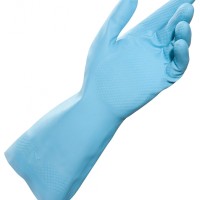
- Nitrile — resists oil, grease and many detergents well, no latex proteins; Pros: costs more than polyethylene; Cons: raw meat, dishwashing, cleaning; long sleeve for deep sinks
- Latex (natural rubber) — elastic, good sense of touch; Pros: can cause allergy in staff or guests affected by latex proteins; Cons: cleaning and dishes if nobody is allergic
- Vinyl (PVC) — cheap, latex-free; Pros: less durable, tears sooner; Cons: short simple tasks
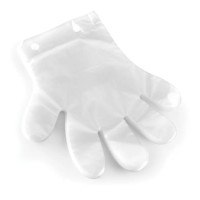
- Polyethylene — very cheap, quick to put on, one size; Pros: loose, slips, tears easily; Cons: sandwiches, service, portioning
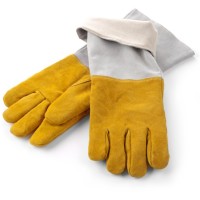
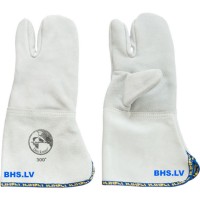
- Leather, aramid, silicone — protect against contact heat; Pros: wet fabric and leather conduct heat; Cons: ovens, grills, fryers
- Stainless steel chain mail — highest cut resistance, washable and can be disinfected; Pros: does not stop stabs from a narrow blade and is not for rotating machines; Cons: boning, meat, fish, oysters
A wet heat glove is dangerous
04 Food safety and HACCP: gloves do not replace hand washing
The EU food hygiene regulation requires staff to keep a high degree of personal cleanliness, but it does not make gloves mandatory for every task. Gloves are one way to reach that level of hygiene, and they belong in the HACCP plan. The most common mistake is to think a glove is clean by itself.
- Wash and dry hands before putting gloves on. Dirty hands contaminate the outside of the glove while you pull it on.
- A glove collects bacteria as fast as skin. Touch a phone, money or a door handle and it is dirty.
- For ready-to-eat food that will not be cooked again, use gloves or utensils (tongs, spatulas), not bare hands.
- Cover a cut on the hand with a waterproof, highly visible plaster and wear a glove over it.
- Colour coding helps keep raw meat away from ready food, just like coloured boards and knives.
- Latex allergy is a real risk for staff and guests. Many kitchens therefore choose nitrile or polyethylene.
When disposable gloves must be changed
- when moving from raw food to ready food;
- after handling foods containing allergens;
- after the toilet, smoking, a break or taking out rubbish;
- after touching the face, hair, a phone or money;
- if the glove is torn, punctured or very dirty;
- regularly during long tasks — set the frequency in your HACCP plan.
About food inspections
05 What health and safety rules require
Health and safety rules look at the glove from the other side — it protects the worker. The basic principle: first remove the risk with equipment and work organisation, and use personal protective equipment only where that is not possible.
- Safety, Health and Welfare at Work Act 2005 — the employer assesses risks, prepares a safety statement and provides protective equipment; What it means: list cut, burn and chemical risks in the risk assessment
- General Application Regulations 2007 (PPE chapter) — set out how PPE is chosen, provided, maintained and used, with training and information for staff; What it means: the right glove for each task, clear instructions, care and replacement
- EU regulation on personal protective equipment — gloves must carry the CE mark and a declaration of conformity; they fall into categories I, II and III by risk; What it means: buy certified gloves, not household gloves for chemicals
- EU regulation on food contact materials — a glove that touches food must not transfer harmful substances to it; What it means: look for the glass and fork symbol
Workplace safety is enforced by the Health and Safety Authority (HSA); food hygiene by HSE Environmental Health and the FSAI. Legislation changes; check the current version before making decisions.
06 Restaurant, takeaway, canteen, production
Risks and glove consumption differ by format.
Restaurant
Takeaway and fast food
Canteen and central kitchen
Production, butcher, catering
Restaurant — common mistake
Takeaway — common mistake
Canteen — common mistake
Production — common mistake
07 Choosing and a simple calculation
Five questions help with the choice.
- Risk — cut, heat, chemicals or food hygiene — and the matching standard on the marking
- Level — for cuts the letter A–F, for heat the contact level, for chemicals the type and the specific substances
- Size — the glove must not be loose at the fingertips or tight; choose chain mail by palm circumference
- Length — deep sinks and fryers need a long cuff or sleeve
- Care — whether the glove can be washed and disinfected, how to dry it and when to discard it
A simple calculation: a full set versus one injury
Assumption: a small kitchen with 3–4 staff. The set covers all four risks and includes a stock of disposable and rubber gloves for the first months.
Set total: €207.80
Comparison
08 Correct use, care and common mistakes
How to put on and take off disposable gloves correctly
- Wash and fully dry your hands.
- Take the glove by the cuff and pull it on without touching the rest of the surface.
- Work on one task only; when the task changes, change gloves.
- To remove, pinch one glove at the cuff from the outside and peel it off inside out.
- Slide the fingers of the bare hand under the cuff of the other glove and peel it off over the first.
- Throw them in the bin and wash your hands.
Care and storage
- Steel chain mail gloves: rinse after work, wash with detergent and a brush, disinfect as the manufacturer instructs and let dry. Check for damaged rings and that the strap holds firmly.
- Leather and fabric heat gloves: store dry, away from steam; dirt and grease reduce protection. Replace if the surface is hard, cracked or thin.
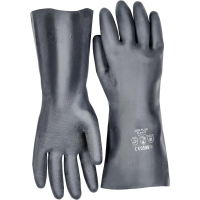
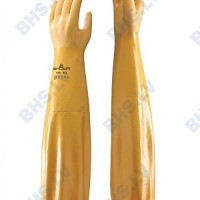
- Rubber gloves: rinse the outside after work, dry and store cuff down. A sticky, swollen or cracking surface means chemicals are already damaging the material.
- Disposable gloves: keep in the box, away from heat and direct sunlight; never wash or reuse them.
Common mistakes
- Burn through an oven glove — the glove is wet or greasy; Cause: two pairs per shift, a dry pair always at the oven
- Cut despite a cut-resistant glove — glove on the wrong hand or too big; Cause: glove on the hand holding the product, size by palm
- Skin irritation, itching — latex allergy or moisture inside; Cause: nitrile, cotton liner, hand cream after the shift
- Hair or fluff in food from a glove — a disposable glove reused; Cause: a new glove for each task
- Glove caught in a slicer or mixer — protective gloves at rotating machines in operation; Cause: use a pusher and guard during operation; chain mail only for cleaning with power disconnected
What it looks like in practice
09 Service, equipment cleaning and maintenance
Many injuries happen not while cooking, but while cleaning and servicing equipment: removing a slicer blade, changing fryer oil, cleaning ovens with alkaline products, dismantling a mincer. For these jobs the glove matters as much as the instructions.
BHS service — 24/7, on site
If a machine is faulty, do not try to fix it with gloves and improvisation. Our technicians diagnose, adjust and replace parts on site, and spare parts are stocked at our warehouse in Riga. Delivery across the Baltics and Europe.
24/7
+371 25 522 233
On site
service visits
Warehouse
Riga, Vagonu iela 23
20+ years
HoReCa experience
Slicer and mincer
Fryer and grill
Oven and chemicals
Dishwasher
| When | What to check |
|---|---|
| Daily | stock of disposables at every workstation, heat gloves dry and in place |
| Weekly | condition of rubber gloves, chain mail rings and straps |
| Monthly | surface and seams of heat gloves, correct sizes for new staff |
| Yearly | review the risk assessment and HACCP plan, update the glove list |
10 Protective gloves in our range
Protective gloves used every day in professional kitchens. Full range in the protective gloves category.
505053
€2.60
About 0.7 mm thick, about 320 mm long, flocked cotton inside. Also available in size S.
View product →BHS-772
€22.40
Cotton lined, good grip, resistant to chemicals, oils and grease. Size 10.
View product →556665
€29.50
Stainless steel outer, HPPE liner, cut resistance F, approved for food contact. Set of 2 gloves.
View product →556672
€29.50
18/8 steel chain mail outer and polyester inner, fits either hand, cut resistance F.
View product →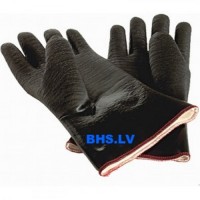
Prices excl. VAT, October 2026. Check the product page for current price and availability.
11 Frequently asked questions
Must a chef wear gloves all the time
What cut level is needed for knife work
Nitrile or latex gloves for food
Can a cut-resistant glove be worn at a slicer
Why a burn through a heat glove
Who pays for protective gloves
How to clean a steel chain mail glove
Get hand protection right across the kitchen
Tell us what tasks happen in your kitchen and BHS will help match gloves to risks, sizes and your HACCP plan. Delivery across the Baltics and Europe.
Related articles
Disclaimer: this article is for information only and is not legal advice. Standard levels are general guidance; the protection of a specific glove is set by the manufacturer's marking and instructions, and the rules of use by your workplace risk assessment and HACCP plan. Legislation changes. Calculation assumptions are illustrative — calculate with your own data. 'What it looks like in practice' describes a typical situation, not a specific customer case. Prices excl. VAT, October 2026.