

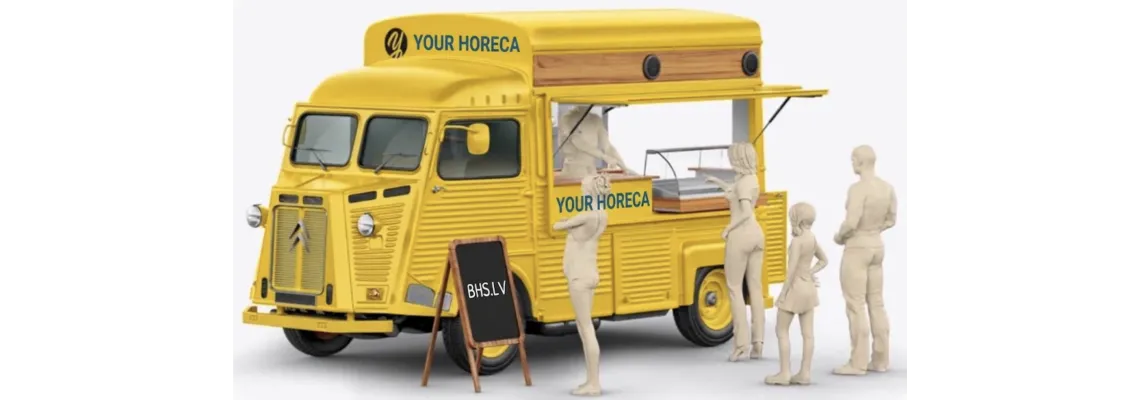
Street food · Food trucks and kiosks
How to equip a food truck or street food kiosk
A food truck is a restaurant in 8–12 square metres that drives on the road, works in rain and sun and sometimes plugs into a single 16 A socket. So every kilogram, kilowatt and centimetre counts. In this article: how to choose the format, what permits you need, which cooking, refrigeration and frying equipment to fit, how to plan stainless steel furniture, ventilation, water and hygiene, how to calculate power and how to lay out the work area in a tight space.
6.1 kW
equipment power in our example — already more than one 16 A socket
750 kg
trailer gross weight usually towable on a B licence — including water and stock
24/7
BHS service, maintenance and spare parts from our Riga warehouse
Contents
- Food truck, trailer or kiosk: what to choose
- Permits and registration
- Choosing professional cooking equipment
- Frying, grilling and griddle equipment
- Compact refrigerators and freezers
- Stainless steel furniture and worktops
- Ventilation, water supply and hygiene requirements
- Electricity, gas and the power budget
- Efficient work area layout in a limited space
- The first festival: a story and common mistakes
- The kit and a simple calculation
- BHS service, maintenance and spare parts
- Food truck equipment in the BHS range
- Frequently asked questions
01 Food truck, trailer or kiosk: what to choose
A street food business is defined by three things: where you will sell, how many portions an hour you need and what your vehicle can tow. The format decides everything else — power, weight, water tank size and permits.
Food truck (van)
A kitchen on a vehicle chassis — quick to set up, but more expensive, and when the van is in the garage so is the kitchen.
Trailer up to 750 kg
A low-cost start, towable on a B licence, but little weight margin — every appliance has to be weighed.
Heavier trailer
More space and equipment; needs a BE or B96 licence or a powerful towing vehicle.
Kiosk or container
Stays in one place, can connect to water and power — closer to a small café.
Market or festival stall
Gazebo, tables and portable equipment — for the season and events.
Carts and bikes
Coffee, ice cream, hot dogs — minimal menu, minimal power.
We don't just sell — we service too
BHS designs food truck layouts, builds trailers and stainless steel furniture, installs equipment and then repairs it in its service workshop in Riga. There is a maintenance contract, spare parts in stock in Riga with delivery across the Baltics and Europe, and customer service 24/7.
Call: +371 25 522 233ServiceSpare parts
02 Permits and registration
Before you start trading you will usually need:
- Food business registration — in Ireland with the HSE Environmental Health Service; a mobile food unit is a food business, and HACCP principles and hygiene training apply.
- A trading licence or permission — for public places, typically a casual trading licence or permit from the local authority; at private sites and events, the landowner's or organiser's consent.
- Vehicle registration and roadworthiness — for the van and the trailer, plus the right driving licence category.
- Customer information — business name and contact details visible, allergen information available.
- Gas and fire safety — certified connections, a fire extinguisher, a fire blanket.
A tip from practice
Ask the event organiser about power, water and waste water before signing the contract — not on the day. And keep copies of your registration, permits and temperature records in the vehicle; inspections at events are common.
This is general information, not legal advice. Check the specific requirements with your local authority and the HSE.
03 Choosing professional cooking equipment
The menu decides the equipment, not the other way round. The best food trucks work with 3–5 dishes that can be made in 2–4 minutes with 2–3 appliances.
- Portions per hour — how fast the appliance recovers temperature after loading; queues won't wait more than a few minutes
- Power — kW and voltage — 230 V or 400 V; total power must match the supply or generator
- Weight and size — every kilogram reduces stock and water capacity; countertop units suit better than floor units
- Movement — appliances fixed to the worktop, oil and water emptied or sealed for driving
- Cleaning — removable trays, smooth surfaces, washable parts — the working day ends late
- Service — spare parts and a service team that knows the appliance — downtime in season costs most
Electricity (230/400 V)
clean, quiet, easy to clean, no gas cylinders
needs a strong supply or a generator
LPG
high power without electricity, heats fast
cylinders, certified connection, ventilation, fire safety
Combined
gas for hot equipment, electricity for cooling and lights
two systems to maintain
04 Frying, grilling and griddle equipment
The hot line is the heart of a food truck. Choose appliances that work in parallel and don't take each other's space:
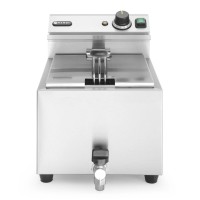
- Fryer — fries, nuggets, churros; Example: HENDI Profi Line 8 l with drain tap, 3.5 kW, 230 V, 305×515 mm
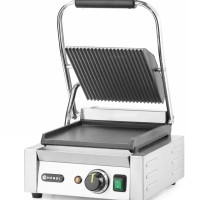
- Contact grill — paninis, sandwiches, meat; Example: HENDI 263600, 1.8 kW, plate 220×230 mm, 50–300 °C
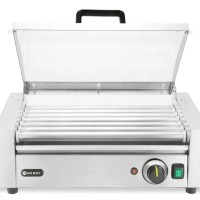
- Hot dog grill — sausages on rollers; Example: HENDI 268636, 7 rollers, 0.62 kW
- Flat griddle — burgers, eggs, vegetables; Example: electric or gas — chosen by burgers per hour
- Crêpe maker — pancakes, crêpes; Example: one plate per cook
- Induction wok — Asian dishes; Example: countertop 230 V model — more in our article on WOK equipment
Frying on wheels — safety rules
- Drain the oil into a sealed container before driving — a full fryer on the move is dangerous.
- A fryer with a drain tap lets you empty oil without lifting.
- Keep a Class F extinguisher and a fire blanket by the hot line; never use water on an oil fire.
- Don't place the fryer next to an open flame or right at the serving hatch.
05 Compact refrigerators and freezers
Refrigeration in a food truck works harder than in a kitchen: a hot metal body, sun, doors opened constantly, and transport.
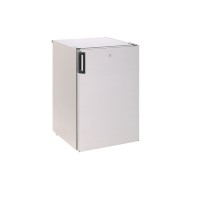
- Under-counter fridge — e.g. GORT 90 l (−1…+10 °C, 540×580×800 mm, 0.06 kW) fits under a 600 mm deep worktop.
- Compact freezer — TEFCOLD CF78 (72 l, −22…−12 °C, 0.124 kW) for fries or ice cream.
- Climate class — in summer it can reach +35 °C or more inside; choose equipment designed for warm surroundings and keep air flowing around the compressor.
- Transport — load products already chilled and switch on the fridges before loading; for longer drives, 12 V or generator power.
- Thermometer — in every fridge, with temperatures recorded; at street food stands this is one of the most common problems found.
| Product | Temperature (approx.) |
|---|---|
| Raw and minced meat | 0…+4 °C |
| Sauces, dairy, salads | up to +4…+6 °C — per label |
| Frozen fries and products | −18 °C or below in storage |
| Hot food held for service | above +63 °C |
06 Stainless steel furniture and worktops
Stainless steel is the food truck standard: it can be washed with hot water and disinfectants, doesn't rust and doesn't absorb odours.
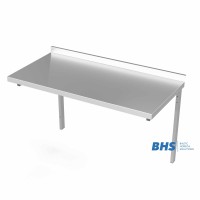
- Wall-mounted tables — Novameta 800 mm wall-mounted (800×600×750 mm, up to 120 kg on top and shelf) frees the floor and stays stable on the road.
- Height — worktop at roughly 85–90 cm; fridges and drawers underneath, shelves with lips above.
- Edges and corners — rounded corners and a raised back edge so nothing falls off while driving and water doesn't run down the wall.
- Fixing — bolt down all equipment and furniture; doors and drawers with latches.
- Made to size — BHS builds stainless steel furniture to individual designs to use every centimetre.
07 Ventilation, water supply and hygiene requirements
Ventilation
- Above the hot line — an extraction hood with baffle grease filters overhanging the appliances on all sides; more in our article on kitchen hoods.
- Make-up air — an opening window or vent; without it the hood won't draw.
- With gas appliances — permanent ventilation and, ideally, a gas leak detector.
- Wash grease filters every working day or after each event.
Water supply
- A fresh water tank with potable water and a waste water tank — the waste tank should not be smaller than the fresh one.
- A pump and, if possible, a water heater — hands and utensils wash better in warm water.
- A separate hand basin, not the utensil sink; if there's no space — a mobile touchless station or a Neumarker basin with a 12 l tank.
- Empty waste water into the sewer, never onto the ground or a street drain.
Hygiene
- Raw and ready-to-eat food apart — separate colour-coded boards and containers.
- Money and food — if possible, two people; if not, wash hands or change gloves after each payment; contactless payments help.
- Cleaning schedule and temperature records — HACCP works on wheels too.
- Waste — a lidded bin; used oil goes for recycling, never down the drain.
08 Electricity, gas and the power budget
The most common problem in the first season isn't the menu but electricity. Add up the power of all appliances before you buy.
| Appliance | Power |
|---|---|
| Fryer 8 l | 3.5 kW |
| Contact grill | 1.8 kW |
| Hot dog grill | 0.62 kW |
| Fridge 90 l | 0.06 kW |
| Freezer 72 l | 0.124 kW |
| Total | 6.1 kW |
- Current — 6.1 kW at 230 V is about 26.5 A. A standard 16 A socket won't cope: you need a 32 A single-phase or 400 V three-phase supply, or to split the appliances across circuits.
- At festivals the organiser usually offers a CEE 16 A or 32 A connection — find out before the contract, not on the day.
- Generator — with headroom above total power (in our example at least about 7.6 kW), inverter type — quieter and safer for electronics; placed outside the work area, exhaust away from windows.
- Gas — cylinders in a separate ventilated compartment, certified hoses and regulators, leak test; connection by a registered gas installer.
- Cables — outdoor-rated only, no extension leads left coiled on reels; more in our article on kitchen electrical power.
09 Efficient work area layout in a limited space
A food truck work area is a line, not a triangle. Food moves in one direction — from cold to hot, from hot to the hatch.
- Storage — fridge and freezer under the worktop at the start of the line.
- Preparation — a worktable with a board and GN containers.
- Cooking — the hot line under the hood, appliances 5–10 cm apart.
- Assembly — space for packaging, sauces and napkins by the hatch.
- Serving and payment — the hatch, with the card terminal, if possible, on the other side from serving.
- Aisle roughly 80–90 cm — two people can pass without touching anything hot
- One person — one zone — the cook doesn't stand at the hatch, the cashier doesn't touch raw meat
- Vertical storage — shelves with lips, magnetic knife holders, hooks
- Most-used items within arm's reach — every step in a tight space costs seconds in the queue
- Hand basin by the prep area — wash hands where you handle raw food
Design before you buy
BHS offers a food truck design drawing: designers and technicians develop or improve the project, choose equipment and fit the furniture. Moving the line on paper is cheaper than moving a welded table. An example from practice — the BHS Kebab Factory bus: the whole kitchen custom-planned to the bus dimensions.
10 The first festival: a story and common mistakes
This is a typical case of the kind BHS sees at the start of the season.
Story: “The first festival”
Conor opened a burger trailer and drove to his first summer festival. At home everything worked: fryer, griddle, fridge. At the event, the organiser provided a single 16 A socket. Five minutes in, the breaker tripped — and the queue stood still.
Conor switched off the griddle, cooked only fries and an hour later borrowed a generator from a neighbouring stall. After the festival he worked out the power budget with BHS, split the appliances across two circuits and booked a 32 A connection for the next events.
The second lesson was water. The waste tank was smaller than the fresh one and full by mid-evening. Now both tanks are the same size and the waste tank is emptied at every break.
- Power not added up — breakers trip, appliances stand idle; Solution: power budget and supply before buying
- Trailer over its permitted weight — fines, overloaded brakes and tyres; Solution: weigh it with water, gas and stock
- Domestic appliances — can't take the load, fail mid-season; Solution: professional equipment with service and spare parts
- No hand basin — inspection remarks, risk to customers; Solution: a separate basin or a mobile station
- Weak ventilation — grease on the ceiling, heat, smoke; Solution: hood with filters and make-up air
- Menu too wide — slow queue, lots of waste; Solution: 3–5 dishes with shared ingredients
11 The kit and a simple calculation
A burger and fries trailer: BHS trailer, design drawing, hot line, refrigeration, a wall table and a mobile hand wash station. Assumptions: 120 portions a day, 150 working days a season, 5 years, gross profit €4.00 per portion. Installation, transport and the vehicle aren't included — they are quoted per project.
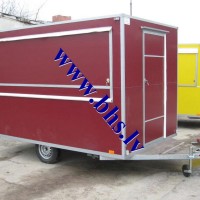
5,000.00 €
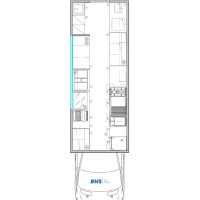
100.00 €
251.00 €
186.00 €
286.00 €
1,099.00 €
289.00 €
295.20 €
| Indicator | Value |
|---|---|
| Portions over 5 years | 90,000 |
| Equipment per portion | ~9.3 c |
| Portions to pay back the kit | ~2,095 |
| Working days to pay back | ~17.5 |
| Total power | 6.1 kW (~26.5 A at 230 V) |
What this means
Equipment costs about ten cents per portion, and the kit can pay for itself within a few weeks of a good season. But only if the appliances work at every event — which is why the power budget, service and spare parts matter as much as the price. Calculate with your own numbers.
12 BHS service, maintenance and spare parts
BHS service — 24/7
We repair food truck and kiosk equipment in our service workshop in Riga, Vagonu iela 23. Spare parts warehouse in Riga with delivery across the Baltics and Europe, certified technicians, more than 20 years of experience.
What BHS service does
Diagnostics and repair
In our Riga workshop: fryers, grills, griddles, fridges, freezers.
Maintenance contract
Before the season — inspection, cleaning, adjustment and safety checks; timely parts replacement.
Spare parts in stock
Heating elements, thermostats, switches, compressors — from our Riga warehouse.
Repair warranty
Repairs carried out in our workshop are covered by the BHS service warranty.
Spare parts for food truck equipment
| When | What to do |
|---|---|
| Every working day | oil filtering, surfaces, grease filters, tanks, temperature records |
| Weekly | deep clean of the fryer, seals, condenser dust |
| Before the season | electrics, gas, heating elements, thermostats, refrigeration — easiest with a maintenance contract |
| After the season | drain water, dry out, clean and store equipment in a dry place |
13 Food truck equipment in the BHS range
Eight steps to a ready-to-work food truck — from design drawing to wall table:
BHS food truck design
Designers and technicians develop or improve the project, choose equipment and fit the furniture.
100.00 €
View product →
BHS project: Kebab Factory bus
A custom-planned mobile kebab kitchen in a bus: compact stainless steel work area, grill, refrigerated counters, a 3400 mm extraction hood and a service counter, with an ergonomic workflow in a narrow space. Delivery and installation across Latvia, the Baltics and Europe.
11,998.00 €
View product →HENDI fryer Profi Line 8 l
With drain tap, 3.5 kW, 230 V, 305×515×354 mm, 8.9 kg.
251.00 €
View product →HENDI contact grill 263600
Ribbed top, smooth bottom, 1.8 kW, 230 V, plate 220×230 mm, 50–300 °C.
186.00 €
View product →HENDI hot dog grill 268636
1 zone, 7 rollers 45 cm, 0.62 kW, 230 V, up to 230 °C.
286.00 €
View product →GORT fridge 90 l
Under-counter, −1…+10 °C, 540×580×800 mm, 0.06 kW, lock, 2 shelves.
1,099.00 €
View product →TEFCOLD CF78 freezer
72 l, −22…−12 °C, 567×567×830 mm, 0.124 kW, flip-flop lid.
289.00 €
View product →Novameta wall table 800
Stainless steel, 800×600×750 mm, up to 120 kg on top and shelf.
295.20 €
View product →Prices excl. VAT, November 2026. 12-month warranty; after that — BHS service, maintenance contract and spare parts. Installation and transport quoted per project.
14 Frequently asked questions
Where to start a food truck project
With the menu and format: 3–5 dishes, portions per hour, where you'll trade and what will tow it. Then the design, the power budget, and only then the equipment.
Whether a 750 kg trailer can be towed on a B licence
Usually yes, if the trailer's gross weight doesn't exceed 750 kg; heavier trailers need BE or B96, or must stay within the combined weight limit. The 750 kg includes water, gas and stock.
Which permits are needed
Food business registration with the competent authority, a trading licence or permission for the site, vehicle registration and roadworthiness, plus gas and fire safety.
Electricity or gas
Electricity is cleaner and simpler but needs power. Gas gives high output without a supply but needs cylinders, a certified connection and ventilation. Many trucks use both.
What generator is needed
One with headroom above total appliance power, inverter type. In our example, 6.1 kW of appliances needs at least about 7.6 kW.
Whether a food truck needs a hand basin
Yes, separate from utensil and food washing, with potable water, soap and single-use towels. Without plumbing, a mobile station with tanks works.
Whether BHS repairs and maintains food truck equipment
Yes. BHS service repairs equipment in its Riga workshop, offers a maintenance contract, and customer service is available 24/7: +371 25 522 233.
Whether spare parts are available
Yes. Heating elements, thermostats, switches, compressors and other parts are in the BHS warehouse in Riga and shipped across the Baltics and Europe; if something is missing, our service will help order it.
Let's design and equip your food truck
Tell us what you'll cook, where you'll trade and what power you'll have. We'll prepare the design, recommend equipment, build the furniture and trailer, and then take care of maintenance, repair and spare parts.
Related articles
This article is for information only and is not legal advice; regulations change. Specific requirements are set by the legislation in force, your local authority and the food safety authority. Power, weights and the calculation are approximate — calculate with your own numbers. The characters in the story are fictional. Prices excl. VAT, November 2026.