

Finance and equipment
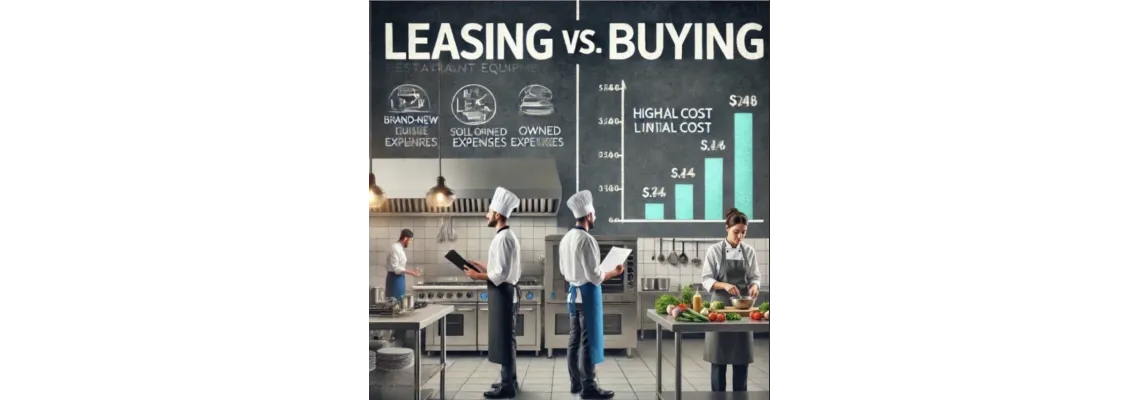
Buy, rent or lease: how to finance kitchen equipment
For a new café or restaurant, equipment is often the biggest one-off cost. Pay for everything in cash and there may be nothing left for working capital. This article compares four routes (buying, leasing, rental and used equipment), works through an example with real prices and explains how VAT and corporation tax affect the choice in Ireland.
3.6c
lease payment per portion in our worked example (150 portions a day)
38%
less cash up front if the oven and coffee machine are bought used
24/7
BHS service, maintenance and spare parts from our warehouse in Riga
Contents
- Short answer: which route suits whom
- How each type of financing works
- VAT, corporation tax and accounting in Ireland
- Total cost, not just the monthly payment
- Restaurant, café, canteen, catering
- Worked example: a café equipment set
- How to prepare for leasing or rental
- Common mistakes and one typical story
- BHS service, maintenance and spare parts
- Equipment in our range: new and used
- Frequently asked questions
01 Short answer: which route suits whom
There is no single right answer. Three questions decide it: how often you will use the equipment, how much cash you can afford to tie up, and how long you plan to keep it. In short:
Buying outright
Finance lease or hire purchase
Operating lease
Short-term rental from BHS
Used equipment
A combination
We do not just sell — we also service
However the equipment is financed, it needs maintenance and fast repairs. BHS repairs equipment in its service workshop in Riga, offers maintenance contracts, keeps spare parts in its Riga warehouse and ships them across the Baltics and Europe. Customer service is available 24/7.
02 How each type of financing works
The difference is not only the monthly payment. What matters is who owns the equipment, what happens at the end of the contract and who is responsible if it breaks down.
Buying
Bank loan
Hire purchase / finance lease
Operating lease
Short-term rental (BHS, Latvia)
Used equipment
Interest on a lease — how to read it
Rates are often variable, based on Euribor plus the lender margin. In autumn 2026 Euribor is higher than a year ago, so a variable payment can rise. Ask about a fixed rate too and compare the APR, not just the margin.
Add to the interest any documentation fee, the insurance lenders usually require and any charges for changing the schedule or early settlement.
03 VAT, corporation tax and accounting in Ireland
The way you finance equipment changes not only cash flow but also how it is treated in your accounts and tax return. Two points matter for Irish businesses.
Corporation tax on trading income is 12.5%. Equipment you buy, or acquire on hire purchase, normally qualifies for capital allowances on plant and machinery: 12.5% a year over 8 years. Payments under an operating lease are generally a deductible business expense. The exact treatment of finance leases follows the accounting rules, so confirm it with your accountant.
| Question | How it usually works |
|---|---|
| VAT when buying | You pay the full VAT (23%) up front; a VAT-registered business reclaims it in its return. For cash flow it is a short loan to the state. |
| VAT on hire purchase | VAT on the full value is usually charged at the start of the agreement. Ask the finance company before you sign. |
| VAT on an operating lease | Charged on each rental invoice, so there is no large sum up front. |
| Accounts | Purchase and hire purchase: a fixed asset with depreciation. Operating lease and short-term rental: operating expenses. |
| Interest | Interest on loans and finance agreements is a business cost; agree the exact treatment with your accountant. |
State support: SBCI
The Strategic Banking Corporation of Ireland (SBCI) supports loan and finance schemes for small and medium businesses, offered through participating lenders, sometimes on better terms than standard finance. Schemes change, so ask your bank or finance provider which ones are open.
Important
This is not tax or financial advice. Rates and rules change; discuss your situation with your accountant before you decide.
04 Total cost, not just the monthly payment
The lowest monthly payment is not necessarily the cheapest option. Compare the full lifetime cost of the equipment: buying, financing, running it and what you can recover at the end.
| Cost item | What to check |
|---|---|
| Purchase price | Compare power, output and warranty of new and used units, not only the price. |
| Finance cost | Interest, documentation fee, insurance; for leases, also the residual value. |
| Maintenance | Water filters, descaling, seals, scheduled service. A maintenance contract makes these costs predictable. |
| Electricity and water | Newer equipment often uses less. Over 5 years the difference can exceed the price gap. |
| Downtime | What a day without an oven or dishwasher costs you. This is where fast service and parts availability matter. |
| Residual value | Well-kept branded equipment can be sold or traded in after years; on an operating lease you simply hand it back. |
A practical rule: the finance term should not be longer than the time you really need the equipment and it stays in good working order. For choosing the right oven, see our article convection oven or bakery oven.
05 Restaurant, café, canteen, catering
The best mix differs by type of business.
New café
Established restaurant expanding
Canteen and central kitchen
Catering and events
The most common mistake
Everything new and paid in cash at once. In the opening months income is still low, but wages, rent and stock must be paid. With the cash tied up in equipment you end up taking an expensive short-term loan or delaying supplier payments.
06 Worked example: a café equipment set
Example: a new café needs a convection oven with steam, a dishwasher, a coffee machine and an ice maker. Prices from our range, excluding VAT, November 2026. The finance terms are assumptions, not an offer from a specific lender.
Equipment set (new)
- FM STG 71 V7 convection oven with steam — €4,099
- 500×500 dishwasher (801506) — €1,238.97
- SCHAERER COFFEE CLUB — €3,699
- SP30/12 ice maker — €999
Total: €10,035.97 excl. VAT (€12,344.24 incl. VAT at 23%)
A. Buying
B. Finance agreement
C. Mix with used units
D. Cost per portion
What this means: with finance, €8,028.78 stays in the business, and over 5 years you pay about €1,738.90 in interest for that. If that cash saves you from a more expensive loan or a delayed opening in the first months, the finance pays for itself. Option C saves the most, but the used oven is smaller (5.3 kW) and the warranty has to be confirmed for each unit. Run the numbers with your own prices and your lender offer.
When short-term rental pays
A simple formula: equipment price ÷ daily rental = the number of days after which buying is cheaper. For example, if rental cost €35 a day (an illustration only — ask BHS for the real price), an ice maker at €999 would pay for itself after about 29 days. Need it for a few weekends a year: rent. Need it all summer: buy.
07 How to prepare for leasing or rental
The finance company pays the supplier for the equipment, and you pay the finance company. To keep it quick:
1. Choose the equipment
2. Compare 2–3 offers
3. Prepare documents
4. Delivery and handover
Questions for the finance company before signing
- Is the rate fixed or variable, and what is the APR.
- When and how is VAT charged.
- Do you also finance used equipment and installation work.
- What insurance is required, and does your existing policy cover it.
- What does early settlement or swapping equipment during the term cost.
Equipment rentalUsed equipmentKitchen design
08 Common mistakes and one typical story
Most financing mistakes are not about the rate but about planning.
- Payment too high — chosen from the catalogue, not from portion numbers; Fix: size the equipment to your menu; do not finance what you do not need
- Term longer than the need — a small payment over 7 years on equipment you will replace after 4; Fix: match the term to the equipment life and your plans
- Unexpected VAT bill — VAT on the full value at the start of a hire purchase; Fix: put that VAT into the cash-flow plan for month one
- Cheap used unit, untested — unknown condition, no warranty; Fix: buy tested equipment with a known warranty and available parts
- Renting what you use daily — rental adds up; Fix: after 1–2 months compare with buying or finance
- Unit breaks, payments continue — no maintenance, no service arrangement; Fix: a maintenance contract and a service with parts in stock
What it looks like in practice: two cafés on one street
Seán and Niamh opened cafés the same spring. Seán bought everything new from his savings — oven, coffee machine, dishwasher. Three months later, in a wet June, there were fewer customers than planned, and he had to take an expensive short-term loan to cover wages.
Niamh put the oven and coffee machine on finance, bought a used ice maker and, for the summer terrace festival, rented a second coffee machine. Her monthly payment was clear from day one, and enough cash stayed in the business for the rainy month. By autumn, with the terrace closed, the rented unit had already gone back.
Neither route is right for everyone, but in Niamh’s plan the cash followed the income.
09 BHS service, maintenance and spare parts
Equipment you are still paying for must not stand idle. Lease payments continue during repairs, so service is a financial question too.
BHS service, maintenance and spare parts
Customer service 24/7: +371 25 522 233. Repairs in our service workshop at Vagonu iela 23, Riga. Certified technicians, more than 20 years of experience, a spare parts warehouse in Riga with delivery across the Baltics and Europe.
What BHS service does
Diagnostics and repair
Maintenance contract
Spare parts in stock
Repair warranty
Spare parts for the equipment in this article
Parts can also be ordered on their own if your technician fits them.
Convection ovens
Dishwashers
Heating elements
Parts from used equipment
| When | What to do |
|---|---|
| Daily | Clean the oven cavity, dishwasher filters and the coffee machine milk system. |
| Weekly | Check seals, descaling indicators and the ice maker bin. |
| Every 1–3 months | Replace the water filter by usage, clean the condenser. |
| Once a year | Technical service and safety check — easiest with a maintenance contract. |
10 Equipment in our range: new and used
Four new and four used units from the example, plus similar alternatives. All can be bought outright or through a finance company.
New
Convection oven with climate and steam control, 7 × GN 1/1, 67 mm spacing, 7-inch touchscreen, up to 300 °C, 10.2 kW, 400 V.
€4,099
Prices excluding VAT, November 2026. New equipment has a 12-month warranty; after that — BHS service, maintenance contract and spare parts. Warranty terms for used equipment may differ — confirm them and the condition of the unit before buying. Used stock changes.
11 Frequently asked questions
Which is cheaper — buying or leasing
Does BHS rent out equipment
Can used equipment be financed
Does leasing reduce tax
What if leased equipment breaks down
Does BHS repair and maintain equipment
Are spare parts available
Where to start if unsure what is needed
Let us plan the financing together
Tell us what you plan to open or expand. We will prepare a quotation for buying or leasing, suggest what is better rented or bought used, and then look after maintenance, repairs and spare parts.
Related articles
The calculation is illustrative: the interest rate, deposit and rental price are assumptions, not the terms of a specific offer. This article is not financial, tax or legal advice; rates and regulations change. The characters in the story are fictional. Prices excluding VAT, November 2026.