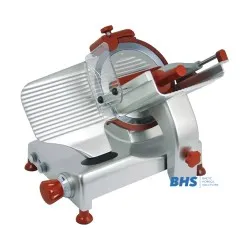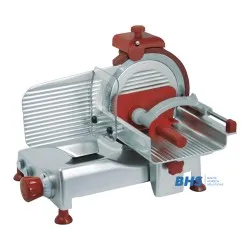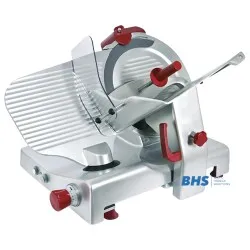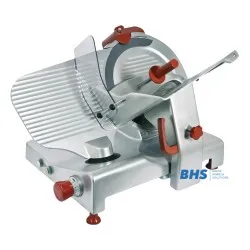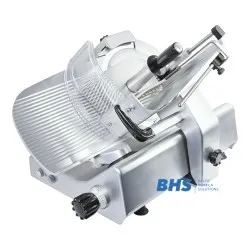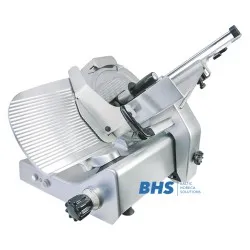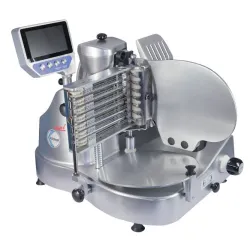
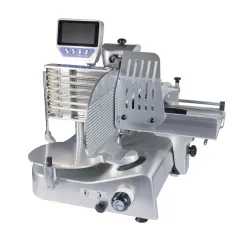
Vegetable slicers for HoReCa kitchens — BHS offers professional vegetable slicers to restaurants, hotels, canteens, catering companies, food production facilities and other HoReCa businesses: a vegetable slicer is a commercial cutting appliance with interchangeable cutting discs that allow one appliance to produce various vegetable cutting shapes — slices, julienne strips, cubes, grated mass and other forms — and the main advantages of a vegetable slicer are high speed and consistently uniform cutting shapes, which are critical for large vegetable volumes in HoReCa kitchens.
See also Deli Slicer and Cheese Slicers for other specialised cutting appliance types.
Vegetable slicers — the interchangeable cutting disc system and powerful motor ensure fast vegetable cutting into slices, julienne strips, cubes and grated mass for large volumes without manual cutting effort in HoReCa kitchens across Europe.
Interchangeable disc system and cutting shapes
Vegetable slicers — the main technological feature of a vegetable slicer is the interchangeable cutting disc system, which allows one appliance to perform several cutting functions. Slice disc — the vegetable slicer slice disc cuts vegetables into thin slices with adjustable thickness from 1 mm to 8 mm and more; suitable for cutting cucumbers, tomatoes, beets, fennel, celery and other hard and medium-hard vegetables; slices are used in salads, for garnish decoration and garnish preparation. Julienne disc — the vegetable slicer julienne disc cuts vegetables into thin or medium-thick strips; suitable for carrots, zucchini, peppers, celery stalks and other long vegetables; strips are used in wok dishes, salads and as a garnish. Cube set — some vegetable slicer models have a cube cutting attachment that first cuts into strips, then cross-cuts into cubes; cubes are used in soups, salads, sauces and side dishes. Grating disc — the vegetable slicer grating disc grates vegetables finely or coarsely; suitable for carrots, beets, zucchini and other soft vegetables; grated mass is used for burgers, cutlets and pastry products. BHS offers vegetable slicers.
Cutting speed and capacity
Vegetable slicers — the powerful motor and professional cutting mechanism speed of a vegetable slicer are critical for high vegetable processing capacity. Motor power — a professional vegetable slicer is usually equipped with a 250–750 W motor depending on the model and processing capacity; a more powerful motor allows cutting harder vegetables (beets, roots, fennel) without motor overheating. Daily capacity — a medium-power vegetable slicer can process 50–200 kg vegetables per day in an intensive kitchen; higher-class models — more; choose capacity according to the establishment's vegetable consumption. Feed hopper size — a larger feed hopper allows placing larger vegetable pieces or several small vegetables at once; reduces pauses between cutting cycles; a vegetable slicer with a large hopper has higher productivity with fewer people. Disc change speed — professional vegetable slicers have discs that can be changed quickly without tools; quick disc change between slice and julienne functions reduces downtime in the kitchen.
Hygiene and vegetable cleaning
Vegetable slicers — vegetables are lower HACCP risk products than meat, but cleaning the vegetable slicer is important to prevent cross-contamination and bacterial growth. Cleaning frequency — the vegetable slicer must be cleaned after each work shift and obligatorily before switching from one vegetable type to another (allergen considerations); celery residue on the blade can affect the next product's taste. Disc cleaning — remove and wash the vegetable slicer cutting discs in a dishwasher or by hand; blade edges are sharp — use safety gloves; after washing, dry the discs completely to prevent rusting. Hopper and body cleaning — vegetable liquid and juices accumulate in the feed hopper and body; clean with moisture and disinfect; damp surfaces are ideal for bacteria; after cleaning, allow the appliance to dry. Allergen control — if allergen-containing products (celery is the main vegetable allergen) are cut with vegetable slicers, disinfect the appliance before switching to allergen-free products. See also the slicer range.
HoReCa usage scenarios
Restaurant with a wide salad and garnish range — vegetable slicer; carrots, cucumbers, fennel, celery cut into slices and strips without manual cutting. Hotel kitchen with a buffet that processes 30–50 kg vegetables daily — vegetable slicer; interchangeable discs allow quickly changing the shape from slices to cubes. Food production facility with serial salad and garnish production — vegetable slicer; high processing capacity and standardised shapes for product appearance; BHS supplies the appliance.
Frequently asked questions
Can a vegetable slicer also cut fruit? Vegetable slicers — yes, hard fruits (apples, pears, pineapples, mango) can be cut with a standard slice disc; do not cut overly soft fruits (bananas, kiwi) with vegetable slicers as they deform; before cutting fruit, clean the appliance of vegetable residue to avoid flavour transfer; see the slicer range.
How often should vegetable slicer cutting discs be replaced? Vegetable slicers — discs wear out depending on the cutting volume and vegetable hardness; wear sign — vegetables are cut unevenly or torn, not cleanly cut; in intensive use (100 kg per day) check discs every 3–6 months; compatible spare disc parts are available; see the slicer range.
Why choose BHS?
BHS – Baltic HoReCa Solutions supplies professional equipment for restaurants, cafés, hotels and canteens: more than 20,000 products from many manufacturers. Our specialists help you choose the right equipment and spare parts for your kitchen or bar.
Delivery
We deliver across the European Union. Delivery time and cost depend on the order volume and destination — contact the BHS team for an exact price and lead time.