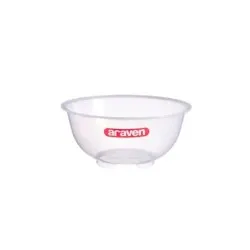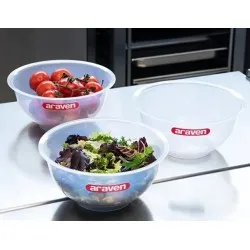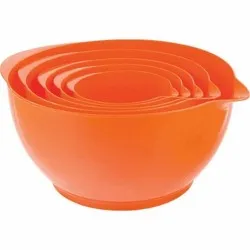
Plastic Bowls are practical and economical kitchen accessories for restaurant kitchens, dining establishments, cafés, patisseries and HoReCa businesses across Europe. Food-grade plastic bowls are an indispensable kitchen inventory for mixing, marinating, chilling, storing and transporting products—they are lighter than Metal Bowls, more resistant to impacts, hygienic and available in a wide range of sizes, covering both small sauce bowls and high-capacity food preparation bowls for professional kitchens. BHS offers Plastic Bowls as part of a broad range of bowls and buckets for HoReCa businesses across Europe.
BHS specialists help choose the most suitable plastic bowls based on the volumes, material and storage requirements needed in the kitchen. Also explore Metal Bowls, Glass Bowls and other Bowls, Buckets for a complete kitchen inventory.
Plastic bowls are one of the most widely used categories of kitchen accessories in HoReCa kitchens—their lightness, impact resistance, food safety and wide range of sizes make them a versatile choice for food preparation, mixing and storage, from small portions to large batch processing. BHS offers plastic bowls to HoReCa businesses across Europe.
Types and sizes of plastic bowls
Plastic bowls for professional kitchens are available in various sizes and shapes. Small bowls (0.5–2 l) — sauce bowls for dressings, spices and small portion preparation tasks. Medium bowls (3–8 l) — versatile mixing bowls for salads, marinades and food preparation. Large bowls (10–20 l) — for large batch food preparation, dough mixing and high-volume portioning. Extra-large bowls (20+ l) — industrial-sized bowls for large kitchens or catering event food processing. Rounded and rectangular bowls — different shapes to suit the kitchen tools and storage needs. BHS helps choose the most suitable plastic bowls based on the volumes and functions required in the kitchen.
Where to use plastic bowls
Plastic bowls are essential in practically all HoReCa kitchen sections. Food preparation area — bowls for salad preparation, meat marinating, vegetable chopping and product weighing. Patisserie and bakery kitchen — dough mixing bowls, icing mixing bowls and egg whisking bowls. Cold kitchen — bowls for cold dish preparation, salads and chilling products in the refrigerator. Catering business — portable, lidded bowls for transporting products to event venues. Kitchen storage — bowls with lids for hygienic product storage in the refrigerator and freezer.
HACCP and hygiene
Using plastic bowls in food processing requires compliance with HACCP standards. Food-grade plastic — all plastic bowls that come into contact with food must be made from approved food-contact plastic (food grade), typically polypropylene or polyethylene. Colour coding — in HACCP practice, it is recommended to use different coloured bowls for different types of products (red for meat, yellow for poultry, green for vegetables, white for dairy products) to prevent cross-contamination. Cleaning and disinfection — plastic bowls must be cleaned with approved food industry detergents; damaged bowls with deep scratches must be replaced, as they can harbour bacteria. Temperature resistance — bowls must be suitable for both freezer (down to -20°C) and kitchen conditions.
HoReCa usage scenarios
Restaurant cold kitchen — various sizes of plastic bowls for salad and cold dish preparation with colour coding to prevent cross-contamination in accordance with HACCP. Patisserie or bakery — large plastic bowls for dough preparation and icing mixing, as well as small bowls for decoration elements. Catering business for events — bowls with lids for safe product transportation and storage at event venues across Europe. School or corporate canteen — large-volume bowls for mass portion preparation with high daily processing volumes. Fast food or large dining kitchen — durable, easy-to-clean plastic bowls for intensive daily use with high sanitary standard compliance.
Frequently asked questions
How to check if a plastic bowl is suitable for food contact? Plastic bowls suitable for food contact must have a marking (fork and glass pictogram) or manufacturer certification for food-grade material compliance. All plastic bowls offered by BHS meet food contact requirements. Also see Metal Bowls as an alternative.
Can plastic bowls be used in the freezer and dishwasher? Most professional plastic bowls are suitable for freezing (down to -20°C or lower). Dishwasher suitability depends on the specific model—check the manufacturer’s instructions. Contact the BHS team and explore the Bowls, Buckets range.
Why choose BHS?
BHS – Baltic HoReCa Solutions supplies professional equipment for restaurants, cafés, hotels and canteens: more than 20,000 products from many manufacturers. Our specialists help you choose the right equipment and spare parts for your kitchen or bar.
Delivery
We deliver across the European Union. Delivery time and cost depend on the order volume and destination — contact the BHS team for an exact price and lead time.