

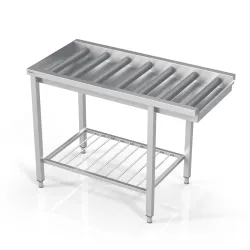
Article number: BHS-IPSO-80/60/90
A stainless steel worktop table designed to connect directly to a commercial dishwasher, smoothing t..
Is available
881.00€
with VAT: 1,066.01€
Article number: BHS-IPSO-90/60/90
This Novameta table, article BHS-IPSO-90/60/90, is designed for use with dishwashers. It features lo..
Is available
899.00€
with VAT: 1,087.79€
Article number: BHS-IPSO-100/60/90
A stainless-steel worktop on four legs that bridges the gap between a manual cleaning station and th..
Is available
949.00€
with VAT: 1,148.29€
Article number: BHS-IPSO-110/60/90
A table-to-dishwasher unit bridges the gap between the worktop where dirty plates accumulate and the..
Is available
1,004.00€
with VAT: 1,214.84€
Article number: BHS-IPSO-120/60/90
A stainless steel worktop mounted on a sturdy frame, designed to bridge the gap between a preparatio..
Is available
1,016.00€
with VAT: 1,229.36€
Article number: BHS-IPSO-130/60/90
A stainless-steel worktop mounted on a sturdy frame, designed to bridge the gap between a commercial..
Is available
1,069.00€
with VAT: 1,293.49€
Article number: BHS-IPSO-140/60/90
A stainless steel worktop on four legs forms a continuous run from the dishwasher to the sorting are..
Is available
1,123.00€
with VAT: 1,358.83€
Article number: BHS-IPSO-150/60/90
A stainless-steel worktop on castors links the dishwashing machine to the drying area, keeping plate..
Is available
1,137.00€
with VAT: 1,375.77€
Article number: BHS-IPSO-160/60/90
A stainless-steel worktop on legs forms a straight run between a commercial dishwasher and the next ..
Is available
1,190.00€
with VAT: 1,439.90€
Article number: BHS-IPSO-170/60/90
This stainless-steel workstation connects directly to a dishwasher, allowing smooth movement of croc..
Is available
1,243.00€
with VAT: 1,504.03€
Article number: BHS-IPSO-180/60/90
A stainless-steel worktop table built to bridge the gap between manual sorting and automatic dishwas..
Is available
1,258.00€
with VAT: 1,522.18€
Article number: BHS-IPSO-190/60/90
A stainless-steel worktop on legs links the final plating station to the dishwasher, eliminating the..
Is available
1,311.00€
with VAT: 1,586.31€
Article number: BHS-IPSO-200/60/90
A stainless-steel worktop on four legs forms a continuous surface between a commercial dishwasher an..
Is available
1,323.00€
with VAT: 1,600.83€
Article number: BHS-IPSO-210/60/90
A continuous roller conveyor carries racks of washed crockery straight from the dishwasher onto the ..
Is available
1,404.00€
with VAT: 1,698.84€
Article number: BHS-IPSO-220/60/90
This stainless-steel worktop table connects directly to a commercial dishwasher, eliminating the nee..
Is available
1,456.00€
with VAT: 1,761.76€
Article number: BHS-IPSO-230/60/90
A stainless steel worktop on castors links the dishwasher to the rest of the wash-up line. Trays and..
Is available
1,468.00€
with VAT: 1,776.28€
Article number: BHS-IPSO-240/60/90
A stainless-steel transfer table bridges the gap between the worktop and the dishwasher, keeping rac..
Is available
1,522.00€
with VAT: 1,841.62€
Article number: BHS-IPSO-250/60/90
A stainless steel worktop on castors bridges the gap between a commercial dishwasher and the washing..
Is available
1,577.00€
with VAT: 1,908.17€
Article number: BHS-IPSO-260/60/90
A stainless steel worktop on four legs links the dishwasher to the washing-up area, carrying racks o..
Is available
1,589.00€
with VAT: 1,922.69€
Article number: BHS-IPSO-270/60/90
A stainless-steel worktop with an integrated roller conveyor allows staff to move racks of soiled di..
Is available
1,641.00€
with VAT: 1,985.61€