

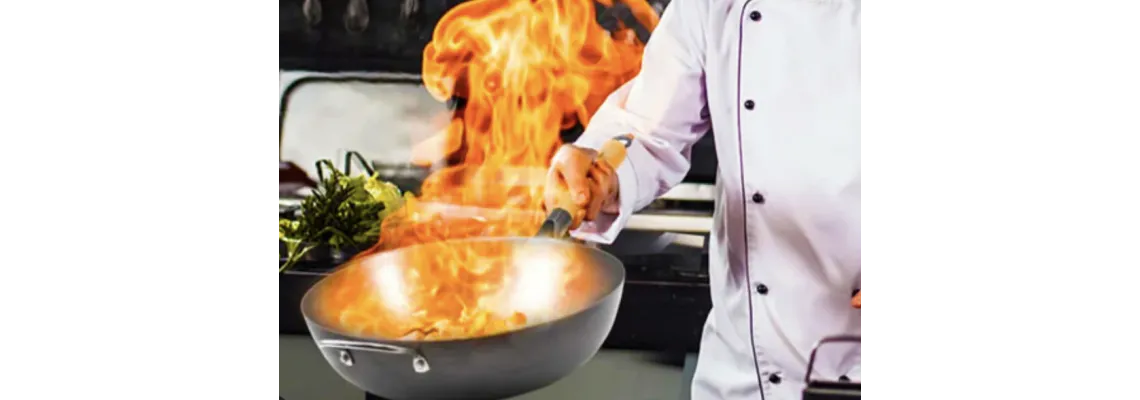
Asian cuisine · Hot equipment
WOK equipment for professional kitchens: Asian cooking technology, power and efficiency
On an ordinary range, a wok dish often stews in its own juices: the pan cools, the meat turns grey, the vegetables go soft and one portion takes 6–8 minutes. A professional WOK cooker solves this with power. In this article: what a wok and wok hei are, how gas and induction WOK units work, which pan to choose, how to prepare for service, a chef's recipe, safety, a simple calculation and models with prices.
14–21 kW
gas wok burner output — 3–5 times more than a standard range burner
2–4 min
one wok portion from hot pan to plate
24/7
BHS service, maintenance and spare parts from our Riga warehouse
Contents
- What a wok is and who needs WOK equipment
- How a WOK cooker works: power, flame and wok hei
- Gas or induction: comparison and models in numbers
- Wok pans: materials, shape and seasoning
- How to cook in a wok: preparation, sequence and a chef's recipe
- Safety, gas and HACCP
- WOK in restaurants, takeaways, canteens and catering
- How to choose and a simple calculation
- Installation: gas, electricity, ventilation
- Daily work, common mistakes and a story
- BHS service, maintenance and spare parts
- WOK equipment in the BHS range
- Frequently asked questions
01 What a wok is and who needs WOK equipment
A wok is a deep pan with a round or semi-round base, used in China for more than two thousand years. Its shape allows very hot cooking with little oil: the hottest point is at the bottom, the sides are cooler, and the cook keeps moving and tossing the food. A WOK unit (wok cooker, wok station) is a range with a very powerful gas burner or induction zone designed for exactly this pan.
Asian restaurant
Chinese, Thai and Vietnamese dishes where wok hei is the essence. Usually 2–3 gas burners of 14–21 kW.
Takeaway and street food
Noodles and rice in 3 minutes, the queue keeps moving. Speed and easy cleaning matter most.
Bistro with a fusion menu
A few wok dishes next to European ones — one burner or an induction wok is enough.
Canteen and staff restaurant
Quickly fried vegetables and meat in small batches that look and taste better than stewed.
Hotel and live cooking
A wok station in the dining room or buffet as a show; induction is often chosen — no open flame.
Food truck and events
A countertop induction wok on 230 V or a compact gas station with a certified connection.
We don't just sell — we service too
BHS repairs WOK cookers and other hot equipment in its service workshop in Riga, offers a maintenance contract, and spare parts — burners, thermocouples, fans — are in stock in Riga and shipped across the Baltics and Europe. Customer service is available 24/7.
02 How a WOK cooker works: power, flame and wok hei
A standard range burner gives roughly 3–7 kW. A professional gas wok burner delivers 9.5, 14 or 21 kW, and the flame from a cast-iron burner rises vertically, wrapping the base and lower third of the pan. The pan sits in a ring right in the middle of the flame, so it keeps its heat when cold food goes in.
An induction WOK heats the pan with a magnetic field: a coil under a curved glass-ceramic zone (Ø 29–30 cm) heats the steel of the pan itself. Efficiency is high, response is instant and the kitchen stays cooler — but there is no open flame.
Wok hei — the breath of the wok
Cantonese cooks use this term for the smoky, slightly charred aroma people recognise as a real wok dish. It comes from three things: the Maillard reaction (browning of meat and vegetables), caramelisation of sugars and droplets of oil that briefly ignite above the flame when the pan is tossed.
That is why full wok hei needs an open flame and a very hot pan. Induction gives a hot pan and speed — the food is well seared and juicy, but the smoky flame notes are less pronounced.
What a professional WOK station consists of
- Burner — atmospheric cast-iron burner with a vertical flame; CASTA cookers offer 3 to 21 kW.
- Ring or grate — holds the round pan in the flame; enamelled cast iron.
- Pilot flame and thermocouple — if the flame goes out, the gas supply shuts off.
- Top — AISI 304 stainless steel 2–2.5 mm, removable grease trays, back panel.
- For induction — curved zone, coil, fan and electronics with power levels, pan detection and overheat protection.
Why an ordinary range is not a wok cooker
On a 3–5 kW burner the pan cools after 300 g of meat, the meat releases its juices and starts to boil. A portion takes twice as long and vegetables lose their crunch. For wok cooking, power is the foundation of the technique.
03 Gas or induction: comparison and models in numbers
Both routes are professional — they differ in flame, heat in the kitchen and connection.
Power per burner
9.5–21 kW
3.5–5 kW
Efficiency (approx.)
25–35 %
85–90 %
Heat in the kitchen
high — needs a strong hood
low — cooler kitchen
Wok hei
full, flame around the pan
hot pan, no flame
Response
fast (valve)
instant, precise levels
Pans
any wok, round too
ferromagnetic, shape to match the zone
Connection
gas supply to a design
230 V (3.5 kW) or 400 V 3N
Price at BHS
from €999.00
from €279.00 (countertop), €1,485.00 (floor-standing)
A 14 kW gas burner at ~30 % efficiency delivers about 4.2 kW to the pan; 5 kW induction at ~90 % about 4.5 kW. The pan gets similar heat, but gas leaves another 9.8 kW in the kitchen, induction about 0.5 kW. Figures are approximate.
Models in numbers
- FORCAR BT350W — induction, countertop; Power: 0.8–3.5 kW, 230 V; Size, mm: 340×440×120; Price: €279.00
- HENDI 239681 — induction, countertop, with pan 239773; Power: 3.5 kW, 230 V; Size, mm: 340×450×295; Price: €372.00
- Stalgast 9704005 — induction, floor-standing, Ø 290 mm; Power: 5 kW, 400 V; Size, mm: 400×700×850; Price: €1,485.00
- LOTUS PCIW-74ETT — induction, touchscreen, Ø 30 cm; Power: 4.5 kW, 400 V 3N; Size, mm: 400×705×900; Price: €3,459.00
- CASTA TB01060060BB — gas, 1 burner; Power: 3–21 kW (by burner); Size, mm: 600×600×275; Price: €999.00
- CASTA CC/01 BB275H — gas, cast-iron burner; Power: 9.5 / 14 / 21 kW; Size, mm: 500×500×275; Price: €1,219.00
- CASTA LADYQ 900 — gas, burner Ø 175 mm; Power: 14 kW; Size, mm: 400×900×275; Price: €1,499.00
- CASTA LS02100070BB — gas, 2 burners; Power: by configuration; Size, mm: 1000×700×275; Price: €1,799.00
04 Wok pans: materials, shape and seasoning
The pan is half the result. In a professional kitchen the wok pan is replaced more often than the cooker, so it pays to know the materials.
- Carbon steel — light, heats and cools fast, naturally non-stick once seasoned; must be protected from rust; Suitable for: the professional standard for gas, also works on induction — e.g. Stalgast Ø 400 mm €15.75
- Cast iron — holds heat, but heavy and slow to respond; Suitable for: home and slower cooking; hard to toss in a restaurant
- 3-ply stainless steel — durable, no seasoning needed, but sticks more; Suitable for: induction — HENDI 239773 Ø 360 mm €90.50
- Aluminium with non-stick coating — light and easy, but the coating dislikes very high heat and metal spatulas; Suitable for: gentler frying, canteens — Comfort Plus Ø 360 mm €69.30, 8.5 l
Round or flat base, size and handles
A round base is the classic on gas with a ring. On induction, use a round pan only if the cooker has a curved wok zone (Stalgast Ø 290 mm, LOTUS Ø 30 cm); a flat induction top needs a flat base. Restaurants usually use Ø 36–40 cm pans for 1–2 portions. One long handle with a helper ear is easier to toss; two ears suit large quantities.
How to season a new carbon steel wok
- Wash off the factory protective oil with hot water and detergent — the only time — and dry it over heat.
- Switch the hood to full power and heat the pan, turning it, until the steel turns straw or bluish.
- Using kitchen paper in tongs, rub in a thin layer of high smoke point oil and heat until it smokes. Repeat 3–4 times.
- The first time, fry spring onions and ginger — this helps build the layer and removes the metallic taste.
- After each use, wash with hot water and a brush without detergent, dry over heat and rub in a thin film of oil. Never in the dishwasher.
05 How to cook in a wok: preparation, sequence and a chef's recipe
A wok portion takes 2–4 minutes, so all the work happens before. If the cook is still cutting onions during service, the pan is already too hot or the dish takes too long.
Preparation (mise en place)
- All ingredients cut to the same size — meat in ~5 mm strips, vegetables in pieces that cook at the same time.
- Sauces mixed in advance, in GN containers on the station with a ladle.
- Rice cooked the day before and chilled — fresh rice clumps.
- Noodles cooked, rinsed, drained, with a drop of oil.
- Meat marinated with starch and egg white (velveting) — it stays juicy.
- At the station: oil container with ladle, water container, wok spatula, ladle, strainer, warm plates.
- Hood on before the burner.
The right sequence in the wok
- Heat the empty pan until the first wisp of smoke.
- Add oil and swirl it around the sides.
- Meat or seafood — let it brown for 20–30 s, then stir; then take it out.
- Harder vegetables first, then softer ones.
- Aromatics (garlic, ginger, chilli) — only 20–30 s so they don't burn.
- Rice or noodles, tossing.
- Meat back in, sauce down the hot side — it caramelises.
- Greens and sesame oil at the end, straight onto the plate.
- Rinse the pan with water and a brush, back on the heat — next portion.
- Chicken, pork in strips — 1.5–2.5 min; Tip: marinate with starch, let it brown
- Beef in thin slices — 1–1.5 min; Tip: cut across the grain
- Prawns — 1–2 min; Tip: until opaque
- Broccoli, carrots — 1.5–2 min; Tip: add a spoon of water for steam
- Peppers, onion, courgette — ~1 min; Tip: large pieces
- Sprouts, spinach, pak choi leaves — 20–30 s; Tip: at the very end
- Yesterday's rice — 2–3 min; Tip: separate the grains
- Noodles — ~1 min; Tip: drained, tossing
Oil: refined rapeseed, peanut or rice bran oil — smoke point above 200 °C. Extra virgin olive oil and butter burn and turn bitter at wok temperatures. Peanut oil is an allergen and must be declared on the menu.
Chef's recipe: chicken with vegetables and egg noodles
2 portions (1 wok batch) · prep 20 min · cooking 5–6 min · gas 14–21 kW or induction 5 kW
| Ingredient | Amount |
|---|---|
| Chicken breast in strips | 300 g |
| Marinade: soy sauce, cornflour, egg white | 1 tbsp, 1 tsp, 1 |
| Egg noodles (cooked) | 200 g |
| Broccoli | 150 g |
| Red pepper | 1 |
| Spring onions (white and green parts separate) | 3 |
| Garlic, fresh ginger | 2 cloves, 2 cm |
| Sauce: soy sauce, oyster sauce | 2 tbsp, 1 tbsp |
| Sauce: rice vinegar, sugar, water | 1 tsp, ½ tsp, 3 tbsp |
| High smoke point oil | 2 tbsp |
| Sesame oil | 1 tsp |
Method
- Mix the chicken with the marinade and leave for 10 minutes. Combine the sauce ingredients in a bowl.
- Heat the wok to the first smoke, add the oil and swirl.
- Spread the chicken in the pan, let it brown for 20–30 s, cook for up to 2 minutes and take it out.
- Broccoli and pepper — 1 minute (1 tbsp water for the broccoli). Ginger, garlic and white spring onion — 20 seconds.
- Noodles — 1 minute, tossing. Chicken back in, sauce down the side, 30–40 seconds until everything is coated.
- Turn off the heat, add the green spring onion and sesame oil. Check that the chicken is cooked through and serve at once.
Chef's tip
Don't overload the pan: no more than 2 portions per batch on a 14 kW burner, one on a 3.5 kW countertop induction. If liquid gathers in the pan, the food boils. Allergens in this recipe: gluten, soy, egg, sesame and molluscs (in oyster sauce).
06 Safety, gas and HACCP
A wok station combines an open flame or high power, hot oil and very fast work. All of these risks can be controlled with the right equipment and habits.
Gas safety
- A gas appliance must carry CE marking under the EU Gas Appliances Regulation and have flame supervision: if the flame goes out, the thermocouple shuts off the gas. CASTA CC and LADYQ cookers have safety valves, a pilot flame and a thermocouple.
- Installation and connection only by a Registered Gas Installer (RGII in Ireland), to a design and with a leak test.
- Switch on the hood before the burner. Whether gas must be interlocked with ventilation or a leak detector is decided by the design.
- A yellow, sooty flame means a dirty burner or lack of air. If you smell gas, close the valve, ventilate, don't touch electrical switches and call the gas emergency service.
If oil catches fire in the pan
Never use water. Shut off the gas or switch off the cooker, cover with a lid or fire blanket and don't carry a burning pan. Keep a Class F extinguisher for cooking oil fires next to the wok station.
HACCP at the wok station
- Meat and seafood cooked through. Guideline: 75 °C at the core (probe thermometer); set the final value in your HACCP plan.
- Rice: chill cooked rice quickly in shallow GN trays, keep it cold and reheat until steaming hot when frying. Never keep rice at room temperature.
- Raw and ready-to-eat food apart — separate boards and containers, a refrigerated counter with GN containers at the station.
- Allergens: soy, gluten, sesame, peanuts, egg, fish, crustaceans, molluscs. The EU food information regulation requires information on 14 allergens. Wash the pan between orders with allergens.
- Replace the oil when it darkens or smokes too early.
Who inspects
In Ireland food businesses register with the HSE Environmental Health Service, which carries out inspections; the FSAI sets national food safety guidance. Gas connection and fire safety have their own rules — ask your designer and gas installer.
07 WOK in restaurants, takeaways, canteens and catering
A wok means something different for every business. Typical choices:
- Asian restaurant — 2–3 gas burners of 14–21 kW — e.g. CASTA LS02100070BB with 2 burners — a separate station under a powerful hood; Most common mistake: hood too small, smoke in the dining room
- Takeaway, street food — 1–2 gas burners or, without gas, Stalgast 5 kW or LOTUS induction; Most common mistake: a 3.5 kW countertop unit for heavy volume
- Canteen, central kitchen — 1 wok burner for small batches and non-stick pans; large batches in other equipment; Most common mistake: 5 kg of food in one wok — the food boils
- Hotel, live cooking — countertop induction FORCAR or HENDI — no flame in the dining room; Most common mistake: no plan for smells and extraction
- Catering, food truck — countertop induction on 230 V or a compact gas station with a certified connection; Most common mistake: electrical supply too weak at the event
The most common mistake in every segment
Buying a WOK cooker and thinking about the hood, gas supply or 400 V line afterwards. Plan the station together with ventilation and connections — then nothing has to be rebuilt.
08 How to choose and a simple calculation
The choice starts with portions and connections, not with price.
- Portions per hour — 1 burner — roughly 15–20 portions per hour (3–4 min); more — 2 burners or 2 stations
- Energy on site — gas supply or 400 V; without gas, induction
- Menu — if wok hei is your signature — gas; for fast, well-seared dishes — induction works too
- Ventilation — gas needs stronger extraction and make-up air
- Space — 400–600 mm width per burner, a cold counter and water next to it
- Maintenance — removable burners and trays, thermocouples available, service nearby
A simple calculation: gas or induction for one burner
A bistro with one wok burner: 80 portions per evening, 3 min per portion at full power, 300 working days a year, 5 years. Assumptions: gas €0.10/kWh, electricity €0.22/kWh, efficiency ~30 % for gas, ~90 % for induction. Calculate with your own tariffs.
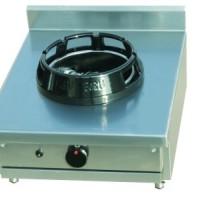
Gas: CASTA CC/01 BB275H, 14 kW
1,219.00 €
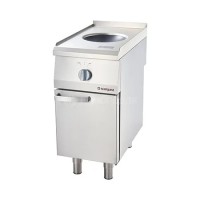
Induction: Stalgast WOK 5 kW
1,485.00 €
Energy per portion
0.70 kWh
0.25 kWh
Cost per portion
€0.070
€0.055
Per evening (80 portions)
€5.60
€4.40
Per year (300 days)
€1,680
€1,320
Equipment + pans per portion (120,000 portions)
1.04 c
1.26 c
Total per portion
~8.0 c
~6.8 c
What this means
Induction costs €266 more to buy but saves about €360 a year in energy — the difference pays back in ~9 months. Gas gives full wok hei and cheaper equipment. Either way the equipment costs about one cent per portion, while one lost order (€12–15) costs more than two evenings of energy for one burner. Ventilation and air conditioning are not included — they usually cost more with gas.
09 Installation: gas, electricity, ventilation
A WOK station is one of the most powerful appliances in the kitchen, so installation should be planned with the design.
- Location — under the hood, against a non-combustible wall, next to a cold counter with prep and water. Keep fryers and open flame apart or use a splash guard.
- Gas — design, Registered Gas Installer, isolation valve at the appliance, certified flexible hose, leak test. Injectors must match the gas type — natural gas or LPG.
- Electricity — 3.5 kW on 230 V needs a dedicated 16 A circuit; 5 kW on 400 V 3N is about 7–8 A per phase. More in our article on kitchen electrical power.
- Ventilation — the hood overhangs the cooker by 15–30 cm on each side, baffle grease filters, make-up air. More in our article on kitchen hoods.
- Water and drainage — the pan is rinsed after every portion, so a tap or water container and a drain are needed nearby. CASTA burner layout and size can be chosen for individual orders — specify it when ordering.
- First start-up — blue, stable flame, pilot holds, thermocouple works; for induction — pan detection and fan. Pans seasoned, cooks trained.
10 Daily work, common mistakes and a story
Daily routine
- Before service: hood on, burners clean, pilot lit, mise en place ready.
- During service: rinse the pan between portions, keep oil and water containers full.
- After service: clean the cooled top and trays, dry and oil the pans.
- Weekly: remove the burners and clean the ports, wash the grease filters.
- Yearly: full maintenance — easiest with a maintenance contract.
- Food boils instead of frying — too much food, pan not hot; Solution: 1–2 portions per batch, heat to smoke
- Meat sticks — pan not seasoned or too cold; Solution: season, heat before adding oil
- Yellow, sooty flame — dirty burner, lack of air; Solution: clean the burner; air adjustment — for service
- Pilot flame goes out — dirty or worn thermocouple; Solution: clean, replace the thermocouple
- Induction beeps and doesn't heat — wrong pan or not in the zone; Solution: ferromagnetic pan of the right shape
- Induction switches off — overheating, blocked fan; Solution: free airflow, clean vents, check the fan
- Rust in the pan — dishwasher or left wet; Solution: scrub and re-season
Story: “Friday, 7:30 pm”
Ronan is the wok cook at an Asian bistro. On Friday evening there are 14 tickets on the rail and both burners are at full power. Suddenly the flame on the second burner turns yellow and lazy, the noodles start to boil, and a minute later the pilot goes out.
Ronan doesn't experiment: he closes the second burner's valve, moves everything to the first burner and asks the sous chef to take the two slowest dishes off the menu for a while. The queue moves slower, but it moves. After service he calls the BHS 24/7 line.
The cause: burner ports clogged with grease and sauce, and a worn thermocouple — a part costing under €12 that BHS ships from its Riga stock. Since then the burners are cleaned every Monday and a spare thermocouple sits on the shelf.
Quick plan if a wok burner stops during service
- Close the burner valve.
- Move portions to the other burner or induction, shorten the menu for a while.
- Check the cooled burner: yellow flame — dirty ports, pilot won't hold — thermocouple.
- Call BHS service: +371 25 522 233 (24/7).
11 BHS service, maintenance and spare parts
BHS service — 24/7
We repair WOK cookers and other hot equipment in our service workshop in Riga, Vagonu iela 23. Spare parts warehouse in Riga with delivery across the Baltics and Europe, certified technicians, more than 20 years of experience.
What BHS service does
Diagnostics and repair
In our Riga workshop: burners, gas valves, thermocouples, induction electronics and fans.
Maintenance contract
Scheduled inspection, cleaning and adjustment, safety checks, timely parts replacement.
Spare parts in stock
Burners, thermocouples, knobs, fans, thermostats — from our Riga warehouse.
Repair warranty
Repairs carried out in our workshop are covered by the BHS service warranty.
Spare parts for WOK equipment
Gas cooker parts
Burners (from €19.70), thermocouples (from €12.00), knobs — the most often replaced gas wok parts.
Fans
For cooling induction woks. If the fan is noisy or stops, the cooker overheats and switches off.
WOK pans
A consumable: a carbon steel pan lasts for years, coated pans need replacing more often.
| When | What to do |
|---|---|
| Daily | trays, top, rinse and oil the pans |
| Weekly | burner ports, rings, grease filters; for induction — air vents |
| Monthly | flame colour, pilot, hoses and cables visually |
| Yearly | burners, thermocouples, valves, leak test, electronics — easiest with a maintenance contract |
12 WOK equipment in the BHS range
Eight models from countertop induction to a two-burner gas station:
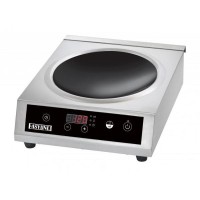
FORCAR Wok Easy Line BT350W
Countertop induction wok 3.5 kW (0.8–3.5 kW), 230 V, 340×440×120 mm, glass ceramic. Pan not included.
279.00 €
View product →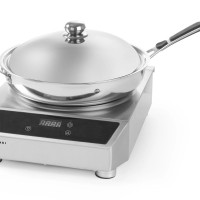
HENDI Wok 3.5 kW 239681
Countertop induction wok, 230 V, stainless body, touch control, grease filter. Works with wok pan 239773 (€90.50).
372.00 €
View product →Stalgast WOK 5 kW 9704005
Floor-standing induction wok, 400 V, Ø 290 mm zone, 9 power levels, pan detection, overheat protection.
1,485.00 €
View product →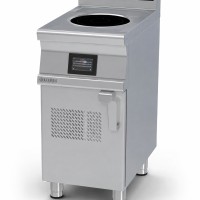
LOTUS WOK Touch Screen 70
Induction wok 4.5 kW, 400 V 3N, Ø 30 cm zone, 4.3-inch touchscreen, 10 levels, timers, WiFi diagnostics.
3,459.00 €
View product →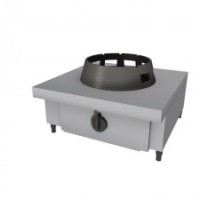
CASTA wok cooker TB01060060BB
Gas wok, 1 burner, 600×600×275 mm, AISI 304, 2.5 mm top, burner of choice 3–21 kW.
999.00 €
View product →CASTA wok station CC/01 BB275H
500×500×275 mm, cast-iron vertical-flame burner 9.5 / 14 / 21 kW, safety valve, pilot, thermocouple.
1,219.00 €
View product →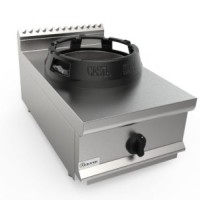
CASTA LADYQ 900 LQ/CC/01.BB
400×900×275 mm, 14 kW burner Ø 175 mm, flame supervision, pilot flame, heat-resistant handles.
1,499.00 €
View product →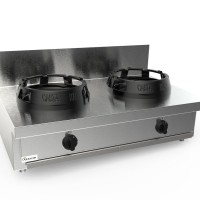
CASTA LS02100070BB, 2 burners
1000×700×275 mm, AISI 304, 200 mm back panel, removable trays; output by configuration.
1,799.00 €
View product →Prices excl. VAT, November 2026. 12-month warranty; after that — BHS service, maintenance contract and spare parts.
13 Frequently asked questions
What wok hei is
The smoky “breath of the wok” aroma from browning, caramelisation and oil droplets igniting in the flame. Full wok hei needs a gas burner and a very hot pan.
Gas or induction — which to choose
Gas if wok hei is the heart of your menu and you have a gas supply. Induction if there is no gas, or you want a cooler kitchen, lower energy costs or a station in the dining room. Both give the pan similar heat.
How powerful a burner you need
For a restaurant — 14 kW, for intensive Asian cooking — 21 kW. For induction — 5 kW for a floor-standing station, 3.5 kW countertop for lower volume.
Which pan suits an induction wok
Ferromagnetic (carbon or multi-ply stainless steel); a round pan only on a curved wok zone. HENDI 239681 works only with pan 239773.
How to season a new carbon steel wok
Wash off the factory oil, heat until the colour changes and season with a thin layer of oil 3–4 times (see section 04).
Whether a wok cooker needs its own hood
A gas wok station needs a powerful hood with grease filters and make-up air; the design sets the capacity. Induction needs less, but steam and smells remain.
Whether BHS repairs and maintains WOK cookers
Yes. BHS service repairs gas and induction WOK equipment in its Riga workshop, offers a maintenance contract, and customer service is available 24/7: +371 25 522 233.
Whether spare parts are available
Yes. Burners, thermocouples, knobs, fans and other parts are in the BHS warehouse in Riga and shipped across the Baltics and Europe; if something is missing, our service will help order it.
Let's choose the WOK equipment for your kitchen
Tell us how many portions you cook and whether you have gas or 400 V on site. We will recommend a gas or induction WOK, pans and ventilation, and then take care of maintenance, repair and spare parts.
Related articles
This article is for information only. Outputs, efficiency and the calculation are approximate — calculate with your own tariffs and volumes. Gas appliances must be installed by a registered gas installer only. Set food safety values in your HACCP plan. The characters in the story are fictional. Prices excl. VAT, November 2026.