

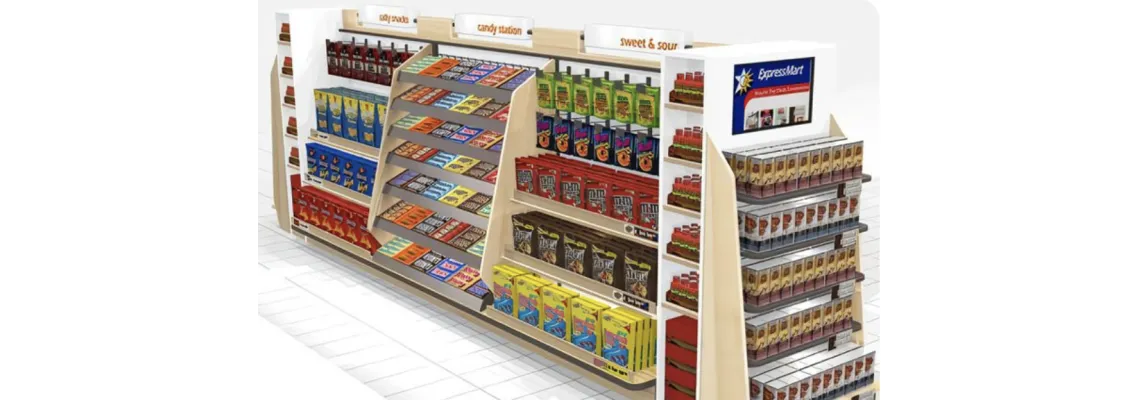
Shop equipment · Retail display cases
Impulse display cases — one step closer to your customer
A customer stands in the queue at the till, wallet already in hand, looking at their phone for three minutes. If a cold drink or a fresh dessert with a clear price is right in front of them at that moment, some people will take it. That is an impulse display case. In this article: how an impulse purchase happens, how to achieve it, where to place the case, how to present and hand the product to the customer — plus models, a calculation and service.
2.5 mo.
payback of an impulse case in our example when 3 % of customers take one item
120–160 cm
eye-level zone where impulse products sell best
24/7
BHS service, maintenance and spare parts from our Riga warehouse
Contents
- What an impulse purchase is and who needs an impulse display case
- How impulse happens: four steps to a purchase
- Types of impulse display cases and models in numbers
- Achieving the impulse: which products to put in the case
- Placing the impulse: where a case sells most
- Presenting and handing the impulse to the customer
- Temperature, HACCP and rules
- Impulse cases in cafés, shops, fuel stations and hotels
- How to choose and a simple calculation
- Installation and first start-up
- Daily care, common mistakes and a story
- BHS service, maintenance and spare parts
- Impulse display cases in the BHS range
- Frequently asked questions
01 What an impulse purchase is and who needs an impulse display case
An impulse purchase is an unplanned purchase the customer decides on in a few seconds at the point of sale: a cold drink in the queue, an ice cream on a hot day, a cake with a coffee. An impulse display case is a small, well-lit case — usually refrigerated — that puts the product right in the customer's path: at the till, counter or queue. It is one step closer to your customer: the product doesn't have to be found, it offers itself.
Café and coffee bar
Desserts, yoghurts and drinks with the coffee — the average ticket grows without new customers.
Bakery and patisserie
Small cakes, juices and milk next to the bread the customer has already bought.
Fuel station and convenience store
Cold drinks, ice cream and snacks for the road — the classic impulse spot.
Hotel and reception
Water, juices and snacks while guests check in or wait for a taxi.
Cinema, gym, events
Drinks and ice cream where people queue or take a break.
Canteen and office café
Salads, sandwiches and drinks grab-and-go — no waiting.
We don't just sell — we service too
BHS repairs impulse display cases and other refrigeration equipment in its service workshop in Riga, offers a maintenance contract, and spare parts — compressors, fans, thermostats, LED bulbs — are in stock in Riga and shipped across the Baltics and Europe. Customer service is available 24/7.
Call: +371 25 522 233ServiceSpare parts
02 How impulse happens: four steps to a purchase
Impulse happens when four things come together: the customer sees the product, wants it, can take it without effort and understands the price at once. If one step is missing, there is no purchase.
- See — at the till the eye catches light, colour and glass; What the case does: LED light, glass on several sides, eye-level position
- Want — coolness, condensation on the bottle, a fresh look, a single portion; What the case does: right temperature, full shelf, small packs
- Take — the hand reaches without asking or extra steps; What the case does: self-service, open front or an easy lid
- Decide — the price is clear at once, no maths; What the case does: clear price tags, round prices, bundles
Why impulse works right at the till
In the queue the customer has already decided to buy, the wallet is in hand and attention is free. Next to the main purchase, a small extra seems minor: with a €6 lunch, a €1.80 drink doesn't feel expensive. The case uses this moment instead of interrupting it.
What kills impulse
- a dark, dirty or fogged case;
- empty or mixed shelves;
- products behind the staff member's back;
- no price, or one you have to search for;
- a warm drink;
- too much choice — the customer starts thinking and the impulse is gone.
03 Types of impulse display cases and models in numbers
An impulse case is chosen by product and location. The main types:
Countertop cooler with glass lid
drinks, yoghurts
+2…+10 °C
on the counter
Cylindrical can cooler
cans, bottles
+2…+12 °C
at the till, on castors
Impulse freezer
ice cream
−22…−12 °C
at the till or exit
Countertop case with curved glass
desserts, sandwiches
+2…+8 °C
on the counter
Open self-service case
grab-and-go, salads, drinks
+2…+6 °C
till area
Upright case with shelves
wide range
+4…+10 °C
along the queue, by a wall
Non-refrigerated case
chocolate, biscuits
room temperature
at the till
Models in numbers
- SCANDOMESTIC TK42BE — countertop cooler with glass lid, energy class B; Volume: 37 l; Temperature: +2…+10 °C; Price: €233.00
- TEFCOLD CF78 — impulse freezer, flip-flop lid; Volume: 72 l; Temperature: −22…−12 °C; Price: €289.00
- TEFCOLD CC55 — cylindrical, 84 × 0.33 l cans, castors; Volume: 78 l; Temperature: +2…+12 °C; Price: €399.00
- TEFCOLD VOC100 — LED panel, 80 × 0.33 l cans; Volume: 103 l; Temperature: +2…+12 °C; Price: €749.00
- SCANDOMESTIC IM 111 E — curved glass, LED, 2.4 kWh/24 h, class D; Volume: 55 l; Temperature: +2…+8 °C; Price: €956.00
- JUKA SOLO 90 — open, 900×830×1330 mm; Volume: 1.2 m²; Temperature: +2…+6 °C; Price: €2,599.00
- JUKA MINI VARNA 60 — upright, 5 shelves, 600×620×2000 mm; Volume: 0.92 m²; Temperature: +4…+10 °C; Price: €2,769.00
- UNIS COOL DRINKCOOLER 900 — for drinks, LED, 895×400×911 mm; Volume: —; Temperature: +8…+10 °C; Price: €2,799.00
Impulse display casesRetail display cases
04 Achieving the impulse: which products to put in the case
The case doesn't sell on its own — the right product does. A good impulse product has five traits:
- A single portion — eaten or drunk right away, no knife or plate.
- A small price next to the main purchase — roughly up to 10–20 % of the average ticket.
- A high margin — impulse space is valuable, it must hold a profitable product.
- Fast turnover or long shelf life — nothing that has to be written off in the evening.
- Time and season — yoghurts and juices in the morning, desserts in the afternoon, drinks in the evening; ice cream in summer.
Pairs that sell
| Main purchase | Impulse product |
|---|---|
| Coffee | biscuit, croissant, mini dessert |
| Lunch | drink, fruit, yoghurt |
| Fuel | cold drink, snack bar, ice cream |
| Bread | milk, juice, small cake |
| Cinema ticket | drink, ice cream |
| Hotel room | water, snacks |
Handing over the impulse: the role of staff
Impulse can also be given. A short, specific offer works better than a general one: not “anything else”, but “fresh cinnamon rolls with your coffee today — €1.90”. Staff point to the case with a glance or a hand, and the product is 30 cm away — the customer only has to nod.
Rule: one idea per case
A drinks case, a dessert case, an ice cream case. A small countertop case needs only 6–10 products. When choice is too wide, the customer starts comparing — and the impulse purchase turns into a considered no.
05 Placing the impulse: where a case sells most
The best case in a bad spot sells little. The impulse spot is where the customer stops and waits.
- At the till, on the customer's right — waiting time, free hands; most people reach with the right hand first; What to put there: drinks, desserts
- On the counter 30–50 cm from the payment point — the product is within reach while paying; What to put there: countertop cooler, non-refrigerated case
- Along the queue — customers spend minutes there; What to put there: upright or cylindrical case
- At the exit — the last call; What to put there: water, ice cream
- Next to a related product — a pair — coffee machine, lunch counter; What to put there: desserts, drinks
- Not in the first 2–3 m after the entrance — the customer is still adjusting and doesn't notice details; What to put there: —
Height zones
| Zone | What to put |
|---|---|
| Eye level, 120–160 cm | highest margin, new products |
| Reach zone, 80–120 cm | bestsellers |
| Low zone, below 80 cm | large packs, stock |
Don't block the flow
Leave a walkway of roughly 90–120 cm, make sure the doors don't open into the queue and keep escape routes clear. If the case gets in the way, people walk around it instead of looking at it.
06 Presenting and handing the impulse to the customer
Presentation is how the product looks and how it reaches the customer's hands.
- A full shelf sells — fill the gaps, pull the product forward.
- Labels facing forward, one product in a vertical band — colour blocks are visible from a distance.
- A price for every product, large digits.
- Light — LED, neutral white; products must not look bluish or grey.
- Clean glass — no fingerprints or condensation.
- FIFO rotation — new stock at the back, older at the front.
- A seasonal touch — one, not ten stickers.
Self-service or served
Self-service (case on the customer's side, with a lid or open) is faster and drives more impulse — the customer takes it before starting to doubt. Served (case on the staff side) suits cakes, products that need cutting and premium items; then staff are part of the impulse — they offer and hand over.
Phrases that work
- “Fresh cinnamon rolls with your coffee today.”
- “The cold water is right here — take one for the road.”
- “This is our new pistachio dessert.”
- “Coffee and a croissant together — €3.50.”
07 Temperature, HACCP and rules
An impulse case often holds food, so temperature is not just about taste.
| Product | Temperature (approx.) |
|---|---|
| Drinks in cans and bottles | +2…+8 °C — for taste |
| Dairy, yoghurts, sandwiches, salads | up to +4…+6 °C — per label |
| Cream cakes, desserts | +2…+6 °C |
| Ice cream | storage −18 °C; in the case as the manufacturer specifies |
| Chocolate, biscuits | +15…+20 °C, dry, away from the sun |
- Check the temperature with a thermometer or automatic monitoring — more in our article on HACCP temperature monitoring.
- In open cases, don't stack above the load line — the cold air no longer reaches it.
- Open food must be protected by glass or a lid; labelling and allergens under the EU food information regulation.
- For alcohol and energy drinks, follow national rules on sales to minors.
Energy label
Since March 2021, EU refrigerating appliances with a direct sales function carry an energy label. Compare not only the price but also kWh/24 h — for example TK42BE is class B, IM 111 E class D at 2.4 kWh/24 h.
Who inspects
In Ireland, food businesses are inspected by the HSE Environmental Health Service; the FSAI sets national food safety guidance. Set final temperatures and check frequency in your HACCP plan.
08 Impulse cases in cafés, shops, fuel stations and hotels
Typical choices in different businesses:
- Café — IM 111 E for desserts and TK42BE for drinks on the counter; Most common mistake: too many product types
- Bakery, patisserie — a cooler for drinks and milk, a refrigerated case for cream cakes; Most common mistake: cream cakes in a non-refrigerated case
- Fuel station, convenience store — VOC100, CC55 or DRINKCOOLER 900, freezer CF78 at the exit; Most common mistake: case behind the staff member's back
- Hotel — TK42BE or IM 111 E at reception; Most common mistake: no prices, guests are shy to ask
- Canteen, office — open SOLO 90 grab-and-go or upright MINI VARNA 60; Most common mistake: overloaded above the load line
- Events, cinema — CC55 on castors and CF78; Most common mistake: no socket planned
The most common mistake everywhere
The case is placed where there is free space, not where the queue stands. First find the customer's waiting point, then choose a case that fits there.
09 How to choose and a simple calculation
The choice starts with the product and the location, then size and energy.
- Product — drinks, dairy, desserts, ice cream — sets the temperature range
- Location — counter or floor, width, depth, height, walkway
- Self-service — lid, doors, open front or staff side
- Capacity — how many units until the next refill
- Energy efficiency — kWh/24 h and energy class
- Light and mobility — LED, castors if the case is moved
- Maintenance — access to the condenser, spare parts, service nearby
A simple calculation: does an impulse case pay back
A café or convenience store: 250 tickets a day, 3 % of customers take one impulse item at €2.50 excl. VAT, gross margin 55 %, 30 days a month. Case TEFCOLD VOC100, 0.16 kW, running ~50 % of the time, electricity €0.22/kWh. Calculate with your own numbers.
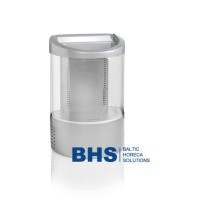
TEFCOLD VOC100, 103 l
749.00 €
Impulse items per day
7.5
2.5
Extra turnover per day
€18.75
€6.25
Turnover per month
€562.50
€187.50
Gross profit per month
€309.38
€103.13
After electricity
€296.70
€90.45
Average ticket grows by
7.5 c
2.5 c
The case pays back in
~2.5 mo.
~8.3 mo.
What this means
Even if only one customer in a hundred takes an impulse item, the case pays back in under a year; at 3 % — in ~2.5 months. This happens without a single new customer — the same people already standing at the till. The biggest lever is location and presentation, not the price of the case.
10 Installation and first start-up
A correctly installed case runs quieter, uses less energy and doesn't fog.
- Location — away from the sun, heaters and the hot air of the coffee machine; free space around the condenser as the manufacturer specifies (often about 10 cm).
- Climate class — for example JUKA MINI VARNA is class III; in a very warm room the case runs at full load.
- Electricity — a dedicated 230 V socket without extension leads; a separate circuit for large open cases.
- Level — adjustable feet; the lid or door closes by itself.
- Open case — not under air-conditioning flow or next to the entrance door: draughts break the cold air curtain.
- First start-up — after transport, wait the time the manufacturer specifies, switch on empty, reach temperature and fill with pre-chilled products.
11 Daily care, common mistakes and a story
Daily routine
- Morning: check the temperature, refill, pull products forward.
- During the day: fill gaps, wipe the glass, check prices.
- Evening: open cases — night blind or products into a fridge.
- Weekly: clean the inside, drain and seals.
- Monthly: dust the condenser (with the case unplugged).
- Yearly: maintenance — easiest with a maintenance contract.
- Products don't sell — bad spot, not visible or no price; Solution: move to the till, eye level, price tags
- Glass fogs — humidity, draught, lid left open; Solution: close, move away from doors, check the seal
- Case doesn't cool — dirty condenser, fan, thermostat; Solution: clean; if that doesn't help — call service
- Ice in the freezer — lid doesn't close, damaged seal; Solution: defrost, replace the seal
- LED is off — bulb or power supply; Solution: replace the bulb
- Noisy — fan, not level; Solution: level it, check the fan
Story: “The queue at the till”
Orla owns a small café. In the morning queue, people wait three or four minutes looking at their phones. Drinks were in a fridge behind the counter, and only those who asked bought them.
Orla puts a countertop case with desserts and drinks at the till, on the customer's right, with large price tags, and the barista offers one specific dessert with every coffee. The queue is no longer just waiting — it becomes a shop window for the case.
In July the case starts fogging and stops cooling. It turns out it sits next to the coffee machine and the condenser is clogged with dust. Following advice from BHS service, the condenser is cleaned and the case moved 20 cm away. Since then the condenser is cleaned every month.
If the case stops cooling
- Move perishable products to another fridge.
- Check the socket and the thermostat setting.
- With the case unplugged, clean the condenser.
- Call BHS service: +371 25 522 233 (24/7).
12 BHS service, maintenance and spare parts
BHS service — 24/7
We repair impulse display cases and other refrigeration equipment in our service workshop in Riga, Vagonu iela 23. Spare parts warehouse in Riga with delivery across the Baltics and Europe, certified technicians, more than 20 years of experience.
What BHS service does
Diagnostics and repair
In our Riga workshop: compressors, fans, thermostats, electronics, lighting.
Maintenance contract
Scheduled inspection, cleaning and adjustment, safety checks, timely parts replacement.
Spare parts in stock
Compressors, evaporators, thermostats, fans, bulbs — from our Riga warehouse.
Repair warranty
Repairs carried out in our workshop are covered by the BHS service warranty.
Spare parts for impulse display cases
Compressors
The heart of cooling: hermetic compressors for cases and freezers (R600a, R290 and others).
Refrigerator parts
Thermostats, seals, glass doors and other parts, TEFCOLD included.
| When | What to do |
|---|---|
| Daily | temperature, glass, refilling |
| Weekly | inside, drain, seals |
| Monthly | condenser dust, fan |
| Yearly | refrigeration system, electrics, lighting — easiest with a maintenance contract |
13 Impulse display cases in the BHS range
Eight models from a small countertop cooler to an upright case:
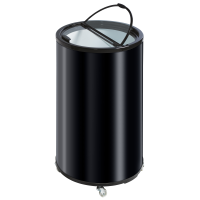
SCANDOMESTIC TK42BE, 37 l
Countertop drinks cooler with glass lid, +2…+10 °C, 445×445×735 mm, energy class B.
233.00 €
View product →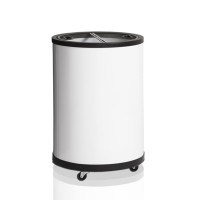
TEFCOLD CF78, 72 l
Impulse freezer, −22…−12 °C, 567×567×830 mm, flip-flop lid, dividers, R600a.
289.00 €
View product →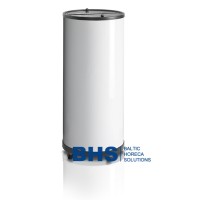
TEFCOLD CC55, 78 l
Cylindrical case, +2…+12 °C, 2 baskets, 84 × 0.33 l cans, castors, fan-assisted cooling.
399.00 €
View product →TEFCOLD VOC100, 103 l
+2…+12 °C, LED panel, 80 × 0.33 l cans, 660×460×970 mm, 0.16 kW.
749.00 €
View product →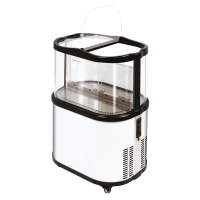
SCANDOMESTIC IM 111 E, 55 l
Curved front glass, LED, +2…+8 °C, 750×555×1010 mm, 2.4 kWh/24 h.
956.00 €
View product →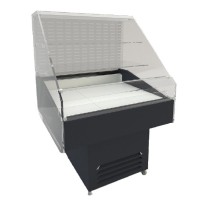
JUKA SOLO 90
Open self-service case, +2…+6 °C, 1.2 m², tempered glass shelves, R290.
2,599.00 €
View product →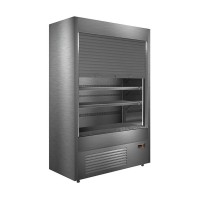
JUKA MINI VARNA 60
Upright, +4…+10 °C, 5 shelves, 0.92 m², top and side lighting, 600×620×2000 mm.
2,769.00 €
View product →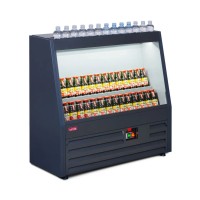
UNIS COOL DRINKCOOLER 900
Drinks case, +8…+10 °C, LED, 895×400×911 mm, 0.72 kW, R290.
2,799.00 €
View product →Prices excl. VAT, November 2026. 12-month warranty; after that — BHS service, maintenance contract and spare parts.
14 Frequently asked questions
What an impulse purchase is
An unplanned purchase the customer decides on in a few seconds at the point of sale — a drink, ice cream or dessert at the till.
Where to place an impulse case
Where the customer waits: at the till on the customer's right, on the counter 30–50 cm from the payment point or along the queue. Not right at the entrance.
Which products to put in it
Single-portion, high-margin products with a small price next to the main purchase that go with it — coffee and dessert, lunch and a drink.
How many product types
6–10 in a small countertop case, one idea per case. Too much choice stops the impulse.
Whether an impulse case must be refrigerated
For drinks, dairy, desserts and ice cream — yes. A non-refrigerated case works for chocolate and biscuits.
How fast the case pays back
In our example a VOC100 (€749.00) at 250 tickets a day pays back in ~2.5 months if 3 % of customers take one item, and ~8.3 months at 1 %.
Whether BHS repairs and maintains impulse cases
Yes. BHS service repairs display cases in its Riga workshop, offers a maintenance contract, and customer service is available 24/7: +371 25 522 233.
Whether spare parts are available
Yes. Compressors, fans, thermostats, bulbs and other parts are in the BHS warehouse in Riga and shipped across the Baltics and Europe; if something is missing, our service will help order it.
Let's bring your product closer to the customer
Tell us what you sell and where your customers wait. We will recommend an impulse display case, its location and presentation, and then take care of maintenance, repair and spare parts.
Call: +371 25 522 233Impulse display casesRetail display casesService
Related articles
This article is for information only. Temperatures, conversion and the calculation are approximate — calculate with your own numbers. Set food safety values in your HACCP plan. The characters in the story are fictional. Prices excl. VAT, November 2026.