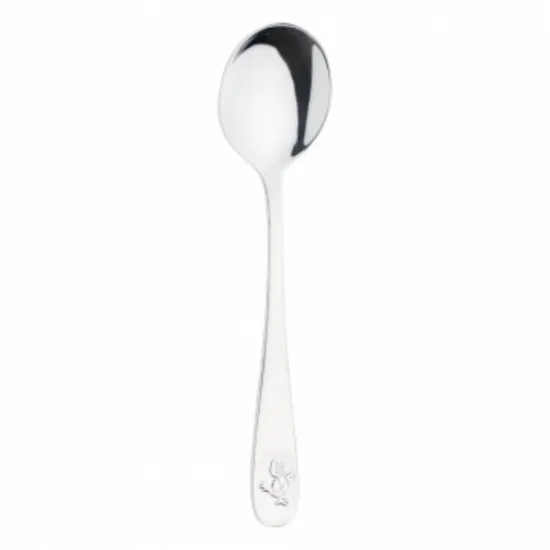
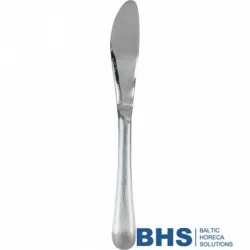
Children's cutlery is a specialised product segment that reflects dining establishments' care for their youngest guests. Well-designed children's cutlery makes self-service easier, helps children learn to hold cutlery correctly and creates a positive dining experience, which also helps build loyalty among parents.
Size and ergonomics
Children's knives and spoons are 15–18 cm long — approximately 20–30% smaller than adult versions. This size matches the hand proportions of children aged 3–10 and allows for targeted holding of the cutlery. The handle is usually thicker and more rounded, ensuring a better grip and reducing the risk of dropping the cutlery.
Children's knives are always with a rounded blade — a safe knife profile reduces the risk of cuts from accidental pressure. Fork tines are shorter and more rounded, reducing the risk of puncture. The spoon has a flat base to prevent tipping on the table.
Materials and safety
Professional children's cutlery for dining establishments is made from 18/10 stainless steel, which is completely safe for contact with food and meets European food contact requirements. This material does not release any substances that a child's body could absorb even with prolonged use. Stainless steel is easy to disinfect and withstands high dishwasher temperatures.
Plastic or silicone children's cutlery is an alternative more commonly used in households, but less suitable for professional dining — it is less hygienic (develops scratches where bacteria accumulate) and does not withstand long-term intensive dishwashing cycles.
Use in different establishments
Hotel restaurants and family eateries — a children's cutlery set for a complete table setting matching the adult service style, only in a reduced format. School canteens and kindergarten kitchens — reinforced and ergonomic series suitable for intensive daily use with younger children (from 2–3 years). Canteens with a family format — an available reserve of children's cutlery, pre-placed at the table to adapt service for regular family guests.
Inventory planning
The volume of children's cutlery should be planned according to the average number of children per meal. It is recommended to calculate 15–20% of the maximum seating capacity as a children's set, with three times that amount for rotation during the dishwashing cycle. In hotels where families with children are regular customers, this portion can reach 30% of the total tableware inventory.
Styling
Professional children's cutlery is usually made from the same material and stylistic series as the main adult cutlery — thus the table setting maintains visual unity. Decorative children's series with pastel tones or animal motifs are also often available, suitable for children's restaurants or establishment canteens with a strong children's focus.
Age groups and cutlery suitability
Choosing children's cutlery by age group is an important safety and ergonomics requirement. For the youngest children (two to four years), spoons with a flat blade and thicker handle are suitable. Older children (five to ten years) are suited to forks and knives with a medium-sized handle. Teenagers usually use standard café cutlery in a smaller format. The correct size promotes proper eating habits.
Safety standards and certification
Children's cutlery used in a professional environment must meet European food contact material requirements. Stainless steel is one of the few materials that fully complies with these requirements, even for tableware intended for children. Plastic or silicone cutlery may contain softeners whose effects on children are less predictable, so stainless steel is the preferred choice in a professional environment.
Washing and intensive use
Children's cutlery in canteens and school cafeterias undergoes intensive washing cycles — dozens of times a day in the dishwasher. Stainless steel cutlery withstands this load without colour damage or shape changes. Plastic cutlery wears out quickly under such intensity and develops scratches, which not only look bad but also create hygiene risks.
Differences between household and commercial cutlery
Household children's cutlery and professional HoReCa children's cutlery differ in durability and hygiene standards. Household cutlery is not designed for commercial dishwashing cycles and can be damaged after hundreds of machine washes. Professional cutlery is made with a different material thickness to ensure longevity in intensive rotation. Investing in professional cutlery is more cost-effective in the long term.
Requirements for kindergartens and school canteens
Kindergartens and school canteens have special requirements for children's dining equipment. Tableware and cutlery must meet the ergonomic needs of the age group and be easy to disinfect. In school canteens with hundreds of children per day, the cutlery inventory is larger — usually one and a half to two sets per child to ensure the necessary rotation. Planning must also account for natural losses for replacement.
Stock planning
When planning children's cutlery inventory, fifteen to twenty percent of the total number of guests should be accounted for as children if the business actively serves the family segment. Reserves should be planned in double the quantity so that the available inventory is not depleted during dishwashing. Regular inventory checks allow for timely replenishment of lost or damaged cutlery.
Cutlery storage and organisation
Children's cutlery should be stored separately from adult sets to ensure quick separation during service. Specially marked sections in the tableware storage area make access easier and reduce the risk of errors. Such organisation speeds up the service process and ensures that each child guest receives an appropriate, ergonomic cutlery set.
Why choose BHS?
BHS – Baltic HoReCa Solutions supplies professional equipment for restaurants, cafés, hotels and canteens: more than 20,000 products from many manufacturers. Our specialists help you choose the right equipment and spare parts for your kitchen or bar.
Delivery
We deliver across the European Union. Delivery time and cost depend on the order volume and destination — contact the BHS team for an exact price and lead time.