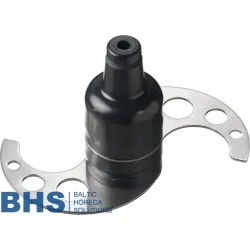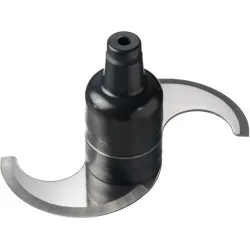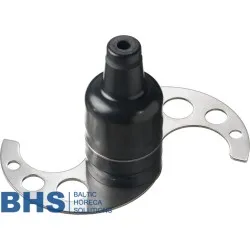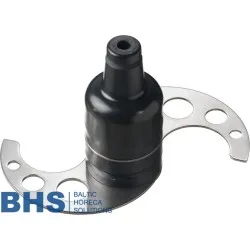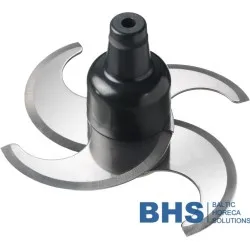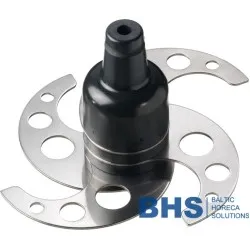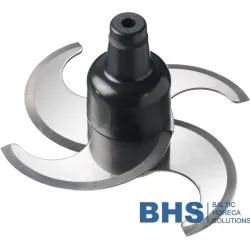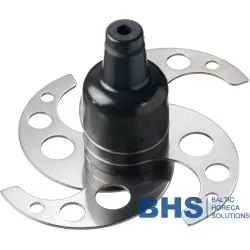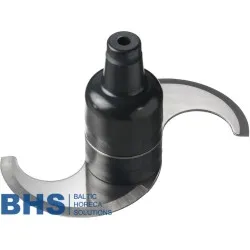
Knives for cutters — professional cutter knives for mincing and emulsifying meat, fish, vegetables and food mixtures in restaurants, meat processing businesses and food production facilities. Cutter knives are the main working part of a cutter — their sharpness and technical condition directly determine the efficiency of mincing, the uniform consistency of meat mixtures and the quality of the finished product. Timely replacement or sharpening of professional cutter knives is a mandatory maintenance task that ensures consistent mincing results, high-quality meat emulsion and prevents cutter motor overload during intensive daily commercial use.
Explore other professional electromechanical kitchen equipment and their accessories.
Cutter knives are an essential part of the meat processing and food preparation process in a professional commercial kitchen — their regular maintenance and timely replacement ensure quality production and equipment longevity.
Types and construction of cutter knives
Cutter knives are available in various types according to the cutter size and mincing task. Flat knives for cutters — flat S-shaped or straight cutter knives for mincing meat and fish; designed for fast cutting at high speeds. Curved knives for cutters — curved cutter knives for better product movement in the bowl during the mincing process; optimal emulsification. Double-sided knives for cutters — double-sided cutter knives with blades on both sides; extends service life as they can be turned. Hub diameter knife options — cutter knives with different hub diameters to match the spindle size of a specific cutter model; the cutter model must be specified before ordering. Also explore cutters.
Signs of wear and replacement time for cutter knives
Monitoring the condition of cutter knives is important for production efficiency and food quality. Deterioration in mincing quality — a worn cutter knife does not create a uniform emulsion; uneven fractions remain in the meat mixture. Increased meat temperature — a worn cutter knife creates friction instead of cutting; the product temperature rises during mincing; this is critical for meat emulsion. Increased motor load — worn cutter knives require more motor power to achieve the same result; increased motor operating noise. Longer mincing time — cutter knives with a worn blade require a longer mincing time.
Sharpening and correct use of cutter knives
Correct use and maintenance of cutter knives ensure optimal mincing results. Product temperature — place cold meat in the cutter for processing; the temperature increases during the mincing process; cold product ensures better emulsion. Knife balancing — cutter knives must be mounted in pairs symmetrically; unbalanced knives cause vibration and accelerate cutter bearing wear. Avoiding overload — do not place too much product in the cutter bowl; overfilling damages the knives and motor. Permissible products — cutter knives are designed for meat, fish, vegetables and combined mixtures; do not put bones or very hard products in the cutter. Also explore electromechanical kitchen equipment.
Cleaning and hygiene of cutter knives
Regular cleaning of cutter knives is a mandatory hygiene requirement for meat and food processing equipment. After each session — remove and wash cutter knives separately; knives must only be removed when the equipment is completely stopped and discharged. Safe cleaning — cutter knives have sharp blades; use a special knife cleaning tool or protective gloves for cleaning. Disinfection — disinfect cutter knives after washing with disinfectants suitable for food contact; disinfection is mandatory for meat processing equipment. Drying — dry cutter knives immediately after washing; moisture promotes corrosion on the blade metal. Also explore cutters.
HoReCa usage scenarios
Meat processing business with a cutter — monthly knife inspection; replacement or sharpening in case of wear. Restaurant with a cutter for sausage and filling preparation — regular replacement of cutter knives to ensure high-quality emulsion. Food production facility with high cutter usage intensity — a set of spare knives for quick replacement.
Frequently asked questions
Should cutter knives be replaced or can they be sharpened? Cutter knives can be sharpened several times; sharpening is suitable if the blade is only worn but not damaged; knives with cracks or deformation must be replaced; BHS specialist helps choose the solution. See cutters.
How to determine which knives are suitable for a specific cutter model? Specify the cutter model designation; the hub diameter and shape of cutter knives are model-specific; BHS specialist helps identify the appropriate knives.
Why choose BHS?
BHS – Baltic HoReCa Solutions supplies professional equipment for restaurants, cafés, hotels and canteens: more than 20,000 products from many manufacturers. Our specialists help you choose the right equipment and spare parts for your kitchen or bar.
Delivery
We deliver across the European Union. Delivery time and cost depend on the order volume and destination — contact the BHS team for an exact price and lead time.