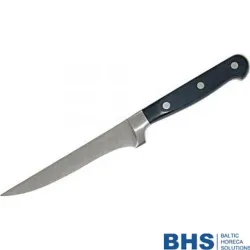
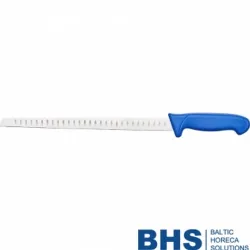
A filleting knife is a specialist tool that differs from a general kitchen knife with its flexible blade — it allows the knife to follow the shape of the product, separating the fillet with one smooth motion. When used correctly, a filleting knife allows you to obtain the maximum amount of meat or fish, which a shaky or uncoordinated hand with an unmatched cutting tool could never achieve. BHS supplies filleting knives to HoReCa businesses across Europe.
Types of filleting knives and flexibility
Very flexible fish filleting knives — a thin, long blade (18–25 cm), which bends almost perpendicularly. Designed for fresh fish with delicate flesh and for filleting large fish, where blade flexibility allows it to follow the rib bone contour. Semi-flexible filleting knives — a medium-flexibility blade (15–20 cm), suitable for both fish and white meat. More versatile for everyday use. The stiffest filleting knives — a less flexible blade, suitable for separating meat from bones, where a stiffer blade provides better control. Filleting knives with a hook — separate models with a special hook for removing skin from fish fillets. SANELLI filleting knives — premium knives from an Italian manufacturer with top-grade steel blades for professional use. BHS helps choose the flexibility level.
Blade length and material
Shorter filleting knives (15–18 cm) — for precise work with smaller fish (trout, dorado, sprat) or poultry filleting. Longer filleting knives (20–30 cm) — for large fish (salmon, pikeperch, tuna) and large pieces of meat, where one smooth sliding motion over the full length ensures a cleaner cut. Blade steel: high-alloy stainless steel with a hardness of HRC 54–58 ensures sharpness and flexibility without the risk of breaking. Grinding: a flattened blade is more flexible and lighter; a grooved blade reduces friction and food sticking. BHS advises on blade length and profile selection.
HACCP and hygiene requirements
Filleting knife handles must comply with HACCP — smooth, non-porous, made from food-grade materials. The blue HACCP colouring indicates that the knife is intended for fish and seafood — this prevents cross-contamination with meat products. After filleting fish, the blade must be thoroughly washed with warm water and a disinfectant — fish oils and proteins are a good breeding ground for bacteria. Regular sharpening is not only a matter of productivity but also safety — a sharp blade requires less force and reduces the risk of accidents. BHS helps implement HACCP knife maintenance.
HoReCa usage scenarios
In a fish restaurant, a chef with a good filleting knife can obtain a fillet from fresh salmon, leaving minimal meat on the bones — every gram saved is product value. In a seafood bar, a fast filleting knife allows processing a large quantity of fresh fish before the evening service. In a sushi restaurant, an ultra-thin and sharp filleting knife is absolutely essential for precise slicing of sashimi. In a hotel restaurant offering fresh fish, filleting knife skill and quality directly impact portioning efficiency and waste.
Frequently asked questions
Which filleting knife length should I choose? For smaller fish and poultry — 15–18 cm. For medium-sized fish (trout, dorado) — 18–21 cm. For large fish (salmon, pikeperch, tuna) — 24–28 cm. A longer knife provides one smooth motion over the full cutting length. BHS helps calculate the optimal length based on the daily product type.
Can filleting knives be sharpened at home? Yes — sharpening a filleting knife with ceramic or diamond rods and sharpening stones is possible, but the direction of the thin and flexible blade must be observed. Incorrect sharpening can damage the blade profile. BHS recommends periodic professional sharpening services. Also explore Knife Sharpeners.
Why choose BHS?
BHS – Baltic HoReCa Solutions supplies professional equipment for restaurants, cafés, hotels and canteens: more than 20,000 products from many manufacturers. Our specialists help you choose the right equipment and spare parts for your kitchen or bar.
Delivery
We deliver across the European Union. Delivery time and cost depend on the order volume and destination — contact the BHS team for an exact price and lead time.