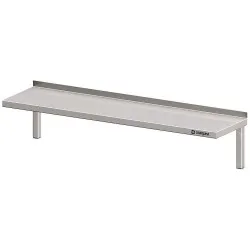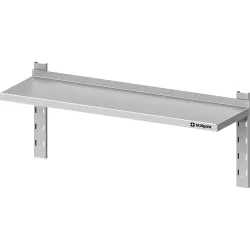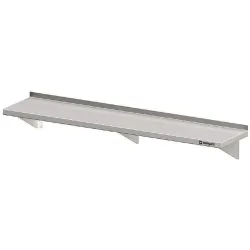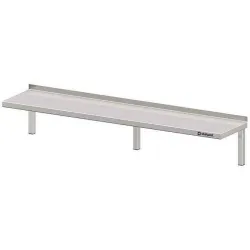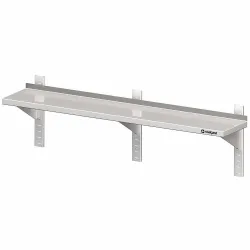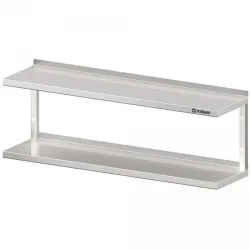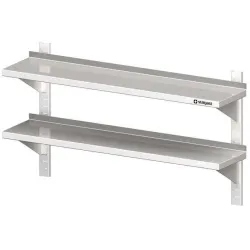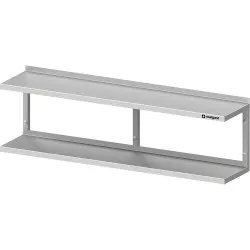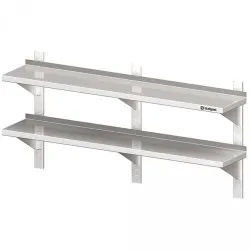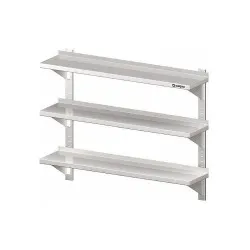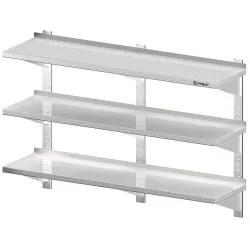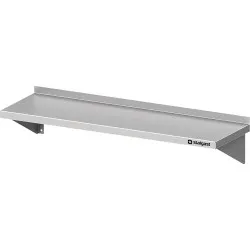
The Wall Shelves category’s Non-Rusting Stainless Steel Wall Shelf Economic Class is a practical solution for HoReCa businesses that need a functional wall shelf at a reasonable price. The Economic Class series delivers the key benefits of stainless steel—hygiene, durability and easy cleaning—at a lower price point, making it especially suitable for start-ups, small cafés and businesses equipping a large number of identical kitchen stations. The Non-Rusting Stainless Steel Wall Shelf Economic Class is ideal for small cafés, kitchen annexes and utility rooms where reliability and hygiene at a reasonable price are important. BHS offers Economic Class wall shelves as part of its Stainless Steel Furniture range.
Explore other Wall Shelves options and other Stainless Steel Furniture for complete kitchen equipment.
Wall shelves are an indispensable element in any professional kitchen—they optimise vertical space, provide easy access to frequently used items and keep work surfaces tidy. The Economic Class wall shelf offers these benefits at a reasonable price, making them accessible to businesses with a limited equipment budget.
Economic Class characteristics
Economic Class means a simplified construction with a thin stainless steel surface and a standardised mounting system. The shelf surface is smooth, hygienic and easy to clean—meeting the same food safety requirements as premium class models. The difference lies mainly in the material thickness and the quality of the mounting finish, not in safety or hygiene properties.
Economic Class shelves are certified to meet the standards applicable to food processing areas. Stainless steel (EN 1.4301 or equivalent grade) ensures corrosion resistance and the ability to disinfect with standard alkaline cleaning agents.
Dimensions and load capacity
Wall shelves are typically available in widths from 400 mm to 1500 mm with a depth of 200–400 mm. The load capacity of Economic Class shelves is usually 30–60 kg per shelf, which is sufficient for most everyday kitchen items. For heavier items (large pots, bulk storage), reinforced premium class models are recommended.
Mounting
Mounting wall shelves to the wall requires correctly chosen screws and mounting elements according to the wall material. For brick or concrete walls, plastic expansion dowels or fixing anchors should be used. For lightweight plasterboard or metal frame walls, special fixings with a wider support are necessary. Professional installation of wall shelves is recommended to ensure the permissible load.
Standard mounting hardware is usually included with Economic Class models. A detailed assembly instruction is provided with each shelf.
Hygiene and maintenance
Wall shelves should be cleaned at least once a week with an alkaline cleaning agent and wiped dry. Regular disinfection should be carried out in accordance with the company’s HACCP system. Stainless steel withstands most food-grade cleaning agents—avoid strong acids containing chlorine (which can damage the surface), but standard sanitary agents are fully compatible.
Regular cleaning prevents food residue and condensation from affecting the material. Timely treatment of scratched surfaces extends the shelf’s service life.
HoReCa applications
Economic Class wall shelves are a popular solution for small cafés and bars where space utilisation is critical but the budget is limited. They are also suitable for kitchen corners and utility rooms—storage areas, service corridors and delivery zones where premium aesthetics are not a priority. Shelves are also ideal for temporary or seasonal kitchens, where the scale of investment should match the intensity of use.
High capacity at a lower price allows purchasing a larger number of shelves in a single order, effectively equipping the entire kitchen with the necessary wall storage system.
Shelf installation tips
Installing wall shelves requires appropriate tools and experience working with different wall materials. Before installation, check the wall’s load-bearing capacity and determine the optimal height for access based on the staff’s height. The shelf should usually be secured with at least four mounting points to distribute the load evenly and prevent warping.
Planning the number of shelves
The number of shelves in the kitchen should be planned according to the volume of inventory and the available wall space. Optimal kitchen equipment includes shelves at each work zone—preparation, thermal processing, washing and storage—to reduce movement time. Proper shelf placement significantly increases kitchen efficiency and allows staff to work quickly and comfortably.
Organisation on the shelf
Effective use of wall shelves requires a disciplined storage system—each item should have a designated place that staff adhere to. Frequently used items should be placed at eye and hand level. Less frequently used items should be placed higher or lower. A clear storage system reduces search time and prevents chaos during busy periods.
Comparison with premium class
The Economic Class differs from the premium series mainly in material thickness and finish precision, not in hygiene or safety properties. Premium models are more mechanically durable and retain their aesthetics longer under intensive use. The Economic Class is suitable for medium loads and is not intended for areas with maximum mechanical impact, such as intensive portioning zones in large canteens.
Combining shelves
Economic Class wall shelves can be successfully combined with other wall storage elements—wall rails, hooks and closed wall cabinets. A consistent visual style with stainless steel elements maintains a professional appearance. This combined approach allows the use of different storage formats in one zone: shelves for larger dishes, rails for small items, hooks for tools.
Kitchen equipment budget
When setting up a new business or renovating a kitchen, the wall shelf budget is a separate item. Choosing Economic Class shelves can save 30–50% on wall storage system costs compared to premium class. These savings can be used to install shelves in utility rooms and corridors where premium aesthetics are not necessary.
Long-term investment approach
Economic Class shelves can serve as an initial equipment solution with the option to gradually replace them with premium models. This approach allows businesses to develop kitchen infrastructure in line with growing turnover and financial capabilities. Many cafés use this strategy, initially equipping their business with Economic Class shelves.
Why choose BHS?
BHS – Baltic HoReCa Solutions supplies professional equipment for restaurants, cafés, hotels and canteens: more than 20,000 products from many manufacturers. Our specialists help you choose the right equipment and spare parts for your kitchen or bar.
Delivery
We deliver across the European Union. Delivery time and cost depend on the order volume and destination — contact the BHS team for an exact price and lead time.