
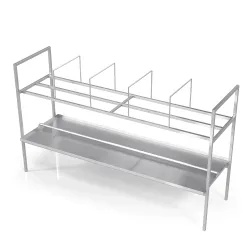
Sorting Table B is a stainless steel sorting table for the initial position in the dishwashing area, differing from the A version with specific dimensions or structural solutions tailored to a particular kitchen layout. The sorting table provides an organised space for the pre-treatment of dirty dishes before washing. During the sorting stage, dirty dishes are separated by type and level of soiling before being placed in the dishwashing machine. The stainless steel construction withstands intensive working conditions and meets HACCP requirements. The B version is suited to a specific kitchen layout and space arrangement that differs from the standard A version configuration. BHS offers this table as part of the Stainless Steel Furniture for the Dishwashing Area range to HoReCa businesses across Europe.
See also Sorting Table A.
Sorting Table B is a stainless steel dishwashing table for organising the sorting stage, offering an alternative configuration compared to the A version. The B version meets specific kitchen layouts where the flow of dishes comes from a particular side or where space dimensions dictate special requirements. The sorting table is the first stage in the dishwashing conveyor, where dirty dishes are separated before being placed in the dishwashing machine. This organisation is important for HoReCa businesses.
The importance of the sorting stage in the dishwashing area
The sorting table is the starting point of the dishwashing process, where all dirty dishes from the dining area are arranged before being placed in the dishwashing machine racks. Proper sorting ensures more efficient washing—dishes with similar levels of soiling are grouped and processed with the appropriate washing cycle. During the sorting stage, larger food residues are also removed, protecting the dishwashing machine from overload. Effective sorting saves time and resources.
Specifics and differences of the B version
Sorting Table B is designed for a specific kitchen layout where the dimensions or configuration of the A version do not meet space requirements. The B version may offer a different length, width, or placement position that better suits the flow of dishes from the dining area to the dishwashing area. The availability of different versions allows for more precise adaptation of dishwashing equipment to any kitchen layout and space configuration.
Comparison with the A version
Compared to Sorting Table A, the B version is better suited for dish flow from the opposite side or other space configuration requirements. The A version is the standard, but the B version provides an alternative when the A version does not fit the specific space. BHS helps assess which version is suitable for a particular kitchen layout, considering the direction of dish flow and available space.
Pre-treatment on the sorting table
On the sorting table, staff remove food residues from plates, group dishes, and fill racks before placing them in the dishwashing machine. Effective pre-treatment ensures better washing results and protects the dishwashing machine’s filters and pumps from large debris particles. The stainless steel table surface is easy to clean and resistant to impacts from dishes and water jets.
Hygiene organisation in the sorting stage
The sorting table must be organised so that dirty dishes and racks never mix with clean ones. Visual separation between the dirty and clean dish zones is a HACCP requirement. The sorting table with a stainless steel surface is disinfected several times during a shift, as it is in constant contact with dirty dishes. BHS advises on hygiene organisation in the dishwashing sorting stage.
Ergonomics in sorting work
The height and width of the sorting table should be chosen so that staff can work in a comfortable and ergonomic position during long shifts. An appropriate table height reduces back strain, while sufficient width allows for processing more dishes simultaneously. The sorting stage is physically intensive, so ergonomically correct equipment directly impacts staff productivity and health.
Integration into the dishwashing conveyor
Sorting Table B is the first stage in the dishwashing conveyor and must integrate with the rack input mechanism at the front of the dishwashing machine. The table height must align with the dishwashing machine’s rack input height to ensure smooth rack movement. Proper integration ensures uninterrupted rack flow and prevents stoppages or rack stacking at the input point.
Space planning for the sorting area
The sorting table’s placement should be planned to ensure easy access from the dining area and convenient rack input into the dishwashing machine. A sufficiently wide aisle next to the table should be provided for staff movement, as well as space for a waste container to collect large food residues. The sorting area is a high-activity point, so the space layout must be both functional and safe.
Maintenance and cleaning
Daily maintenance of Sorting Table B includes cleaning and disinfecting the table surface, side rails, and legs several times during and after each shift. Contact with dirty dishes and food residues requires more frequent disinfection compared to other dishwashing stages. The stainless steel surface is chemically resistant to disinfectants and easy to clean. BHS advises on cleaning methods.
Stainless steel durability
Stainless steel provides the sorting table with the necessary durability against dirty dishes, moisture, food acids, and disinfectant chemicals. In the sorting stage, the table surface is exposed to intensive mechanical and chemical stress, so high-quality stainless steel is a mandatory requirement. Durable equipment reduces replacement costs and ensures a stable working environment in HoReCa businesses.
The importance of investment for long-term kitchen operation
Purchasing Sorting Table B is a long-term investment in efficient dishwashing organisation and easier daily operations. A well-organised and ergonomic sorting stage directly impacts washing speed, dish turnover intensity, and staff satisfaction with the working environment. Choosing equipment tailored to the specific kitchen layout and rack system ensures long-term benefits. BHS helps assess the return on investment and select the most suitable version.
Frequently asked questions
What is the main difference between Sorting Tables A and B?
The A and B versions differ in dimensions or configuration to suit different kitchen layouts. BHS helps choose the most suitable version, considering the direction of dish flow.
Should the sorting table include rack retention guards?
The sorting table configuration may include additional guards for rack retention. BHS advises on available configurations and the most suitable solutions.
Why choose BHS?
BHS – Baltic HoReCa Solutions supplies professional equipment for restaurants, cafés, hotels and canteens: more than 20,000 products from many manufacturers. Our specialists help you choose the right equipment and spare parts for your kitchen or bar.
Delivery
We deliver across the European Union. Delivery time and cost depend on the order volume and destination — contact the BHS team for an exact price and lead time.