

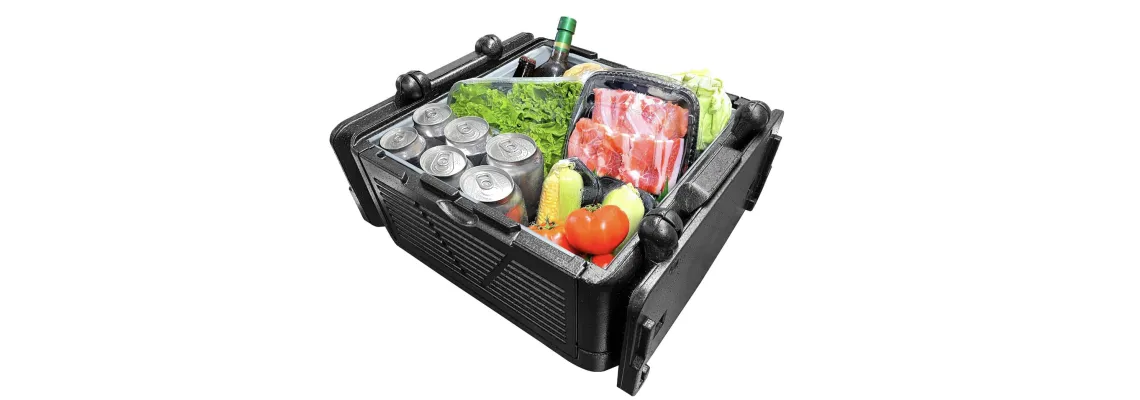
Thermoboxes: transporting food in cold and heat with GN containers
One thermobox holds both heat and cold — in winter and in summer. A practical guide to arranging GN containers and correctly separating hot, cold, liquid and solid loads so food arrives safe and at the right temperature.
What a thermobox is and why you need one
A thermobox is an insulated container that stops heat and cold escaping. It does not heat or chill food itself — it keeps whatever temperature is already inside.
Professional thermoboxes are made of durable insulating material — expanded polypropylene (EPP), polyurethane or thick‑walled plastic. The best EPP models tolerate −40 to +120 °C, meet HACCP requirements, are light, easy to clean and designed to fit GN containers. They are used for catering deliveries, off‑site banquets, canteen and school food transport, restaurant deliveries and event buffets.
A thermobox works only as well as it is prepared. For a hot load, briefly rinse the box with hot water (or pre‑warm it); for a cold load, chill it and add ice packs. A half‑empty box loses temperature faster than a full one.
In winter cold and summer heat
Insulation works both ways — it keeps heat in during winter just as well as it keeps heat out in summer. That is why one good thermobox serves all year round:
Keeps the heat in
Hot soup, stew or roast meat won't freeze or go lukewarm while the vehicle stands in the cold. For a cold load the frost even helps — frozen or chilled products stay in a safe range more easily.
Keeps the heat out
Salads, desserts, dairy and raw products stay cool even at +30 °C. With ice packs a thermobox becomes a portable fridge that respects food‑safety temperatures.
The key principle in both seasons is the same: never mix hot and cold in one box. The hot will warm the cold, the cold will chill the hot, and both end up at the wrong temperature. Hot and cold loads go in separate boxes.
Arranging GN containers in a thermobox
Thermoboxes are built to the GN (Gastronorm) standard — the European norm EN 631 that almost the whole professional kitchen works to. So GN containers slide in precisely, with no gaps, and can be stacked in several layers.
The base is GN 1/1 (530×325 mm). Every other size is a fraction of it, so they combine like a puzzle in one layer:
| GN size | Approx. (mm) | Fits in GN 1/1 area |
|---|---|---|
| GN 1/1 | 530 × 325 | 1 |
| GN 1/2 | 325 × 265 | 2 |
| GN 1/3 | 325 × 176 | 3 |
| GN 1/4 | 265 × 162 | 4 |
| GN 1/6 | 176 × 162 | 6 |
Depth is a separate variable: GN containers come in 20, 65, 100, 150 and 200 mm. Choose depth by the content — shallow (20–65 mm) for roast meat and vegetables, deep (100–200 mm) for soups, sauces and stews. Lids and seals are essential for liquids and to contain odours.
Put heavy, deep containers (soups, sauces) at the bottom and light, shallow ones on top. That keeps the load balanced and stops deep containers spilling as the box moves. Polypropylene GN containers (−40…+85 °C, HACCP) are light and travel well.
What to carry and how: liquid, solid, hot, cold
A thermobox can carry almost anything — what matters is the right container and the right temperature group:
| Load | Container / solution | Group |
|---|---|---|
| Soups, sauces, broths (liquid) | Deep GN 1/2 or 1/3 (150–200 mm) with airtight lid | Hot |
| Roast meat, roasted vegetables (solid) | Flat GN 1/1 or 1/2 (65 mm) with lid | Hot |
| Boiled potatoes, rice, pasta | GN 1/2 (100 mm) | Hot |
| Salads, cut vegetables | GN 1/3 with lid + ice pack | Cold |
| Desserts, creams, dairy | GN 1/6 or sealed containers | Cold |
| Drinks, hot coffee, tea | Drink thermos or percolator | Separate |
Always use a sealed container for liquids and don't fill to the brim — leave 2–3 cm so it doesn't spill in transit. Carry hot coffee and drinks in separate drink thermoses, not in GN containers.
Example: how to divide the load correctly
Say you need to deliver lunch for 40 people at an off‑site event — a main course, sides, salad and dessert. The right answer is two separate thermoboxes — one for hot, one for cold — each filled with GN containers and no gaps:
In the hot box the deep stew container sits at the bottom, the flat sides on top. In the cold box, ice packs go under the GN containers, and salad and dessert stay separate from the hot so they don't warm up. Each box is full — the less empty air, the longer the temperature holds.
Load at the last moment and travel with the box full. If space is left between containers, fill it with a clean towel or a spare lid — the gap speeds up temperature loss by exactly as much as the last customers will miss.
Hygiene, HACCP and care
- Respect the temperature limits. Keep hot food above +63 °C and cold below +5 °C — the middle zone is where bacteria multiply. A thermobox helps hold, but does not replace a correct starting temperature.
- Don't mix groups. Hot, cold and raw products go in separate boxes, or at least in sealed, labelled GN containers.
- Clean after every run. EPP and plastic boxes wash easily; use food‑safe products and let them dry fully to avoid odours.
- Check seals and lids. A damaged seal means spills and heat loss. Spare lids and seals are a cheap way to extend a box's life.
How to choose a thermobox
The choice comes down to volume, load and transport method:
- Volume. A 40–50 l GN 1/1 box suits daily deliveries; large events need several boxes or taller ones with 2–3 GN layers.
- Material. EPP — light with a wide temperature range; thick‑walled plastic — robust for everyday load.
- Loading. Top‑lid boxes are easy to stack; front‑door boxes are quick to unload on deliveries.
- Accessories. Ice packs for cold loads, heating elements for hot, spare seals and lids.
- GN compatibility. Make sure the box fits your GN container size and depth.
If you carry both hot and cold, plan for at least two boxes from the start — that is a basic hygiene requirement, not an added convenience.
Let's choose thermoboxes and GN containers for your deliveries
YourHoReCa offers a full range of food thermoses, thermoboxes, GN containers and accessories — for catering, restaurant and event logistics, HACCP‑compliant, with delivery across the Baltics and Europe. We'll help match the box to your GN containers.