

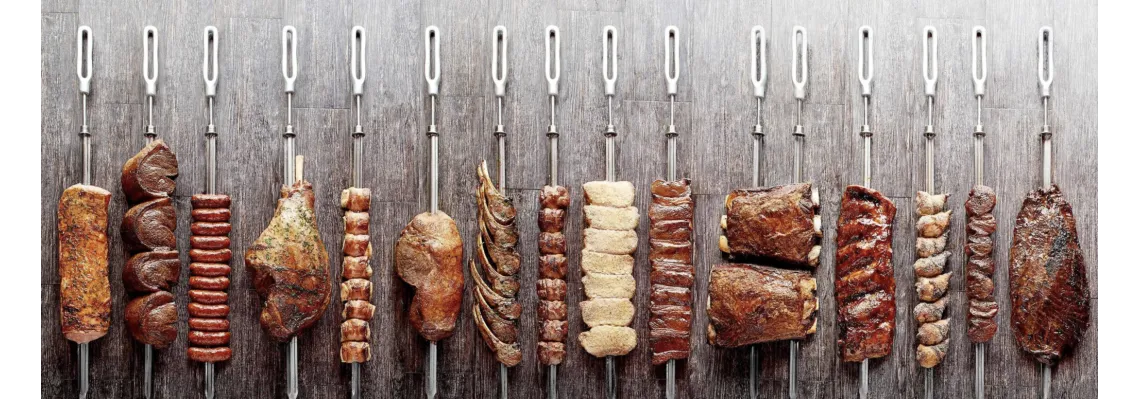
Rotisserie grills: meat, fish, vegetables and a recipe on the spit
A simple rotating spit and a self-basting effect — the food cooks in its own juices, forming a crisp crust without drying out and without manual turning. What to grill on a rotisserie and how to spit-roast a chicken step by step.
What a rotisserie grill is
A rotisserie grill is a grill with a rotating spit that cooks food evenly from every side with no manual turning.
Its main advantage is the self-basting effect: as the food turns, its fat and juices run over the surface and moisten it continuously. The result is a golden-brown, crisp crust and a juicy interior that's hard to achieve on a static grill. Staff involvement is minimal: load the product, set temperature and time, and the machine does the rest.
The design is deliberately simple — the food just rotates on the spit, with no conveyor, no lifting grates and no complex moving parts. Fewer mechanisms mean fewer breakdowns and a longer service life under heavy use.
How it works
Rotating spit
An electric motor or mechanical drive turns the spit at a steady speed, exposing the food to heat from all sides.
Heat source
Electric or gas burners at the side or rear of the product; heat spreads directly and by reflection.
Self-basting
Melting fat runs over the surface like a natural glaze — the crust turns crisp, the inside stays juicy.
Drip tray
A tray under the spit collects the fat; use it for basting or empty it after the shift.
An electric model is easier to install and gives finer temperature control; a gas model reaches higher temperatures and a more pronounced grilled flavour. For catering with no mains power, a gas rotisserie with LPG cylinders is the most convenient option.
What to grill: meat, fish, vegetables
A rotisserie suits anything that benefits from even cooking all around. The three main product groups:
- Whole chicken (45–60 min)
- Pork shoulder, ham (2–4 h)
- Leg of lamb, roulade
- Kebab / shawarma on a vertical spit
- Whole fish in a grill basket
- Thicker steaks (salmon, tuna)
- Fish skewers with vegetables
- Peppers, courgette, onion
- Potatoes, sweet potatoes
- Vegetable skewers under the meat
For a versatile option there is also a chicken, fish and vegetable grill; for delicate products, an electric griddle or a contact grill.
Recipe: spit-roasted chicken with vegetables
A simple, reliable recipe that shows off the rotisserie's self-basting — the chicken moistens both itself and the vegetables beneath it.
Spit-roasted whole chicken with vegetables
Crisp skin, juicy meat, vegetables in the chicken's juices
Ingredients
- 1 whole chicken (1.2–1.5 kg)
- 3 tbsp olive oil
- 2 tsp salt
- 1 tsp freshly ground pepper
- 2 tsp sweet paprika
- 3 garlic cloves (crushed)
- 1 lemon (juice and zest)
- Thyme or rosemary
- 1 pepper, 1 courgette, 1 onion (for the tray)
Method
- Mix olive oil, salt, pepper, paprika, garlic, lemon juice and zest into a marinade.
- Rub the chicken with the marinade, also under the skin; ideally leave 1–2 h in the fridge.
- Truss the legs and wings tightly to the body so it rotates evenly and nothing catches.
- Mount the chicken on the spit, secure it and make sure it is balanced.
- Cut the vegetables into large pieces and spread them in the drip tray under the spit.
- Set 200–220 °C and rotate 45–60 min until the skin is golden and crisp.
- Check with a thermometer in the thickest part of the thigh — it must reach +74 °C.
- Rest the chicken 10 min, then carve and serve with the grilled vegetables.
Don't over-salt the vegetables separately — they take their flavour from the chicken's fat and juices. If roasting several chickens, choose a multi-spit model and use birds of the same size so their cooking times match.
Types and capacity
Choose a rotisserie by volume and menu:
Single-spit grill — 1–4 chickens or one large cut of meat; handy for a smaller restaurant or as an extra unit. Multi-spit grill — 6–30 chickens at once; for high-turnover venues. Vertical-spit (kebab) grill — for shawarma and kebab. Heat source — electric for easier control or gas for higher temperature and catering.
In hotel buffets a chicken turning on the spit doubles as a visual 'culinary show' in front of guests. See the full grill range for more options.
Care, hygiene and safety
Spit — wash after every shift with hot water and a degreaser; hardened fat makes the next cook harder. Drip tray — empty and clean after every shift or more often; an overfilled tray is a fire risk. Gas burner — clear fat deposits so the flame stays even. Grill interior — weekly with a degreasing solution. Safety — before deep cleaning, disconnect gas/electricity and let heating elements cool.
For additional grill solutions, also look at a salamander grill and gas or electric griddles.
Let's choose the right rotisserie grill for your kitchen
YourHoReCa offers rotisserie grills and a wide grill range for restaurants, pizzerias, hotels and catering — electric and gas models with one or several spits, with delivery across the Baltics and Europe. We'll help pick the spit count and power for your volume.