

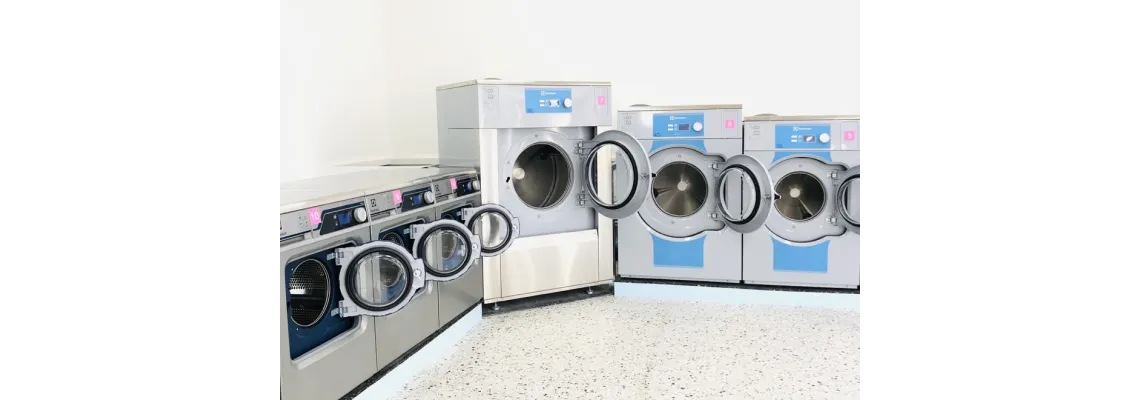
Laundry equipment · DANUBE · Buying guide
Professional washing machine: how to choose by kilograms, extraction and workload — and why the G-factor determines your drying costs
When buying a professional washing machine, most people look at capacity and price. But the biggest cost in a laundry is not washing — it's drying, because every litre of water the machine fails to extract has to be evaporated by the dryer using electricity or gas. In this article: how to calculate the kilograms you need, what standard and high extraction mean, what the G-factor is, what it costs you every day, and how to plan the laundry room so the equipment lasts.
G 200 → G 450
standard vs high extraction in the DANUBE WEN and WED series
~10–15 kg
less water in the dryer for every 100 kg of dry linen with high extraction
8–120 kg
DANUBE machine capacities — from a guesthouse to an industrial laundry
In this article
- Why a household machine can't cope with professional work
- How to calculate the kilograms you need
- Workload: cycles per day and how to load the drum
- G-factor: what it means
- Standard or high extraction
- How extraction determines drying costs
- Heating: electric, hot water or steam
- Laundry room design
- Choosing in 7 steps
- Service, maintenance and spare parts
- DANUBE models in the YOUR HORECA range
- Frequently asked questions
01Why a household machine can't cope with professional work
A household washing machine is designed for a few cycles a week. In a guesthouse, sports club or spa it runs 5–10 cycles a day, and within a few months the bearings, shock absorbers and electronics start to fail. A professional machine is built for a different regime.
Service life
Programmability
Traceability
Extraction
02How to calculate the kilograms you need
Capacity is chosen by kilograms of dry linen per day, not by the size of the business. The calculation has three steps: how many kilograms of linen arise per day, how many cycles fit into a shift, and how large one batch is.
| Linen item | Approximate dry weight |
|---|---|
| Double bed set (sheet, duvet cover, 2 pillowcases) | 2.0–2.5 kg |
| Single bed set | 1.2–1.6 kg |
| Large bath towel | 0.5–0.7 kg |
| Hand towel | 0.2–0.3 kg |
| Bathrobe | 1.0–1.5 kg |
| Restaurant tablecloth | 0.4–0.8 kg |
| Chef's jacket, apron | 0.3–0.5 kg |
📊 Example: a hotel with 40 rooms
If the laundry runs 8 hours and one cycle including loading takes about 70 minutes, a shift allows ~6 cycles. 100 kg / 6 cycles ≈ 17 kg per batch. An 18 kg machine is suitable, or two 11–14 kg machines if backup and separating different linen types matter.
Two smaller machines instead of one large one is often the smarter choice: if one stops, the other keeps working, and white linen can be washed separately from coloured or kitchen linen. One large machine, on the other hand, is cheaper per kilogram and takes less space.
03Workload: cycles per day and how to load the drum
Professional machine capacity is given in kilograms of dry linen at a drum volume ratio of about 1:10 — so an 18 kg machine has a drum of about 180 litres. Linen must fall and rub in the drum to wash well, so the load affects both quality and cost.
| Linen type | Recommended load | Why |
|---|---|---|
| Bed linen, towels (cotton) | 90–100% of rated capacity | Optimal water and chemical use per kg |
| Workwear, mixed fabrics | 70–80% | Less creasing, better rinsing |
| Duvets, pillows, curtains | 50–70% | Bulky items fill the whole drum |
| Mops and cleaning cloths | 70–80% | Heavy soiling needs more water |
Overloaded drum
- linen doesn't wash or rinse properly
- more strain on bearings and shock absorbers
- uneven distribution — the machine reduces extraction
- higher residual moisture in the dryer
Underloaded drum
- water, chemicals and electricity per kg go up
- machine capacity is wasted
- more cycles for the same amount
- more wear per kg of linen
Professional machines with a weighing function adjust the water to the actual load, but the most accurate result still comes from properly sorted and weighed laundry bags.
04G-factor: what it means
The G-factor shows how many times the centrifugal force in the drum exceeds the earth's gravity during extraction. It is a more accurate indicator than revolutions per minute because it also takes drum diameter into account: a larger drum has a higher G-factor at the same speed.
For example, a drum 0.6 m in diameter at 1000 rpm gives G ≈ 0.6 × 1,000,000 / 1790 ≈ 335. That's why two machines with the same speed can have very different extraction results. When comparing machines, look at the G-factor, not just the rpm.
| Extraction class | G-factor | DANUBE series | Installation |
|---|---|---|---|
| Standard (normal) | ~200 | WEN (11–80 kg) | Hard-mounted, anchored to the floor |
| Medium | ~300 | WEM (11–27 kg) | Depends on model |
| High | 350–500 | WED (11–120 kg), WPR (8–10 kg, G 450) | Free-standing, suspended, no anchoring needed |
✔ Why high extraction needs suspension
05Standard or high extraction
Both machines wash equally well. What differs is how much water remains in the linen after extraction, how the machine must be installed and how much it costs.
| Criterion | Standard extraction (WEN, G ~200) | High extraction (WED, G 350–500) |
|---|---|---|
| Residual moisture (cotton) | About 70–75% of dry weight | About 55–65% of dry weight |
| Drying time | Longer | Shorter, the dryer is free sooner |
| Installation | Hard-mounted, anchored to a concrete base | Free-standing, suspended, no anchoring |
| Location in the building | Basement, ground floor with a solid floor | Also upper floors and lighter floors |
| Purchase price | Lower | Higher (e.g. 18 kg: about €8,450 vs €13,600) |
| When it pays off | Small volume, linen goes straight to the ironer, cheap energy | Large volume, many towels, the dryer is the bottleneck, expensive energy |
💡 An important exception: bed linen for ironing
06How extraction determines drying costs
A dryer uses energy mainly to evaporate water. In practice, a tumble dryer evaporates one kilogram of water using roughly 0.8–1.2 kWh depending on the model and heat recovery. So every kilogram of water left in the linen after extraction is a directly calculable expense.
| G-factor | Water remaining in 100 kg of dry cotton linen | The dryer must evaporate |
|---|---|---|
| ~100 (old or basic machines) | ~95–100 kg | Almost as much water as the linen weighs |
| ~200 (standard extraction) | ~70–75 kg | Baseline |
| ~300 (medium extraction) | ~65 kg | ~5–10 kg less |
| ~450 (high extraction) | ~60 kg | ~10–15 kg less |
Indicative figures for cotton terry after a standard extraction cycle. Actual results depend on fabric, cycle length and load.
✎ Example: 100 kg of towels and bathrobes per day
Time matters just as much: the drying cycle gets about 15–20% shorter. If the dryer is the bottleneck of the laundry, that means more batches per shift without buying a second dryer, less overtime and less fabric wear, as linen spends less time in the heat.
At 250–300 kg a day the savings are 2–3 times larger, and the price difference of a high extraction machine usually pays back within a few years.
High extraction is also a good match with a heat pump dryer: both cut energy use, and since heat pump dryers are slower, lower moisture shortens their cycle significantly. To choose the right dryer, see laundry drying equipment and heat pump dryers.
07Heating: electric, hot water or steam
DANUBE machines come in three heating versions, marked in the model name by the letters E, HW and S.
| Version | How the water is heated | When to choose |
|---|---|---|
| E — electric | Built-in heating elements | No central hot water, or it's expensive; simplest installation |
| HW — hot water | Takes ready hot water from the building's system | The building has cheap hot water (boiler house, heat pump, solar); faster cycle |
| S — steam | Heated by steam from a steam generator or boiler | Large laundries, hospitals and sites with an existing steam system |
The choice has a big impact on the electrical connection. An electric 18–28 kg machine requires considerable power (400 V), and several machines together with electric dryers can exceed the site's connection capacity. That's why the heating type is best chosen together with the laundry room design.
08Laundry room design
A well-chosen machine won't help if the laundry room isn't planned. Most problems are caused not by the equipment itself, but by drains, ventilation and electrics.
Soiled and clean linen flow
Drainage
Water supply and hardness
Electrics
Ventilation and dryer exhaust
Floor and base
⚠ The most common design mistakes
YOUR HORECA design and installation
From calculating linen volume to a finished laundry room
Calculation
we calculate kilograms of linen per day and recommend the right combination of washer, dryer and ironer
Design
we plan the layout, linen flow, drainage, water, electrics and ventilation
Installation
we deliver, install, connect dosing and commission the equipment
Training
we train staff on programme selection, loading and daily care
YOUR HORECA is the official DANUBE distributor in the Baltics. A project starts with a conversation about your linen volume and premises. YOUR HORECA projects and custom solutions →
09Choosing in 7 steps
- Calculate kilograms of dry linen per day. Use the table in section 2 and add restaurant, spa and workwear linen.
- Set working hours and number of cycles. An 8-hour shift usually fits 5–7 cycles. Divide daily kg by the number of cycles — that's your batch size.
- Decide: one large or two smaller machines. Two give backup and let you sort linen; one gives a lower price per kg.
- Choose the extraction. Many towels and tumble drying — high extraction (WED, WPR). Bed linen to the ironer, small volume, solid floor — standard (WEN).
- Choose the heating. Electric, hot water or steam — based on the building's utilities and energy prices.
- Match the dryer. Dryer capacity should be at least equal to the washer's, as dried linen takes up more space. With high extraction the drying cycle is shorter and balances with washing.
- Check the room and the service. Drainage, electrics, ventilation, floor — and whether spare parts and service are available locally.
10Service, maintenance and spare parts
A washing machine that stops in a hotel mid-season means a shortage of clean linen the very next morning. Regular maintenance prevents most breakdowns and keeps the machine in a condition where it reaches its rated extraction.
YOUR HORECA service
Warranty and after-sales service for DANUBE washing machines, dryers and ironers
24/7
customer service
+371 25 522 233
On site
mobile service, diagnostics and repair in your laundry room
Original parts
DANUBE spare parts and a wide range of heating elements, pumps and valves in stock in Riga
Maintenance contracts
scheduled maintenance that prevents breakdowns and makes costs predictable
With DANUBE IoT telemetry, the service team can see error codes and cycle statistics even before setting out. About YOUR HORECA service →
Maintenance schedule
| When | What to do | Who |
|---|---|---|
| Daily | Clean the door seal and glass, empty the lint and foreign-object filter, leave the door ajar after work | Staff |
| Weekly | Clean the detergent dispenser and hoses, check that the drain isn't clogging | Staff |
| Monthly | Check dosing pumps and chemical concentration, water inlet filters | Staff / service |
| Every 6–12 months | Bearings and seals, belts, shock absorbers, drain valve, heating elements, door lock, electrical connections | Service |
Most frequently replaced parts
Door gasket
Bearings and shaft seals
Heating elements
Drain valve and pumps
Motor and inverter
Door lock and switches
✎ What it looks like in practice
Hard water is one of the main causes of heating element and valve failures. If the water on your site is hard, consider water filters and softeners.
11DANUBE models in the YOUR HORECA range
YOUR HORECA offers DANUBE washing machines from 8 to 120 kg: WPR professional, WEN standard extraction, WED high extraction, barrier sanitary machines and self-service models. A few examples:
DANUBE WPR-10 ET2 Electric
10 kg, G-factor 450, suspended (no anchoring), 4.3" touchscreen, IoT as standard. Can be stacked with a WPR/DPR dryer.
€5,285.00 excl. VAT
View →DANUBE WEN-18 E ET2
18 kg, G-factor 200, floor-anchored. Economical purchase when linen goes to the ironer or volume is small.
€8,450.00 excl. VAT
View →DANUBE WED-18 E ET2
18 kg, high extraction (G up to 500), free-standing. Shorter drying and less energy per kg of linen.
€13,600.00 excl. VAT
View →DANUBE WEN-35C E ET2
35 kg, standard extraction, hard-mounted. A large batch at a lower price per kg.
€14,460.00 excl. VAT
View →DANUBE WED-35C E ET2
35 kg, high extraction, free-standing. For large volumes of towels and bathrobes.
€23,070.00 excl. VAT
View →DANUBE MED-16 E ET2 (barrier)
16 kg, built into a partition wall, two opposite doors opening 180°. Physically separates soiled and clean linen, follows RABC principles.
€28,705.00 excl. VAT
View →Prices excl. VAT as of October 2026 and subject to change. All models in the categories Professional DANUBE washing machines, Standard extraction, High extraction, Barrier machines and Self-service machines. See also industrial dryers, flatwork ironers and laundry payment systems.
12Frequently asked questions
What matters more — rpm or G-factor?
The G-factor. It accounts for both speed and drum diameter and shows the real extraction force. Two machines with the same rpm but different drum sizes can give very different extraction results.
Does a high extraction machine wash better?
No, washing quality is the same. What differs is how much water remains in the linen after extraction. That affects drying time, energy use and installation requirements.
Doesn't a high G-factor damage linen?
Not with a correctly set programme. For delicate fabrics and bulky items, extraction can be reduced in the programme. On the contrary — shorter drying reduces fabric wear, as linen spends less time in heat and friction.
Why does the machine sometimes not extract fully?
The most common reason is an unevenly distributed load: the controller detects it and reduces extraction for safety. This happens with an underloaded drum, a single heavy item or worn shock absorbers and bearings. If it happens regularly, call service.
Can a professional machine be installed on an upper floor?
Suspended high extraction machines (WED, WPR) usually can, if the floor has sufficient load capacity and drainage is provided. Standard extraction machines (WEN) must be anchored to a solid base, so the ground floor or basement is better.
Which dryer goes with an 18 kg washer?
Dryer capacity should be at least equal to the washer's, but a slightly larger one is often chosen, as dry linen takes up more space and drying takes longer than washing. With a high extraction washer, the cycles balance better and one dryer is often enough.
Does YOUR HORECA service machines not bought from us?
Contact customer service on +371 25 522 233 and give the machine's manufacturer, model and serial number. We are the official DANUBE distributor in the Baltics and will help find the fastest solution and the spare parts you need.
Planning a laundry room or want to cut drying costs?
Tell us how many rooms, beds or staff you have and how often you change linen — we'll calculate the kilograms you need, recommend a washer and dryer combination, plan the room and provide installation, service and spare parts.
Residual moisture, energy and savings figures are indicative and based on industry practice and typical manufacturer specifications. We will prepare an exact calculation for your site based on actual linen volumes, energy prices and the equipment selected.