

Warewashing equipment · Professional chemicals
Chemicals for the commercial dishwasherwhy they are needed, how to dose them and why they sometimes «don't work»
A professional dishwasher does not wash with water — it washes with correctly dosed chemicals at the right temperature. If dishes come out spotted, greasy or wet, nine times out of ten the fault is not with the machine «as such» but with the chemical feed. In this guide YOUR HORECA service specialists explain how detergent and rinse aid work, how to check dosing, the most common reasons chemicals give no result, and what YOUR HORECA can adjust and repair.
The dishwasher is one of the few kitchen machines that does not work without a consumable. A stove will cook even with a dirty pan, but a dishwasher without chemicals merely splashes the dishes with hot water. So the question «why do the dishes come out badly» is almost always a question about chemicals: are they there, are they the right ones, and are they getting into the machine in the right amount.
Below we sum up what YOUR HORECA service technicians see every week on site visits — from the empty canister nobody noticed to the worn pump tube that has been «dosing» air for a year.
01Why a dishwasher needs chemicals at all
Professional washing rests on four factors working together: temperature, chemicals, mechanical action and time. In a professional machine the cycle lasts only 1–3 minutes, so the time factor is minimal and must be compensated by the other three. Water pressure rinses off loose residue and temperature melts fat — but it is the chemicals that lift fat and protein off the surface and hold them in the water so they do not settle back.
Detergent lifts the soil
The alkaline detergent turns fat into a water-soluble form and breaks down the protein film (milk, egg, meat juices) that hot water alone only bakes on harder.
Rinse aid makes dishes dry
It lowers the surface tension of water so it drains off in a thin sheet instead of sitting in droplets. Without it, dishes dry slowly and with limescale spots.
Hygiene, not just looks
The alkaline wash phase combined with an 80–85 °C rinse is what delivers the bacterial reduction HACCP requires. A visually clean plate without chemicals is not hygienically clean.
Protecting the machine
Correctly dosed chemicals and regular descaling protect heating elements, pumps and nozzles from limescale and grease — the cheapest way to extend the machine's life.
02The three chemical components and what each does
| Component | Job | Typical dose | If missing — signs |
|---|---|---|---|
| Detergent (alkaline) | Lifts fat, protein, coffee and tea deposits; holds soil in the water | 2–4 g/l of wash water (per manufacturer and water hardness) | Greasy film, baked-on residue, brown tea/coffee staining in cups, «fatty smell» in the chamber |
| Rinse aid (acidic / neutral) | Lowers surface tension, speeds drying, prevents limescale spots, gives shine | 0.2–0.5 ml/l of rinse water | Dishes wet after the cycle, white spots and droplet marks on glasses, dull stainless steel |
| Descaler (periodic) | Dissolves limescale on the heating element, in the chamber, nozzles and on boiler walls | Every 2–4 weeks in hard water, every 1–3 months in soft | White coating in the chamber, longer heat-up, arms sputtering unevenly, rising electricity use |
| Water softener / filter (before the machine) | Prevents limescale at the source; lets chemicals work with a smaller dose | Continuous; salt top-up or cartridge change by water consumption | All of the above — but returning quickly even after descaling |
03Correct dosing and how to check it
In most professional machines chemicals are fed by peristaltic dosers — small pumps that squeeze liquid through a flexible tube with rollers. The detergent doser usually runs on time (seconds per cycle or at water fill), the rinse-aid doser at each rinse phase. The setting is a potentiometer or a parameter in the service menu, and it is not universal: the right dose depends on water hardness, the machine's tank volume and the concentration of the specific chemical.
How to check whether chemicals are actually reaching the machine
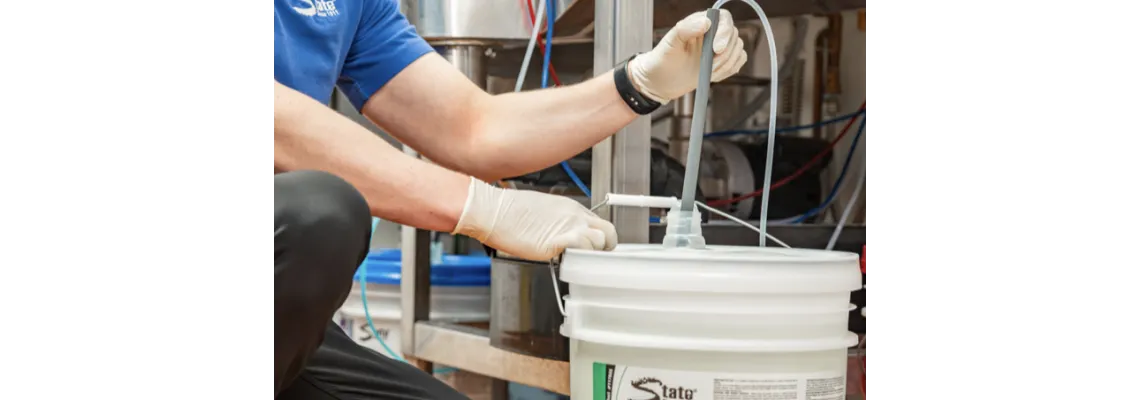
The clear tube from the canister to the doser must be full of liquid with no air bubbles. If the tube is empty or bubbling, no chemical is reaching the machine even though the doser is «running».
Mark the chemical level on the canister and look again after a day. If the level has not changed but the machine washed 200 racks, there is no feed. Rough guide: a 5–10 litre detergent canister a month for an average restaurant machine.
A YOUR HORECA technician checks the actual concentration in the tank water with a titration kit or test strip and compares it with the manufacturer's target. This is the only objective way to know whether the dose is right, rather than «by eye».
After a cycle take out a glass and hold it against the light: drying evenly with no droplets — dose is right; droplets and spots — too little; bluish rainbow streaks — too much.
Chemicals are formulated for a specific temperature. If the wash tank is at 45 °C instead of 60 °C, even a perfect dose will work poorly. Compare the display reading with a separate thermometer.
| Deviation | What you will see | What it costs |
|---|---|---|
| Too little detergent | Grease, protein film, brown cups, residue in racks | Re-washing, complaints, HACCP risk |
| Too much detergent | White/grey film on dishes, alkaline smell, glasses «cloud», rubber seals harden | Wasted chemicals (often 2× the budget), damaged seals and plastics |
| Too little rinse aid | Wet dishes, droplet spots, limescale marks | Hand polishing, slower turnover, premature descaling |
| Too much rinse aid | Rainbow streaks, foam in the chamber, bitter taste in glasses | Wasted chemicals, pump and sensor problems from foam |
04Why the chemicals «don't work» — the 10 most common cases from service practice
When a customer calls with «the machine isn't washing», the technician's first question is about chemicals, not the pump. Here is what most often turns out to be the culprit:
1. Empty canister or dry tube
The most common case. The canister ran out overnight or mid-shift, the tube sucked in air, and even after a new canister is connected the doser pumps nothing for several cycles. The system must be primed — many machines have a manual priming button.
2. Worn peristaltic tube
The flexible tube in the doser wears out in 6–12 months: it collapses, cracks or hardens and no longer builds pressure. The doser turns, the motor hums — the chemical does not move. A cheap part that YOUR HORECA keeps in stock.
3. Blocked suction filter or non-return valve
At the canister end of the tube there is a strainer and a weight; chemical crystals or sediment from a dirty canister block it. The second point is the non-return valve in the machine chamber, which scales up.
4. Wrong doser setting
After the machine was moved, chemicals were changed, or «someone turned it» — the dose no longer matches. It is often increased «to wash better», which causes film and overconsumption.
5. Hard water and limescale
Limescale binds part of the alkaline detergent and the real active concentration drops. Hard water needs a higher dose or — better — a water softener before the machine.
6. Low temperature
A faulty heating element, thermostat or a door left open for long — the tank does not reach 55–65 °C. Chemicals work at half strength in those conditions. Symptom: the cycle takes longer, dishes are lukewarm.
7. Blocked rinse nozzles
If rinse water does not reach the dishes in full, neither does the rinse aid. Nozzles should be removed and cleaned at least weekly; in limescale — descaled.
8. Overloaded or wrongly loaded racks
Plates stacked on each other, glasses with the opening upward, bowls without a tilt — chemicals and water simply do not reach the surface. That is a loading problem, not a chemical one.
9. Wrong or mixed chemicals
Household products, detergent and rinse aid from different manufacturers, or — the classic — detergent and rinse-aid tubes swapped when changing canisters.
10. Dirty tank and filters
If the wash tank holds yesterday's water with a layer of grease, the fresh chemical first «treats» that soil, not the dishes. The tank must be emptied and the filters washed every day.
05Symptom table: what you see and where to look
| Symptom | Likely cause | Check first |
|---|---|---|
| White spots, limescale marks on glasses | Too little rinse aid; hard water; not descaled for a long time | Rinse-aid canister and tube; water hardness; chamber walls |
| Bluish / rainbow streaks | Too much rinse aid | Doser setting; whether tubes are swapped |
| Grease, baked-on residue | Too little detergent; low temperature; dirty tank | Detergent canister; temperature with a thermometer; filters |
| Brown staining in tea/coffee cups | Weak alkaline dose; short cycle | Concentration measurement; longer cycle for china |
| Dishes wet, drying slowly | No rinse aid or low rinse temperature | Rinse-aid doser; boiler temperature 80–85 °C |
| Foam in the chamber, weak pressure | Household chemicals; too much rinse aid; protein foam from a dirty tank | Which chemicals are used; dose; tank change |
| Grey film, alkaline smell | Overdosed detergent; rinse not removing alkali | Doser setting; rinse nozzles |
| Reddish / pink coating | Bacterial biofilm — temperature and chemicals too low for a long time | Service: disinfection, temperature, dosing |
06Correct daily care
Drain the wash tank, remove and wash the filters, rinse the chamber, wipe the door seals. Leave the door ajar so the chamber dries — this prevents odour and biofilm.
Check both chemical canisters and tubes. Fill the tank with fresh water and let the machine heat to working temperature before the first rack — the first cycle in cold water is a wasted cycle.
Remove the wash and rinse nozzles, clean the holes, check that the arms rotate freely. Clean the strainers on the chemical tubes.
A descaling cycle with a professional descaler (e.g. Calcinet) per the manufacturer's instructions, then 2 empty cycles with clean water. Never mix descaler with alkaline detergent in the tank.
Replacement of the peristaltic tubes in the dosers, concentration measurement and dosing adjustment, heating element and thermostat check, condition of seals and nozzles. This is the preventive maintenance that eliminates most «chemicals don't work» calls.
07What YOUR HORECA service does with the chemical feed
YOUR HORECA does not just supply chemicals — it repairs and adjusts dosing systems, on machines bought from YOUR HORECA and on equipment from other suppliers. That matters, because the right dose can only be set by someone who knows the specific chemical, the machine's tank volume and your water hardness.
YOUR HORECA dishwasher and dosing service
Diagnostics by phone or on site, doser adjustment and replacement, concentration measurements, descaling, heating element and pump repair, water softening solutions. We work with Stalgast, Kastel, Omniwash, Silanos, Forcar, MBM, Mach, Scandomestic and other machines.
Service requests: +371 25 522 233 or horecagear.com/service
Dosing adjustment and concentration measurement
The technician measures the actual concentration in the tank, compares it with the manufacturer's target and sets the doser for your water hardness and chemical. A record of the setting stays with you for HACCP documentation.
Doser repair and replacement
Replacement of peristaltic tubes, rollers and motors; installation of a new electronic doser on machines that never had one or whose doser is worn.
Electronic doser for dishwashersDescaling and cleaning
Full descaling of the chamber, boiler and heating element with a professional product, nozzle cleaning, check of tank and filter condition.
Dishwasher chemicalsTemperature and heating repair
Heating elements, thermostats, boiler sensors — if the tank does not heat up, the chemicals will not work no matter how much is dosed.
Heating elementsWater softening and filters
Water hardness measurement and selection of a softener or filter before the machine — in hard water it pays back through savings on chemicals and repairs.
Water filtersStaff briefing
A short on-site training: changing canisters, priming the tubes, cleaning filters and nozzles, what may and may not go into the machine. Most problems start there.
08Chemicals and dosing equipment in the YOUR HORECA warehouse
Professional chemicals, descalers, dosers and water filters are available from the YOUR HORECA warehouse in Riga — same-day collection or delivery within 1–5 working days in Latvia, by courier or freight across the Baltics and Europe. See current prices and pack sizes in the category or ask by phone.
Professional dishwasher detergent
Alkaline, low-foaming concentrate for dosing systems — for fat, protein, coffee and tea deposits. 5–10 l packs.
In stockSee
Dishwasher rinse aid
Lowers surface tension, prevents limescale spots and droplet marks; compatible with the detergent of the same line.
In stockSee
Calcinet descaler
Professional limescale remover for dishwashers, boilers and heating elements. In hard water — every 2–4 weeks.
In stockSee
Electronic doser for dishwashers (361.999)
Detergent and rinse-aid pump with timer-adjustable cycle — for machines without a doser or to replace a worn one.
In stockSee
Water filters and softeners
Filtration systems before the dishwasher — reduce chemical consumption and descaling frequency, protect the heating element.
In stockSee
Pumps, doser tubes, nozzles
Peristaltic tubes, wash and drain pumps, nozzles and seals for the most popular machines — from stock.
In stockSee
See the full range of warewashing equipment in the «Warewashing equipment» category, accessories and dosers in the accessories section.
09Frequently asked questions
Can household tablets or liquid be used in a professional dishwasher?
No. Household products foam and are designed for a 60–120 minute cycle, not a 2-minute cycle at 60 °C. Foam gets into the pump and onto the sensors, the machine loses pressure and may misread the water level. Professional chemicals are low-foaming and dosed automatically.
How much chemical does a dishwasher use per month?
As a guide, an average restaurant hood-type machine uses 5–10 litres of detergent and 2–5 litres of rinse aid a month. If consumption is much higher, the doser is probably overdosing; if it is lower or zero, the chemical is not reaching the machine. In both cases it is worth calling service for a dosing check.
I changed the canister but the machine still isn't washing — why?
After an empty canister there is air in the tube, and the peristaltic doser pumps nothing for several cycles. Prime the system — many machines have a manual priming button or service mode — and make sure the tube is full of liquid. If it does not fill even after priming, the doser tube is worn.
How do I know the chemical dose is right?
The only objective way is a concentration measurement in the tank water with a titration kit or test strip, done by a YOUR HORECA technician. The quick indicator is a glass held against the light after a cycle: droplets and spots mean too little rinse aid, rainbow streaks too much; grease and film mean too little detergent.
How often should a dishwasher be descaled?
In hard water — every 2–4 weeks; in soft water or with a softener — every 1–3 months. Signs it is time: white coating in the chamber, longer heat-up, uneven arm operation. A water softener before the machine reduces the need for descaling several times over.
Does YOUR HORECA adjust chemical dosing on machines not bought from YOUR HORECA?
Yes. YOUR HORECA service works with dishwashers and dosers from all common manufacturers — we check concentration, adjust or replace dosers, descale and repair. Call +371 25 522 233 with the machine model and the symptom.
Detergents, rinse aids and descalers available immediately in Riga — delivery in Latvia in 1–5 working days, free over 200 € (up to 30 kg); courier or freight across the Baltics and Europe.
We agree a chemical delivery schedule based on your consumption so a canister never runs out mid-shift.
Dosing adjustment, concentration measurements, descaling, repair and preventive maintenance. Customer service 24/7.
Dishes coming out badly? Let's start with a chemical feed check
YOUR HORECA supplies professional dishwasher chemicals and — more importantly — checks, adjusts and repairs their feed. One technician visit with a concentration measurement often solves what months of «one more canister» have not.
Customer service 24/7 · +371 25 522 233 · Vagonu iela 23, Riga